

Beirut Embassy Drawdown Raises Lebanon Travel Risk
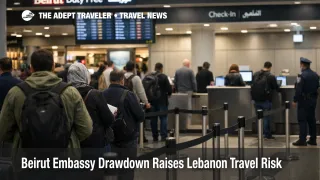
The Beirut embassy drawdown is now a concrete operational signal for Lebanon travel. The U.S. Department of State ordered non emergency U.S. government personnel and eligible family members to depart Beirut, Lebanon, and it also tightened movement posture for remaining personnel, a pattern that often coincides with reduced consular capacity and higher trip interruption risk for private travelers.
If you are traveling to Beirut for business, diaspora visits, or any itinerary that depends on predictable ground movement and reliable last mile logistics, the practical change is not theoretical. Routine visa services in Beirut are paused, emergency services are prioritized, and the Lebanon travel advisory posture is explicitly Level 4, Do Not Travel.
Beirut Embassy Drawdown, What Changed for Travelers
The change that matters is the ordered departure and the immediate service constraint that followed it. State Department guidance updated on February 25, 2026, says the embassy remains operational with core staff, but is prioritizing emergency services for U.S. citizens, and routine visa processing is not available.
Separately, the U.S. government's Lebanon country page notes the advisory was updated on February 23, 2026, to reflect the ordered departure, and it highlights that U.S. Embassy Beirut personnel are restricted from personal travel without advance permission, with additional restrictions possible on short notice. Reuters reporting on February 23 also confirms the ordered departure announcement from the embassy.
For travelers, this is a reliability story more than a single moment headline. When an embassy shifts to essential staffing and limits routine services, the system you rely on for help during disruptions, lost passports, arrests, medical evacuations coordination, or fast documentation changes, is operating with less slack. That does not mean assistance disappears, but it does mean you should plan as if you may have to self rescue for longer than normal, including extra nights, reroutes, and higher out of pocket exposure.
Which Lebanon Itineraries Are Most Exposed
Travelers already holding tickets into Beirut-Rafic Hariri International Airport (BEY) face the highest near term exposure, because they are committing to a specific time and place in a dynamic risk window. The core risk is not only the destination stay, it is the timing sensitivity of departures and arrivals, airport access, and the ability to leave quickly if conditions shift.
Corporate travelers and travelers on employer managed itineraries should assume an elevated probability of automatic policy triggers. Many corporate security programs treat ordered departures, Level 4 advisories, or fast moving embassy security posture changes as thresholds for mandatory approvals, trip suspension, or immediate reroute decisions. Even if your flight is operating, your organization may not allow you to take it.
Transit and positioning itineraries that "touch" the Levant can also become fragile quickly. The second order effect is routing conservatism, carriers tightening their own risk posture, and travelers shifting to alternate hubs when they do not want to rely on a single departure point. This can raise fares, compress seat availability, and reduce same day reaccommodation options if you get canceled and need to leave.
What Travelers Should Do Now
If your trip is optional, the cleanest decision threshold is simple. Do not proceed while the U.S. posture is Level 4, Do Not Travel, and the embassy is operating under ordered departure constraints, because your downside is asymmetric, and your upside is mostly convenience.
If your trip must proceed, switch your planning mindset from "normal travel with alerts" to "contingency travel with exit options." That means building buffer nights before critical meetings, avoiding tight connections on the outbound and return, carrying printed and offline copies of documents, and pre booking flexible lodging that can be extended without penalty. Enroll in STEP or the equivalent for your nationality, and make sure your emergency contacts, itinerary, and check in cadence are explicit before you depart.
Your go, no go threshold should be tied to observable constraints, not vibes. Rebook or postpone if airline schedules begin thinning, if airport access becomes unreliable, if your insurer or employer will not confirm coverage and support in writing, or if official movement guidance expands beyond staff restrictions into broader citizen alerts. Over the next 24 to 72 hours, monitor embassy security alerts, the Lebanon advisory page for any change in language, and your carrier's rebooking or waiver posture, because those are the earliest operational tells that the system is tightening further.
Why Embassy Drawdowns Change Travel Reliability
An ordered departure is not just a diplomatic headline, it is a capacity and mobility signal. First order, it reduces on the ground staffing footprint and often narrows consular services to emergencies, which directly affects travelers who need visas, replacements, or urgent documentation help.
Second order, it changes how other parts of the travel ecosystem price and manage risk. Carriers and their security teams watch the same signals, and insurers and corporate travel desks often use them as objective triggers for coverage decisions, duty of care rules, and allowed travel lists. That is why travelers can see whiplash outcomes where flights are technically operating, but support systems, coverage, and policy permissions degrade around them.
The key mechanism is tight coupling. Beirut itineraries often depend on a small number of workable transfer corridors, specific flight banks, and predictable ground movement to and from BEY. When uncertainty rises, every weak link matters more, because you have fewer safe, reliable substitutes at the moment you need them. Treat the drawdown as a signal to reduce dependency on perfect timing, and to increase your ability to pause, reroute, or exit without negotiation.
Sources
- Limited Services Available at the U.S. Embassy in Lebanon
- Lebanon International Travel Information
- US embassy in Beirut orders departure of government personnel due to security situation, Reuters, February 23, 2026
- US pulling non essential staff from embassy in Beirut amid Iran tensions, Reuters, February 23, 2026
- Lebanon Remains Level 4, BEY Airspace Risk Persists, Use Detours
- Puerto Vallarta Feb 22 Shelter In Place Travel Guidance
- Verification and Fact-Checking Policy