

Puerto Vallarta Feb 22 Shelter In Place Travel Guidance
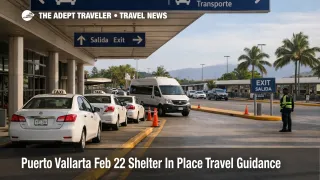
A fast moving security situation on February 22, 2026 triggered shelter in place guidance for Puerto Vallarta, along with reports of burning vehicle roadblocks and broad transportation disruption across parts of southwestern Mexico. For travelers, the practical change was that "being fine at the resort" and "being able to move safely to the airport" diverged sharply, sometimes within hours. Airlines reacted by canceling or suspending some Puerto Vallarta operations, and official travel advisories flagged significant disruption to transportation, including flight delays and cancellations.
This matters because Puerto Vallarta is a corridor driven destination. Most visitors depend on a small set of roads linking the hotel zone, downtown, and Licenciado Gustavo Díaz Ordaz International Airport (PVR). When those arteries are interrupted, risk rises not because resorts instantly become unsafe, but because travelers can get caught in exposed, hard to predict movement, especially with luggage, tight timelines, and limited alternate routes. In this event, Canada's updated advisory explicitly noted a shelter in place order in Puerto Vallarta and reported that taxi and rideshare services were suspended until further notice, which is a direct hit to the normal arrival and departure playbook.
Who Is Affected
Travelers already in Puerto Vallarta were affected in two different ways depending on whether they stayed on property. Large resorts and established hotels tend to be controlled environments with security, limited access points, and strong operational incentives to keep guests sheltered during a citywide disruption. During February 22, the safest default for most leisure travelers already checked in was to remain inside the resort, avoid independent errands, and treat shelter in place language as literal. The biggest mistake people make in scenarios like this is assuming that "nothing is happening in my lobby" means it is safe to do a quick run across town.
Inbound travelers were exposed differently. Even if an aircraft lands, the arrival is not complete until the traveler reaches the hotel zone. With roadblocks reported and transport services disrupted, the highest risk window is the airport to lodging transfer, because travelers are stationary at curbs and decision points, are visibly carrying valuables, and may be pressured into improvised transport choices. The February 22 advisory language about suspended taxi and rideshare services is the tell, it means normal "backup options" may not exist when a traveler steps outside the terminal.
Outbound travelers had the most time sensitive problem. Flight cancellations and suspensions do not always publish in a clean, uniform way, and ground access can deteriorate faster than airline apps update. Reuters reported that Air Canada temporarily suspended operations to Puerto Vallarta and United canceled its flight operations there, which signals that even large carriers treated the conditions as operationally unsafe or too uncertain to run reliably that day. Separately, reporting tied to the same event described wide disruptions and airport level cancellations, reinforcing that a normal departure routine did not apply.
What Travelers Should Do
If you are already in Puerto Vallarta on February 22, 2026, behave as if the safe area is your hotel footprint. Stay inside the property, follow hotel security guidance, and do not attempt discretionary outings, even short ones, until shelter in place language is lifted and transportation services are operating consistently again. If you must move for a medical or urgent reason, ask the hotel to coordinate, because improvised street decisions are where travelers get trapped.
If you are inbound, do not treat a successful landing as confirmation that transfers are normal. Before you depart your origin airport, confirm your ground plan in writing, ideally through your hotel or a reputable transfer operator, and build daylight arrival preference into your routing if you can. If you arrive and find taxi and rideshare disrupted, stay inside the terminal or with official airport staff areas while you coordinate, do not accept unsolicited offers, and do not leave with anyone you cannot verify through the hotel, the airline, or the airport's authorized transport channels.
If you have a scheduled flight out, your decision should be based on two confirmations, that your flight is actually operating, and that safe road access to PVR exists right now, not based on what was true this morning. If you cannot confirm both, delaying or rebooking is often safer than attempting a high stress transfer into an uncertain road environment. Puerto Vallarta has seen how a single artery disruption can cascade into missed cutoffs, which is why travelers should treat transfer time as elastic and avoid last minute runs during disruptions. For a local example of how one chokepoint can collapse timing, see Protest Roadblocks Puerto Vallarta Cruise Access Jan 31.
Background
The February 22 event was tied to a broader security operation in Jalisco and subsequent retaliatory activity across multiple states, which is the pattern that makes travel planning difficult. The first order effect is physical, roadblocks, vehicle fires, sporadic violence, and a sudden reduction in normal transport capacity. That immediately stresses airport access, because staff, crews, fuel deliveries, and passengers all use the same corridors, and because ground transport services can be paused or become unreliable without much notice.
The second order ripple hits itineraries beyond the city streets. When carriers cancel or suspend service, inbound travelers get stranded at origin airports, and outbound travelers can be stuck in hotels for extra nights, which pressures room inventory, changes tour schedules, and increases the number of travelers trying to move at the same time once conditions ease. Reuters' reporting on carrier decisions to halt Puerto Vallarta operations shows how quickly airlines can shift from normal service to a full stop when ground risk and operational uncertainty rise.
A useful way to think about personal safety here is that most leisure travelers are not targets inside resort complexes, but they can become exposed by being in the wrong place at the wrong time during movement. That is why official guidance emphasizes limiting movement and monitoring updates. When shelter in place language is issued, the lowest risk choice for most travelers is to stop trying to solve the city and let professional operators, hotels, airlines, and authorities reopen the system before you re enter it.
Sources
- Mexico travel advice (violence and roadblocks update)
- Air Canada, United Airlines halt flights to Mexico's Puerto Vallarta
- Mexican army kills leader of powerful Jalisco New Generation Cartel during operation to capture him
- Mexican drug lord 'El Mencho' killed in military operation, violence follows
- U.S. travelers urged to shelter in place in Puerto Vallarta
- Cancelan vuelos internacionales en Puerto Vallarta tras violencia