

Flight Delays and Airport Impacts: Feb 26
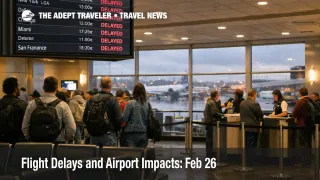
Feb 26 flight delays are shaping up as a multi region reliability day, not a single hub meltdown. The FAA's daily outlook flags thunderstorm and low cloud risk at Hartsfield Jackson Atlanta International Airport (ATL) and Charlotte Douglas International Airport (CLT), with gusty winds and low ceilings also pressuring Denver International Airport (DEN) and San Francisco International Airport (SFO). If you are traveling through any of those hubs, the practical problem is that even moderate arrival slowdowns can erase connection margin and shrink same day rebooking options fast.
Feb 26 Flight Delays: What Changed Across Key Hubs
The core change versus a simple local weather day is that multiple hubs are in play at once. Atlanta and Charlotte are the thunderstorm risk, Denver and San Francisco are the wind and ceiling risk, and Indianapolis International Airport (IND) and San Diego International Airport (SAN) add additional low ceiling and snow shower friction that can complicate aircraft rotations. When the map looks like this, travelers often get surprised by delays that originate elsewhere, because your aircraft and crew may be arriving from a constrained region.
Which Travelers Face The Most Disruption Today
The highest exposure group is anyone connecting through Atlanta, Charlotte, Denver, or San Francisco on a schedule with little slack. A connection under about 90 minutes is the danger zone on days where flow programs become likely, because a single late inbound can push you past the last viable bank of alternates.
A second exposure group is travelers departing smaller or secondary airports whose first leg feeds these hubs. If Atlanta or Charlotte slows, your flight can be held on the ground at the origin as part of traffic management, even when your departure airport looks normal.
The third exposure group is late day travelers. When weather and winds stack with runway, ramp, or construction constraints, the system tends to protect the schedule by trimming, which is when cancellations appear for the last flights and for thin routes with fewer spare aircraft.
What Travelers Should Do Now
Act like this is a capacity day, not just a forecast day. Before you leave for the airport, check your flight status, then check where your aircraft is coming from, because a late inbound is often the earliest honest warning that your departure is about to slide. If your itinerary touches Atlanta or Charlotte, expect the biggest swings around thunderstorm timing, which can turn a normal afternoon into a stop start sequence of departures.
Use a clean decision threshold for rebooking versus waiting. Rebook early if you have a tight connection, you are on separate tickets, you are on the last practical arrival that still meets your real constraint, or you have a cruise, meeting, or one night hotel stay that you cannot easily shift. Waiting is only rational if you can see multiple later options that still work and you are protected on a single reservation, so the airline owns the reaccommodation.
Over the next 24 to 72 hours, monitor program language, not social media noise. The FAA planning posture already points to possible ground stop or delay programs later in the day for ATL, CLT, DEN, and SFO, which is the signal that tends to tighten options before you ever see dramatic delay averages.
Why This Is Happening, And How Delays Spread
The mechanism is the same every time, weather reduces arrival rates, and the network absorbs the shock unevenly. First order effects are spacing aircraft farther apart in thunderstorms, wind, and low visibility, which lowers arrivals per hour and triggers ground delay programs that hold flights at departure airports instead of burning fuel in holding.
Second order effects are where travelers lose the itinerary. Once arrivals drift, gates fill, taxi times stretch, crews time out, and airlines start canceling to reset the rotation. That is why a day that looks "moderate" on averages can still produce expensive misconnects, especially when multiple hubs are constrained and there are fewer clean alternates to reroute through.
For continuity with the recent recovery pattern and how to read these FAA signals day over day, see Flight Delays and Airport Impacts: Feb 25. For the structural context behind recurring constraint days, see U.S. Air Traffic Control Privatization: Reality Check.