

Fort Hancock, Texas Airspace Closed After Laser Incident
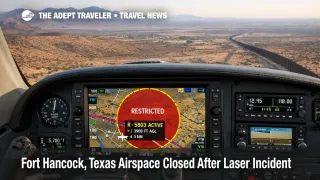
The FAA restricted airspace near Fort Hancock, Texas, on February 27, 2026, after reports tied the move to a laser related counter drone incident involving a U.S. government drone. For most travelers, the immediate takeaway is that this is a security driven Temporary Flight Restriction, which can be implemented fast, widened fast, and lifted early, often with limited public detail. Commercial flights into and out of El Paso International Airport (ELP) are not expected to be directly affected by the Fort Hancock location, but general aviation routing, some charter activity, and certain special mission operations in the corridor can face sudden detours and planning friction.
Fort Hancock Texas Airspace Closure: What Changed
The FAA's action is a security category TFR over the Fort Hancock area, effective February 27, 2026, with the restriction framed as a special security measure. Reporting indicates the move followed an incident in which a laser based counter drone system was believed to have engaged and brought down a U.S. government drone near the border. The practical traveler relevance is not that most airline itineraries will be canceled on this alone, it is that short notice airspace constraints create uncertainty for operators that rely on predictable low altitude routing, and that uncertainty can spill into on time performance when aircraft and crews end up out of position.
For travelers moving through the far west Texas, southern New Mexico, and El Paso corridor, the most likely observable effects are indirect. Expect a higher chance of small schedule slips that show up as late inbound aircraft, plus occasional last minute routing changes for private flights and some charters. If a trip depends on a fixed arrival time, for example a same day event, a medical appointment, or a tight onward connection after landing, it is rational to treat the day as slightly higher variance than normal.
Which Trips And Operators Are Most Exposed
This restriction matters most for pilots and passengers on flights that would normally operate near Fort Hancock at altitudes and routes affected by the TFR, including general aviation transits, aerial work, and certain charter patterns that use the corridor as a clean line between west Texas and the El Paso region. Operators that cannot easily reroute, or that are already fuel tight, face the highest operational stress because detours cost time and margin.
Medevac, air ambulance, and search and rescue style missions are a special case. These flights can sometimes operate when they coordinate with the controlling agency and air traffic control, but the existence of coordination gates still introduces delay risk at exactly the moment time matters most. Travelers using private medical transport should push for explicit confirmation of routing and clearance steps before wheels up, not after the aircraft is already staged.
For commercial travelers, the main exposure band is connecting itineraries that depend on aircraft and crew rotations through the region. When any aircraft arrives late, the next leg inherits the delay, and later legs can stack when gate plans and crews tighten. This is the same basic propagation pattern seen on broader irregular operations days, and it is why travelers who care about arrival certainty should treat a security restriction as a variance amplifier, even when the restriction is geographically limited. For a baseline on how delays spread through the network on mixed constraint days, see Flight Delays and Airport Impacts: Feb 26.
What Travelers Should Do Now
If you are flying commercial through El Paso, treat this as a monitor and buffer story, not an automatic rebook story. Check your flight status, then check whether your inbound aircraft is arriving from a region that would plausibly be routed around the Fort Hancock area, because the earliest honest warning is often a late inbound, not a dramatic headline. If your schedule has a hard constraint, set a decision threshold in advance, for example, "if my inbound is more than 45 minutes late before I leave for the airport, I will switch to the next available flight or move to an earlier departure."
If you are on a charter, private flight, or any small operator itinerary in the region, assume you may be rerouted. Confirm with the operator, in writing if possible, whether they have a viable alternate routing and whether the flight remains legal and fuel safe under that routing. Security TFRs are not the place to improvise at the last minute, and the tradeoff is simple, a conservative reroute may protect the trip, while waiting for clarity may protect cost but risks a same day cancellation.
Over the next 24 to 72 hours, monitor for three things: whether the FAA adjusts the radius or altitude structure, whether exemptions or coordination procedures are clarified, and whether the restriction is lifted early. Because this is tied to security reasons, timelines can be posted far out while actual enforcement posture changes quickly, so the practical move is to recheck close to departure, not only when the trip is booked. For broader air traffic system context and why small constraints can ripple, see U.S. Air Traffic Control Privatization: Reality Check.
Why A Laser Incident Can Trigger Wider Travel Effects
A TFR is a tool the FAA uses to temporarily restrict access to a defined area of airspace for safety or security reasons, and it is communicated through NOTAMs. When a restriction is security driven, the system often prioritizes containment and risk reduction over predictability for civilian users, which is why details can be limited and change fast. In this case, reporting indicates the trigger was a counter drone engagement involving a high energy laser system and a U.S. government drone near Fort Hancock, raising coordination questions across agencies that operate in the same airspace.
The first order effect is straightforward: aircraft that would have flown through the area must avoid it, coordinate for access, or cancel. The second order ripple is where travelers notice it. Detours change block times, late arrivals cascade into later departures, crews can time out, and dispatchers start protecting the schedule by trimming low priority segments. Even if El Paso's commercial traffic is not directly constrained by the restricted area, the region's broader operator ecosystem still interacts with the same airspace management environment, and that is enough to add variance to a day's operations.
Sources
- Temporary Flight Restrictions (TFRs) (Federal Aviation Administration)
- FAA closes airspace in Fort Hancock, Texas after reported use of anti drone laser (Reuters)
- US military used laser to take down Border Protection drone, lawmakers say (Associated Press)
- Pentagon Anti Drone Laser Prompts 2nd Texas Airspace Shutdown (Flying)
- FAA issues temporary flight restriction over Fort Hancock for special security reasons (KVIA)