

Italy Rail Strike 9:00 p.m. Start Raises Misconnect Risk
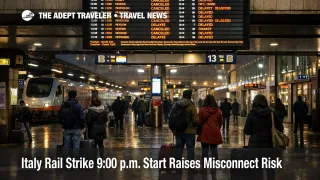
Italy's rail disruption risk just sharpened into a classic overnight misconnect trap. Trenitalia says a national strike window runs from 900 p.m. on Friday, February 27, 2026, to 859 p.m. on Saturday, February 28, 2026, which pulls the highest risk into late night departures and early morning positioning moves that travelers often treat as "safe" because stations are quieter and schedules look simple. This is new versus the last 48 hours in the only way that matters operationally, the start time forces decisions about the last train you can trust on February 27, and the first trains you should not bet a flight, a cruise, or a paid check in window on February 28.
The strike does not mean every train stops, but it does mean cancellations and last minute timetable changes can cluster outside guaranteed service windows, and those windows do not cover the entire night and morning. In Lombardy, Trenord is using the same 900 p.m. to 859 p.m. window, and it explicitly warns that regional, suburban, long distance, and airport services can change or be canceled, with airport replacements only where specified.
Italy Rail Strike Start Time, What Changed
The practical change is that the risk window now begins while many travelers are still in motion, not after they have settled in for the night. A 9:00 p.m. start pushes exposure onto the exact departures people use to position into Rome, Italy, Milan, Italy, Venice, Italy, and other gateways for morning flights, cruise embarkations, and long distance connections on Saturday. If you were planning to arrive late on February 27 and sleep near a hub, the plan may still work, but only if your specific train actually runs and you have a backup when it does not. The same applies to anyone planning a very early departure on February 28, because the strike window covers most of the day, and the "first departure of the morning" is no longer a low risk category by default.
Operators will publish and reference guaranteed service, but that is not the same as normal service. Trenitalia points travelers to its minimum service guidance and to the lists of guaranteed long distance trains, and Italo publishes its own guaranteed train list for the strike date. The decision impact is simple, if your plan depends on a specific train that is not guaranteed, treat it as conditional, not scheduled.
Which Itineraries Are Most Likely To Break
The most exposed itineraries are the ones with a hard downstream clock, meaning flights, cruise embarkations, and any paid or non refundable check in and tour windows that cannot slide. Overnight and early morning positioning is fragile because when a late train is canceled, substitutes are scarce, and when an early train is canceled, you lose the time cushion that would normally absorb the problem.
Regional and commuter style services are also high risk for travelers because they are the glue between city center stations and airports, and they are the first place cascading cancellations turn into missed flights. Trenord highlights guaranteed periods of 600 to 900 a.m. and 600 to 900 p.m., which helps some Saturday airport runs, but it leaves big gaps for the overnight period, the late morning, and much of the afternoon, which is exactly when repositioning demand can spike.
High speed and long distance travel is not immune either. You can sometimes find a guaranteed train that runs even during a strike window, but travelers should treat "running" as only the first filter. The second filter is whether arrival time still protects the itinerary if station access is slower, platforms are crowded, or a last mile connection breaks because taxis, rideshare, and replacement buses become the pressure valve.
What Travelers Should Do Now
Travelers should stop planning around the last train of February 27 and the first trains of February 28 as if they are inherently safer than mid day service. The safer move is to shift critical positioning earlier, and to convert the overnight segment into a buffer instead of a dependency. If you must be at an airport or port on the morning of Saturday, February 28, treat arriving on February 27 as the default, then choose a hotel within a short walk or simple taxi ride of the station or terminal so a local transit failure does not compound the rail failure.
Set a blunt go or no go threshold for same day flight connections. If your rail plan would deliver you to the airport with less than 3 hours before an international flight, or less than 2 hours before a domestic flight, the strike window is a reroute trigger, not a "monitor and hope" situation. The tradeoff is cost versus control, rebooking earlier can feel expensive, but waiting tends to push you into scarcity across trains, rooms, and ground transport at the same time.
Use guaranteed lists as your reality check, not social media, and verify on the operator app close to departure. Trenitalia's strike page and Trenord's strike notice are the best starting points for whether service is being reduced and what minimum windows apply, and Italo's guaranteed list helps travelers on that network identify which trains are protected. If your train is not guaranteed, plan a fallback that still works if the train never leaves, for example arriving earlier, switching to a different hub city, or converting the connection into an overnight.
Why Overnight Strikes Create Missed Flights and Cruise No Shows
Overnight rail strikes break itineraries because the system has low elasticity at night and at dawn. When a late train is canceled, there are fewer later departures to absorb displaced passengers, and fewer open service desks to rebook quickly. When a dawn train is canceled, travelers lose the only resource that matters, time, and they are forced into slower modes that are already constrained by sudden demand.
The disruption spreads through substitution and bottlenecks. First order effects are canceled or retimed trains across regional, long distance, and airport linked services, including across Trenitalia's network and Trenord's services in Lombardy. Second order effects appear when displaced passengers concentrate into the smaller set of trains that still run, station circulation slows, taxi queues lengthen, and hotel inventory in gateway cities tightens because missed connections turn into unplanned overnights. For travelers, the mechanism means the right plan is not merely "take a different train," it is building slack so the same day downstream commitment is not exposed to a single fragile movement.