

Italy Rail Strikes Raise Missed Flight Risk Feb 26 to 28
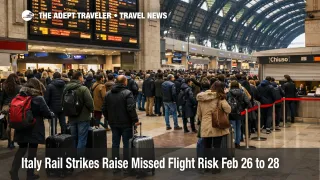
Italy's late week disruption risk is no longer just about whether your flight cancels on February 26, 2026. The bigger traveler failure mode from February 26, 2026 through February 28, 2026 is ground side timing, especially station to airport links, after aviation disruption pushes more people onto trains, and then rail service itself is reduced. Trenitalia flags a national rail strike window running from 900 p.m. on Friday, February 27, 2026, to 859 p.m. on Saturday, February 28, 2026, and it warns that service can shift even before the start and after the end.
Italy Rail Strike Airport Transfers, What Changed For Feb 26 To 28
What changed in practice is the crowding pattern and the transfer corridor pressure. When flight schedules thin on February 26, 2026, passengers who still need to reposition tend to surge toward the biggest rail hubs on February 27, 2026, then try to execute airport transfers on February 28, 2026 inside a constrained rail day. That creates a real scenario where an international flight operates, but the traveler misses it because their rail or station flow fails, or because their backup ground option becomes slow and expensive.
The most fragile corridors are the ones where travelers treat a single rail link as a guarantee. In Rome, Italy, that often means plans that depend on a specific departure from Roma Termini to Leonardo da Vinci Fiumicino International Airport (FCO). In Milan, Italy, it is the chain from Milano Centrale or Milano Cadorna to Milan Malpensa Airport (MXP), plus the station side movements that get slower when platforms are crowded.
Where The Misconnect Risk Is Highest
The highest risk group is anyone with a same day dependency, meaning a flight, a cruise embarkation, or a paid check in window that cannot slip. Rome and Milan are the top nodes because they combine high air volume, high rail volume, and common station to airport handoffs. Naples, Italy, and Venice, Italy, also carry elevated risk because travelers often arrive by rail to connect onward, and because local airport access options can bottleneck when many people pivot at once.
Saturday, February 28, 2026 is the most dangerous day for rail based airport transfers because the strike window covers most of the day, and guaranteed windows do not protect the entire timetable. Trenitalia states that essential regional services are guaranteed on weekdays from 600 a.m. to 900 a.m., and from 600 p.m. to 900 p.m., but outside those windows, cancellations and variations can cascade into missed transfers. In Lombardy, Trenord also emphasizes guaranteed time slots and flags that airport services can be canceled.
What Travelers Should Do Now
Travelers should stop treating station to airport transfers as a fixed duration from February 26, 2026 through February 28, 2026. The practical move is to shift to earlier transfers than normal, and to pick a decision threshold that forces action while options still exist. If an international departure matters, and your planned rail transfer lands you at the airport with less than 3 hours before departure, that is a reroute trigger, not a risk you "see how it goes" on.
In Milan, plan as if the most direct airport rail option might not run outside the guaranteed windows, and as if replacement buses will be slower than rail in peak churn. Trenord explicitly notes non stop replacement buses for specific Malpensa corridors if airport services are canceled, including Milano Cadorna to Malpensa Airport for the RE54 line, which changes where you need to go, and how long it takes. That is exactly how travelers lose time, because the failure is not just the canceled train, it is the station re navigation and the queue for the backup.
Across Italy, treat the strike as a cluster risk, not two separate headlines. Aviation disruption on February 26, 2026 increases the volume of passengers trying to salvage itineraries by rail on February 27, 2026, and February 28, 2026. If you can move one segment earlier, do it, because it reduces the chance you get trapped in the mode shift crush where taxis, rideshare, and hotels become the pressure valve.
How The Disruption Spreads From Aviation Into Ground Mobility
This disruption spreads through substitution and bottlenecks. First order, February 26, 2026 aviation actions create cancellations, retimes, and long processing queues, especially at major hubs, and that pushes people to seek rail alternatives or to reposition to protect onward legs. Second order, rail capacity is not elastic on short notice, so when many travelers pivot at the same time, platforms crowd, dwell times rise, and the remaining departures fill faster.
Then the rail strike window starting at 9:00 p.m. on February 27, 2026 compresses supply further. Trenitalia also warns that modifications can occur before the official start and after the official end, which is why the edges can be more dangerous than the center. The result is a transfer corridor problem, not just a transport provider problem, because the weakest link is often the station to airport handoff that was planned too tightly.
For related coverage inside Adept Traveler, see Italy Feb 26 Aviation Strike, Cancellations Spill Over and Italy Lombardy Rail Strike Feb 27 to Feb 28.