

La Goulette Wind Skip Sends Costa Smeralda to Naples
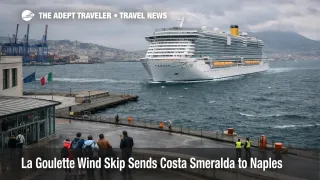
Strong winds in the central Mediterranean are already forcing cruise itinerary changes, and Costa Cruises has confirmed that Costa Smeralda will skip its scheduled call at La Goulette, Tunisia, on March 4, 2026, replacing it with a stop in Naples, Italy. The practical result is that passengers lose a Tunis day, and inherit a Naples day, which reshuffles excursions, private tours, and any transport plans that were built around a Tunisia port call. Travelers should treat this as an immediate rebooking problem for tours and transfers, and a capacity problem in Naples, not a minor timetable tweak.
Costa Smeralda La Goulette Cancellation, What Changed
Costa Smeralda is no longer expected to berth at La Goulette on March 4, 2026, and is instead heading to Naples for that date. Reporting based on a message sent to guests attributes the change to forecast winds and sea conditions that would exceed the port's operating limits for safe cruise operations. Independent ship tracking also shows Costa Smeralda routing toward Naples during the affected window, consistent with a diversion rather than a simple timing adjustment.
For travelers, the immediate disruption is straightforward. Anything purchased for Tunis, whether through the cruise line or privately, may no longer be deliverable, and the replacement port creates a new set of last minute choices in Naples, including whether to book a tour, self tour, or protect the day as buffer in case weather further degrades.
Which Travelers Feel This Change Most
The most exposed group is anyone with independently booked La Goulette day plans, private guides, drivers, museum tickets, or day tours that do not automatically follow the ship. Cruise line excursions are usually easier because the line can cancel and refund or substitute, but private bookings depend on each operator's terms, and the time to resolve disputes shrinks once the ship is inside 72 hours of the call.
A second group to watch is passengers who used the Tunis call as a positioning anchor, for example, meeting friends or family ashore, aligning with separate travel components, or scheduling a land segment in Tunisia around the ship's published arrival. Even when the cruise does not embark or disembark in Tunisia, travelers sometimes build flight and hotel decisions around a specific port day, and a late change can turn that plan into a sunk cost.
Finally, there is a knock on effect for Naples itself. A substituted call can concentrate demand for transport, guides, and popular sites on a single day, especially when the change happens close in. Naples already has its own near term transport sensitivity, including local strike risk on March 6 that can affect tourist rail links used for Pompeii and Sorrento day trips, which matters if passengers try to build onward day touring beyond the port area. See Naples Circumvesuviana Strike Risks Pompeii Trips March 6.
What Travelers Should Do Now
Start by treating the new Naples call as unconfirmed until you see it in your official channel, your cruise app, your daily program, or an onboard notice, then act quickly once it is confirmed. If you booked a private tour or transfer for La Goulette, contact the operator now, and ask two questions in writing, whether they will refund due to a port cancellation, and whether they can rebook you in Naples instead, at what price, and under what timing assumptions.
If you have timed entry tickets, long distance ground transfers, or a chain of bookings connected to the original Tunisia plan, set a decision threshold. Rebook now if your vendor requires 48 hours or more notice for refunds, or if your plans depend on a hard meet time. Wait if you have flexible cancellation terms, and you want to avoid paying twice while the ship's updated berth time in Naples is still settling.
For Naples touring, assume tighter availability and higher prices for vehicles and guides than you would see on a normal scheduled call, because short notice substitutions compress supply. If you must do a headline site with strict timing, build a buffer around the return to ship, and keep a simpler fallback plan in the city center if traffic or queueing turns against you.
Finally, keep your documentation clean. Save the cruise line notification, screenshot the updated itinerary once it appears in the app, and keep receipts for any incremental costs you incur because of the diversion. This is the same discipline passengers are being advised to use in other cruise disruption situations, where itinerary changes collide with separately booked components. See Gulf Cruise Disruptions Leave Passengers Onboard.
Why Wind Limits Trigger Diversions, and Why More Can Follow
Cruise ports set operating limits for wind and sea state because the risk is not just discomfort, it is controllability in confined water. High winds increase lateral forces on a large hull, and gusts raise the margin needed for safe maneuvering and for holding position during berthing, especially when tug availability, berth geometry, and breakwater protection are imperfect. In practice, the threshold is not one universal number, it is a local operating envelope that can be tighter than travelers expect.
Recent Mediterranean cases tied to La Goulette illustrate the pattern. MSC Splendida has also had La Goulette calls canceled due to forecast winds and rough seas in early 2026, including a case where wind gusts were forecast up to 50 knots, and other cases where winds and swell made docking unsafe, with alternate ports added afterward. That matters because it signals a repeatable constraint: when wind and sea conditions line up against the harbor approach, ships often pivot to a nearby workable port rather than linger offshore, and the substitute port then absorbs short notice demand.
For this specific Costa Smeralda change, the key traveler takeaway is not the exact knot value, it is the decision window. When a port has published limits and the forecast clearly crosses them, the ship and port operator will usually decide early enough to protect schedule integrity, crew hours, and downstream calls. That is why travelers should watch for additional adjustments if the wind pattern persists across more than one day, and why it is smart to keep at least one flexible day plan in your pocket rather than locking every port day into nonrefundable timing.
If you want a broader playbook mindset for weather driven itinerary changes, it helps to think in terms of how operators preserve the trip experience when conditions force swaps, even outside ocean cruising. See The 2025 European Heatwave's Impact on River Cruises for how contingency planning works when environmental thresholds reshape itineraries.