

Germany Extends Border Checks Through Sep 15, 2026
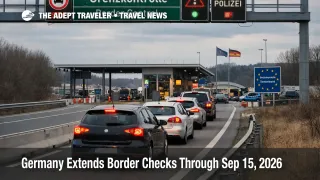
Germany internal border checks will continue across all nine land borders from March 16, 2026, through September 15, 2026, based on Germany's notification listed on the European Commission's Schengen portal. The practical traveler impact is simple, you should expect a higher chance of document checks and occasional queues on cross border road trips, international trains, and coach itineraries that skim border regions, especially during summer peak weekends. If your itinerary chains a land crossing into a flight, a timed rail connection, or a same day cruise embarkation, build buffer time now rather than hoping your crossing will be one of the many that stays friction free.
The extension matters because it is not limited to a single corridor. The Commission listing describes Germany's controls as covering land borders with France, Luxembourg, Belgium, the Netherlands, Denmark, Austria, Switzerland, Czechia, and Poland, with the stated rationale tied to security and migration pressures. In other words, the high exposure summer patterns, Benelux road loops, Rhine Valley rail hops, Munich to Salzburg day trips, Alsace and Baden wine country drives, and onward itineraries toward Prague or Krakow, all sit inside the same risk envelope.
Germany Internal Border Checks, What Changed For Travelers
The change is an extension of the same internal border control framework already in place, not a brand new category of checks. Germany is prolonging temporary controls beyond the prior end date, and the Commission's Schengen page lists the new validity window as March 16, 2026, to September 15, 2026. The Commission description also frames these as border controls at internal borders, meaning the checks occur inside the Schengen Area, not at an external EU frontier.
For travelers, the operational reality is that checks are not guaranteed at every crossing, but they can happen without much warning and they can be enough to break a tight plan. ADAC, which tracks travel impacts for drivers, flags that motorists should expect waiting times at numerous crossings and notes that rail travelers can be affected as well. That is the key planning point, it is not the average delay that matters, it is the variance and the fact that a small stop can cascade into missed onward connections.
Where Summer Itineraries Face The Most Friction
The highest exposure trips are the ones that treat borders like invisible lines and schedule right up against them. That includes road trips that cross multiple countries in one day, international rail segments that pass through border region stations, and airport transfers where the last leg is a cross border drive or train ride. If you are arriving in Germany by train from a neighboring country and connecting onward within a short window, or if you are driving in from Benelux, Austria, Switzerland, Poland, or Czechia to catch a long haul flight, this is where the policy becomes a real itinerary risk.
Group travel is also more sensitive than it looks. Tour buses and private transfers tend to run on tighter blocks, with fixed museum entries, lunch slots, and hotel check in expectations. A 20 to 40 minute stop at the wrong moment does not just delay arrival, it compresses the rest of the day and can force cancellations or paid changes, especially when the schedule has multiple pre booked elements.
What Travelers Should Do Before Departure
Treat any itinerary that crosses into Germany by land as a buffer day when you have a hard commitment later. If you are connecting from a land crossing into a flight, choose an earlier train or departure time than you normally would, because the risk is not that every crossing is slow, it is that one slow crossing breaks the chain. A clean decision threshold, if your plan requires you to arrive at the airport less than two hours after a land border crossing, shift to an earlier departure or add an overnight near the airport.
Keep documents accessible, not packed. The most avoidable failure mode is being selected for a check on a train or at a roadside stop and discovering your passport, national ID card, or residence permit is buried in checked luggage or in a trunk you cannot easily access. If you are a non EU traveler legally resident in a Schengen country, carry your passport and your residence card together so you can produce both quickly.
If you are driving, carry the documents that commonly get asked for during roadside checks and rental car stops, your passport or ID, your driver's license, your rental agreement or proof of permission to use the vehicle, and insurance documentation. Do not assume that because you are "inside Schengen" the border region works like a purely domestic road trip. The cost of being sloppy is not just time, it can be a forced reroute or a turned back situation that triggers rebooking fees downstream.
Over the next 24 to 72 hours before you depart, check the European Commission list for the current notification window and scope, then monitor operator messaging for your specific crossing method. For rail, that means your operator's service alerts and connection guidance. For driving, that means road authority and mobility alerts, plus realistic padding around peak arrival times.
For broader planning context, see Schengen Internal Border Checks Widespread In Late 2025 and the border processing explainer EU entry/exit system starts October 12: what to expect.
Why This Is Happening, And How The Delays Spread
Under the Schengen Borders Code, member states can temporarily reintroduce internal border control when they cite serious threats to public policy or internal security, and they must notify and report under the EU framework. In the Commission's current listing, Germany's stated reasons include continued threats tied to irregular migration and migrant smuggling, strain on asylum reception, and broader security and migration effects linked to the global security situation. Whatever a traveler thinks about the politics, the mechanism for delays is straightforward, enforcement activity inserts uncertainty into what many people plan as a deterministic travel day.
First order effects show up at the crossing point, a stop, a document check, a short queue, or a slowed train segment. Second order effects are where trips actually break, missed timed rail connections, missed hotel check in windows, tour bus arrival compression, and airport transfer failures when a cross border leg was scheduled as if it were a local commute. The policy is not a universal guarantee of long waits, but it is a predictable increase in variance, and variance is what destroys tightly coupled itineraries.