

Melbourne Rail Shutdown March 6 to 8 Hits F1, AFL
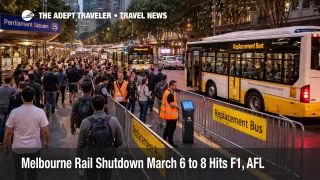
Melbourne is walking into an event stacked transit pinch point from Friday night, March 6, through Sunday, March 8, 2026, with planned shutdowns on the Alamein line and on the Belgrave and Lilydale corridors that trigger widespread bus replacements. The disruption lands as the Formula 1 Australian Grand Prix runs at Albert Park, Melbourne, Australia, Moomba runs across the city, and the AFL Opening Round includes St Kilda vs Collingwood at the Melbourne Cricket Ground (MCG) on Sunday night, March 8. The practical outcome is simple, trains that normally move people east and southeast toward the city will be swapped for buses across key segments, so airport to hotel transfers and late night returns need bigger buffers than a normal Melbourne weekend.
The specific disruption window published by Victoria's transport disruption notice runs from 11:30 p.m. on Friday, March 6, 2026, to last service on Sunday, March 8, 2026. During that window, buses replace trains between Camberwell and Alamein on the Alamein line, and buses replace trains between Parliament and Box Hill on the Belgrave and Lilydale lines.
Melbourne Rail Disruption: What Changed For Travelers
The traveler facing change is not "some delays," it is a forced mode shift on corridors that usually funnel crowds into the CBD and into the inner city tram network. If you are staying in the eastern suburbs, or you planned to ride rail into the city and then take trams to Albert Park, expect slower travel times, more platform crowding at the remaining operating stations, and queues where replacement buses load. Because the disruption starts late Friday night, the highest risk windows are Saturday daytime movements for F1 sessions and Moomba, plus the Sunday afternoon and evening peak that will stack F1 departures with Moomba traffic and the Sunday night AFL crowd heading to the MCG.
For visitors arriving by air, Melbourne Airport (MEL) still has no direct rail link, which means most travelers already enter the city by bus, taxi, rideshare, or private transfer. When the rail network is partially substituted with buses, the handoff points, Southern Cross, the CBD, and the tram grid become more sensitive to minor delays, because more people default to trams, rideshare, and road transfers at the same time.
Which Itineraries Face The Most Disruption
The highest exposure group is anyone whose lodging or friend base sits along the replacement bus segments, and who planned to "ride in and ride out" around event start and end times. If you are staying near Box Hill, Blackburn, Ringwood, Belgrave, or along that eastern spine, your usual rail trip into the city will involve a bus bridge between Parliament and Box Hill, which is exactly the kind of substitution that can look fine on paper and then stretch in real time when crowds surge and buses load slowly.
The next highest exposure group is anyone trying to do a tight schedule across multiple events on the same day, for example a morning Moomba session, an afternoon F1 commitment at Albert Park, and then a night game at the MCG. Moomba runs from Thursday, March 5, through Monday, March 9, 2026, and the Grand Prix weekend runs March 5 through March 8, 2026, which means the city is under sustained demand for five straight days, not just a single afternoon.
Finally, travelers with timed entry, hospitality packages, or fixed check in windows should treat this as a reliability problem, not just a travel time problem. Replacement buses introduce more variance, and variance is what breaks itineraries, because you can lose 20 minutes at a loading point even when the drive time is short.
How To Plan Around It Right Now
First, add buffer based on what you cannot control. If your hotel is on the east side and you need to be in the CBD, plan to arrive earlier than you think you need, because bus substitutions create queue risk at the interchange points. If you are going to the Grand Prix, build extra time for the last mile, because the tram system will absorb spillover demand from rail, and trams are capacity constrained at exactly the moments when big sessions end.
Second, use a decision threshold that forces a simpler plan. If you have a must hit commitment, such as a race session start, a pre booked hospitality window, or a dinner reservation you cannot move, then it is usually smarter to shift lodging closer to the CBD or closer to your main venue for the weekend. The tradeoff is higher room rates, but you are buying down the risk of a missed entry window and the cost of last minute rideshare surges.
Third, for airport transfers, choose the least complicated chain. A direct SkyBus or direct car transfer from Melbourne Airport (MEL) to a CBD hotel reduces the number of timed connections you are betting on, and once you are in the city, you can lean on trams and short walks rather than trying to thread a rail plus replacement bus combo at peak times. If you are new to how the Metro Tunnel and the CBD stations fit together for cross city moves, this explainer can help you plan your station choices and avoid needless backtracking, Melbourne Metro Tunnel Free Weekend Travel Guide.
Why This Disruption Spreads Beyond The Closed Lines
Planned shutdowns are not just about the lines that stop running, they are about where the demand goes next. When trains are replaced by buses between Parliament and Box Hill, the city end of the trip becomes a loading and unloading bottleneck, and the east side end becomes a transfer bottleneck. At the same time, many travelers who would normally take rail will switch to trams, rideshare, or taxis, which increases congestion on the roads feeding the CBD and the event precincts.
The second order effect is that "getting home" becomes harder than "getting there." Daytime travel can be managed with early departures, but late night returns after an F1 session, after Moomba, or after the Sunday night AFL game compress everyone into the same outbound window. That is where replacement bus queues, slow boarding, and road congestion stack together, and where the price and availability of rideshare can shift fast.
If you are deciding whether to leave earlier, shift lodging, or simplify your itinerary, treat March 6 to March 8, 2026 as a weekend where Melbourne's transport system will still work, but will be less predictable. The safest play is fewer connections, earlier departures, and a lodging choice that minimizes cross city travel during peak event exit waves.