

Chicago O'Hare Cap: FAA Moves to Limit Summer Flights
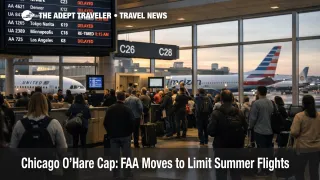
The FAA has launched a formal process that could force airlines to cut scheduled flying at Chicago O'Hare International Airport (ORD) for the Summer 2026 scheduling season, March 29, 2026, through October 25, 2026. The agency is signaling a target of about 2,800 total daily operations after airlines scheduled peak days above 3,080, which is a meaningful gap that cannot be fixed with minor retiming. What changed since Adept's March 2 coverage is that the cap process is now in the open record with defined meetings, timelines, and a clearer description of how the FAA plans to push schedules down into a deliverable envelope.
Chicago O'Hare Flight Cap: What Changed
The FAA and DOT are treating ORD as "severely congested" for the purpose of a scheduling reduction meeting, a statutory tool used when published schedules exceed what an airport can reliably deliver during peak hours. In the Federal Register notice, the FAA describes ORD's manageable level as roughly 100 hourly departures and 100 hourly arrivals, or about 2,800 total daily operations, and it says it will use carrier sessions to review each 30 minute period from 600 a.m. to 959 p.m. local time to meet the proposed limits.
For travelers, this is not just a "summer" issue in the calendar sense. Airlines often pull capacity forward and backward around the edges of a capped season, then retime banks to protect connections and aircraft utilization, which is why spring travel through Chicago can feel the effects first through timetable churn, fewer marginal frequencies, and reduced same day rebooking depth when disruptions hit. The practical impact is that ORD itineraries lose slack at exactly the moment the spring break system is already running hot.
Which Spring and Summer Trips Feel It First
The most exposed itineraries are connection dependent trips where a missed onward flight becomes an overnight by default, domestic to international connections, last flight of the day onward legs, and separate ticket builds that depend on ORD running on time. If airlines have to remove roughly 280 daily operations from peak days to meet a 2,800 target, the easiest cuts are often thinner frequency markets, duplicate flights in the same bank, and "nice to have" late evening departures that currently function as recovery options when earlier flights slip.
This will also land unevenly across carriers because the schedule growth pressure at ORD is tied to a competitive buildup. Reuters and The Wall Street Journal both describe planned increases by United and American that pushed peak day totals above 3,080, and the FAA is explicitly tying the cap to infrastructure, staffing, and construction constraints that reduce recovery margin when schedules thicken.
Second order effects are predictable. When ORD has fewer later flights available as "catch up" inventory, disruptions displace more passengers into nearby alternates and into the next day's first banks, which raises the value of flexibility at Chicago Midway International Airport (MDW), Milwaukee Mitchell International Airport (MKE), Detroit Metro Wayne County Airport (DTW), and Minneapolis Saint Paul International Airport (MSP), while also tightening airport area hotel supply during irregular operations.
How To Book Through ORD This Spring and Summer
For spring break and early summer bookings that route through ORD, the tradeoff is simple, nonstop convenience or short connections versus hub reliability under a coming capacity governor. Travelers who cannot absorb an overnight should bias toward earlier departures, longer connections, and itineraries with at least one viable same day backup flight in the same market, because a capped schedule reduces the number of "later" seats that usually save a trip when delays stack.
A clean decision threshold helps. If your trip has a hard start, for example a cruise embarkation, a wedding, a conference presentation, or a timed tour, avoid tight same day connections through ORD during the March 29, 2026, through October 25, 2026, window. Either add buffer that you control, or position into Chicago the night before, because the cap's whole purpose is to remove excess flying that currently functions as recovery capacity.
Finally, treat schedule change monitoring as part of the plan, not an annoyance. The FAA's meeting timeline puts the first big decision point in early March, with written submissions due March 11, 2026, and a final order expected after the process. That means some travelers will see flight number changes, retimings, and occasional cancellations well before departure, and others will see rolling trims closer in as airlines optimize banks and fleets.
Related Adept coverage that provides helpful context includes Chicago O'Hare Summer Flight Cap Planned by FAA, plus the earlier competitive buildup in O'Hare Gate Fight Drives United, American Flight Surge. For the broader systems context on why staffing and facility constraints turn into hard throughput ceilings, see U.S. Air Traffic Control Privatization: Reality Check.
Why the FAA Is Using a Cap and What Cuts Look Like
The mechanism is capacity realism under peak banking. ORD can look fine on an average day and still fail on peak waves because runway acceptance rates, gate availability, ramp staffing, taxi congestion, and air traffic control spacing rules all interact. The FAA is arguing that the filed Summer 2026 schedules exceed what the airport can deliver "throughout the season," and it is explicitly citing infrastructure and staffing limits, with ongoing long term construction projects as an additional constraint on operational resiliency.
The cap process also matters because it is designed to avoid airlines coordinating with each other directly. In the FAA notice, the agency describes structured carrier sessions and antitrust guardrails, then points toward a final FAA order that could restrict peak hour service for all carriers, including airlines that do not currently operate at ORD. In traveler terms, that increases the likelihood that published schedules actually change, rather than this staying a warning shot.
What cuts "look like" on the customer side is rarely a single dramatic event. More commonly it is a set of small removals and retimes that reduce the number of same day options, thin out late departures that help recover misconnects, and compress banks so that a short delay becomes a missed connection with fewer clean reaccommodation paths. If the cap holds at around 2,800 daily operations versus peak day filings above 3,080, that structural removal of slack is why spring and early summer travel can feel less forgiving, even on days without headline disruptions.
Sources
- Operating Limitations at Chicago O'Hare International Airport (FAA PDF)
- Federal Register Notice PDF (GovInfo, March 3, 2026)
- FAA plans to reduce flights at Chicago O'Hare, cites boost in schedules (Reuters, February 27, 2026)
- United and American Fight at Chicago's O'Hare Draws Federal Scrutiny (The Wall Street Journal)
- FAA, major airlines discuss reducing flights at O'Hare (ABC7 Chicago)