

London Weekend Tube Closures Hit Multiple Lines Mar 7-8
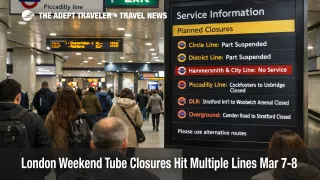
London Tube weekend closures on March 7 and March 8, 2026 are now a defined disruption set, not a strike risk scenario. This is the practical change from Adept's March 4 Heathrow transfer strike watch, travelers can plan around specific line and segment impacts even if no industrial action materializes. The weekend plan hits multiple central corridors on the Circle and District lines, takes the Hammersmith & City line out entirely, and adds DLR, London Overground, and Elizabeth line constraints that can break "simple" station to station moves and airport transfers that rely on easy interchanges.
London Tube Weekend Closures: What Changes March 7-8
Transport for London's planned closures list shows Circle line disruption between Hammersmith and Tower Hill, plus Edgware Road to High Street Kensington, across Saturday, March 7, and Sunday, March 8. The District line is also scheduled to be disrupted between Edgware Road and High Street Kensington on both days. The Hammersmith & City line is listed as no service on the entire line across the same weekend, which matters because it removes a high capacity east west option that many travelers use to reach Paddington, the City, and rail terminals without thinking about it.
Several other segments stack onto that core constraint. The Metropolitan line is shown as disrupted between Baker Street and Aldgate on March 7 and March 8. The Piccadilly line is listed as closed between Cockfosters and Uxbridge across the weekend, including during Friday and Saturday Night Tube, which can change how travelers reach key interchanges even if their final destination is not on the closed segment. The Jubilee line note is narrower, trains will not stop at Baker Street station during Friday Night Tube only, which is still meaningful for late arrivals trying to transfer through that node.
Which Travelers Get Hit Hardest
Travelers staying outside the core Zone 1 hotel belt tend to feel these weekend closures more than visitors already positioned near a major hub station. If a trip depends on an easy Circle or Hammersmith & City move, for example hotel to Paddington for an airport transfer, or hotel to a rail terminal for a day trip, the replacement is usually a multi step reroute that adds walking, stairs, and uncertainty. That is where missed flights and missed timed entries actually happen, not because the city is inaccessible, but because the number of failure points rises fast when you are carrying bags and watching a clock.
Airport sensitive itineraries are the other high exposure group. Heathrow transfer plans are often built around reaching Paddington or a Piccadilly interchange, and Gatwick plans often hinge on a clean connection at Victoria or a fast cross city hop after arriving on Thameslink. When the central circulation network is thinner, the same trip can still be doable, but the variance increases, and the late tail becomes the risk. A traveler who would normally accept a tight connection window should not accept it this weekend.
Two specific modes add extra surface area. DLR closures matter for London City Airport and Docklands hotels, and Overground closures matter for travelers using orbital moves to avoid central London. TfL's list includes DLR closures between Stratford International and Woolwich Arsenal, plus Poplar to Beckton, on March 7 and March 8, and a separate DLR closure between Tower Gateway and Shadwell on March 8. The Overground list includes the Mildmay line closure between Camden Road and Stratford on March 8, the Liberty line closure between Romford and Upminster on March 8, and Windrush line changes, Sydenham to Crystal Palace on March 7, plus Highbury & Islington to New Cross Gate and Clapham Junction across March 7 and March 8.
What Travelers Should Do Now
The simplest way to survive this weekend is to anchor plans on a small number of "known good" interchange stations, then avoid unnecessary transfers. If a plan requires two or more line changes, rebuild it so there is one primary spine, then a short last mile. That is especially true with luggage, because every extra transfer is a queue risk, a platform change risk, and a walking time risk.
For Heathrow, the most resilient posture is to base the long leg on rail that does not depend on the disrupted Circle and Hammersmith & City spine. In practice, that often means aiming for London Paddington, then taking Heathrow Express, or taking the Elizabeth line directly if your origin is already on it. If your usual route uses Circle or Hammersmith & City to reach Paddington, assume it will be slower and less direct, and build the transfer as two steps with extra time. For more general fallback logic on airport corridors, see London Underground Strike Risk Rises, Heathrow Transfers Hit.
For Gatwick, keep the plan simple and station based. If you are using Gatwick Express, anchor on London Victoria, then plan the last mile using a single Underground line rather than a chain. If you are using Thameslink, anchoring on Farringdon can be useful because it gives access to multiple onward options, including the Elizabeth line. Do not assume your first choice interchange will be the best on the day, instead, decide on two acceptable interchange stations before you leave your hotel.
Buffer rules should be blunt this weekend. For international departures, add at least 90 minutes beyond your normal "comfortable" transfer time, and treat that as insurance against bad headways and crowded platforms. For timed tickets, add 30 minutes for each planned transfer, and if you are crossing the city, add a full hour so you are not forced into an expensive taxi decision at the last minute. If a booking is truly immovable, shift the hotel the night before so the morning move is shorter and more direct.
Why This Weekend Disruption Spreads
The mechanism is straightforward. A planned closure on one corridor does not just remove trains, it concentrates demand onto the remaining corridors, which increases dwell time at platforms, makes trains feel full sooner, and increases the odds that travelers will self reroute into the same alternative nodes. When several central segments are constrained at once, Circle, District, Metropolitan, plus no Hammersmith & City, the network loses some of its redundancy, and travelers end up making more transfers on fewer remaining paths, which is exactly what raises variance.
The second order effect is the airport transfer problem. Even if Heathrow Express, Thameslink, and airport bound rail services run normally, the last mile to the departure station becomes the chokepoint. That is why "the airport train is running" is not the same as "the transfer is safe." A separate second order layer is National Rail engineering work. Network Rail and operators have warned about weekend engineering work affecting routes into London Liverpool Street in March, and that kind of work can add additional schedule changes and crowding that spill into the same interchange space travelers use for Tube and Elizabeth line connections.
For broader neighborhood, station layout, and transfer context that helps travelers choose simpler fallback paths, use London Travel Guide: The Ultimate 7-10 Day Itinerary for First-Time Visitors.
Sources
- Transport for London, Planned Track Closures PDF
- Transport for London, Major Works and Events
- Network Rail Media Centre, Reminder to Plan Ahead for Weekend Journeys Into London Liverpool Street in March
- Greater Anglia, Reminder Passengers Should Check Before Travelling as Weekend Engineering Work Takes Place
- National Rail, Future Engineering Works