

Miami Venezuela Flights Approved for American Airlines
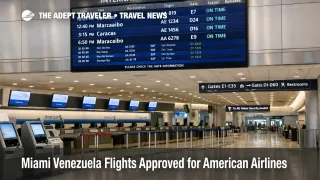
American Airlines has received U.S. Department of Transportation approval to bring back nonstop service between Miami, Florida, and Venezuela, with planned flying to Caracas, Venezuela, and Maracaibo, Venezuela, operated by its wholly owned regional carrier Envoy. The move reopens a nonstop corridor that has been effectively closed for years, and it matters most for travelers who previously relied on Miami International Airport (MIA) as the simplest gateway for family visits, business trips, and humanitarian travel. The catch is that the authorization does not change the State Department's Level 4 warning for Venezuela, and it does not eliminate the operational volatility that comes with restarting a market after a long suspension. Travelers weighing a nonstop booking should treat the next few weeks as a ramp up period, not an instant return to a normal schedule.
Miami to Venezuela Flights: What Changed
The Department of Transportation action gives Envoy authority tied to American Airlines' plan to operate Miami to Caracas and Miami to Maracaibo flying, and the approval window runs from March 4, 2026, through March 4, 2028. In practical terms, that means American can now publish schedules, sell tickets, and work through the final operational steps needed to actually fly, including security and safety coordination that tends to drive last minute timing changes for high risk markets.
This approval lands after a separate January 2026 DOT action that rescinded the 2019 order that had suspended U.S. and foreign carrier authority for air service between the United States and Venezuela. That earlier rescission removed the blanket regulatory barrier, and this week's approval is the concrete airline specific step that turns a policy change into an actual route restart.
Who Benefits Most From This Restart, and Who Should Avoid It
The obvious winners are travelers whose trip purpose strongly rewards a nonstop, especially travelers visiting close family, time sensitive business travelers, and travelers moving humanitarian support who previously had to stitch together third country routings. Before this change, many itineraries effectively required a connection outside the United States, which adds missed connection risk, more baggage failure points, and longer travel days.
The travelers who should be most cautious are those treating this as a casual leisure add on, or those planning tight same day onward connections after landing. Even once the flights begin, early restarts are prone to schedule adjustments, conservative payload decisions, and uneven day to day reliability while crews, aircraft rotations, and airport processes settle into a repeatable pattern. In other words, the first nonstop you can buy is not always the first nonstop you should build a fragile itinerary around.
The biggest constraint remains the U.S. government's own risk posture toward Venezuela. The State Department continues to label Venezuela as Level 4, Do Not Travel, citing risks including wrongful detention, torture in detention, kidnapping, arbitrary enforcement of local laws, crime, civil unrest, and poor health infrastructure. That advisory is separate from whether an airline is allowed to fly, but for traveler decision making it is still the dominant signal about personal risk and about how limited U.S. support can be during an emergency.
What Travelers Should Do Before Booking
Start by deciding what problem you are solving. If the goal is a shorter travel day and fewer connection failure points, a nonstop can be worth it, but only if the ticket and the plan are built for volatility. That means prioritizing refundable fares when possible, building at least one buffer day on either end if the trip purpose allows, and avoiding same day onward flights or cruise embarkations until the route has a stable operating rhythm.
If you have to travel on fixed dates, the tradeoff is simple. Booking early may secure scarce seats when the route first appears, but waiting can reduce your exposure to launch week changes. A practical middle path is to book only if you can tolerate a cancellation without losing the trip, and keep a backup routing via a third country in mind so you can pivot quickly if the nonstop schedule shifts.
Before departure, expect stricter scrutiny than a typical Caribbean or Latin America leisure flight. For travelers who do choose to go, documentation, local law exposure, and personal safety planning matter more than usual, and the best decision often happens before you buy, not at the airport when options are limited. Travelers already in Venezuela, or those supporting family there, should also pay attention to official security alerts and advisory updates because conditions can change faster than airline schedules.
Why This Is Happening, and Why It May Still Feel Uneven
The key mechanism is that the travel system is reopening in layers. In 2019, DOT suspended air service authority between the United States and Venezuela, a decision DOT framed at the time as a security driven action taken with State and Homeland Security involvement. Undoing that kind of suspension is not a single switch flip, it is a sequence: the policy barrier has to be removed, an airline has to request authority, approvals have to be granted, and security assessments have to support operations at the destination airport environment.
That layered restart is why travelers should not expect an instant return to broad capacity. First order, the route can relaunch and cut out a connection for travelers starting in South Florida. Second order, a limited ramp up can tighten seats and raise fares on alternative routings through third countries because some travelers will still hedge, and airlines and airports will have to absorb disruption events with fewer established recovery options than a mature market has.
It is also why the State Department advisory and the airline restart can coexist without contradiction. DOT authority answers whether the route may operate, but the travel advisory answers whether Americans should be there, and what risks they accept if they go. For most travelers, that advisory should drive the decision more than the novelty of a nonstop returning.
For readers who have followed earlier coverage, this is the tangible shift from "policy rescinded" to "route approved," which moves the traveler decision point from theoretical planning to active booking strategy. Related Adept coverage is here: American Airlines Venezuela Flights Restart Pending Approval, Venezuela Security Alert, Depart Immediately Guidance, and the destination hub page Venezuela.
Sources
- USDOT approves American Airlines flights to Venezuela (Reuters)
- American Airlines gets green light to fly to Venezuela (AP News)
- Notice of action taken, Envoy authority effective March 4, 2026 through March 4, 2028 (Regulations.gov PDF)
- Order 2026 1 24 rescinding the 2019 suspension order (Regulations.gov PDF)
- Venezuela Travel Advisory, Level 4 Do Not Travel (Travel.State.gov)
- Secretary of Transportation orders suspension of air service between the U.S. and Venezuela, May 15, 2019 (DOT)