

United Spring Break Forecast Raises Airport Stress
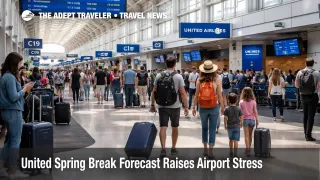
United says more than 27 million passengers are expected to travel during the carrier's spring break window in mid to late March 2026, with about 4,900 flights per day and beach destinations dominating demand. That matters because the real traveler problem is not just crowds, it is crowding plus inexperience, with United saying many younger flyers are stressed by unfamiliar airports and tight connections. Travelers flying United over the next two to three weeks should treat airport time, connection time, and onboard prep as active planning decisions, not afterthoughts. The pressure lands as the broader U.S. system also heads into a record spring travel period.
United spring break airport stress is rising because one airline specific forecast is colliding with a wider national surge, which means small mistakes, late arrivals to the airport, short layovers, forgotten headphones, or assuming help will be instant, can turn into missed flights faster than travelers expect.
United Spring Break Airport Stress: What Changed
The new piece of information is not that spring break is busy. It is that United has now attached numbers and traveler behavior signals to this year's rush. The airline says more than 27 million passengers are expected during its spring break period, that it averages 4,900 flights a day, and that Orlando, Las Vegas, Honolulu, Phoenix, and Fort Lauderdale are its top domestic draws. United also says 52 percent of its spring break travelers are heading to the beach, which helps explain why warm weather markets and the hub routes feeding them are likely to feel crowded first.
That demand spike matters more this year because it sits inside a bigger industry surge. Airlines for America projects 171 million passengers across U.S. airlines from March 1 through April 30, 2026, about 2.8 million a day, with roughly 26,000 daily passenger flights and 3.5 million seats. In plain language, rebooking cushions can disappear quickly when flights fill across the whole system at once, even if your original disruption starts with something minor like a slow security line or a late inbound aircraft.
Which United Travelers Feel It Most
The travelers most exposed are not just college spring breakers. Families with children, first time or infrequent flyers, and anyone connecting through a large United hub are the groups most likely to feel friction. United says 75 percent of younger, less experienced flyers find unfamiliar airports stressful, and 73 percent worry about making a tight connection. Those are not trivial sentiment numbers. They point to the exact points where itineraries break, wayfinding inside a large terminal, moving between concourses, and deciding whether to run, rebook, or ask for help.
Parents have a different pain point. United says two out of three parents view in flight WiFi as important to a smooth trip, and it highlights more than 155,000 seatback screens across its fleet. That is useful, but it also signals where expectations are rising. Families are not just buying transportation, they are trying to preserve a manageable cabin experience for several hours, often after a long airport day. A delayed departure, seat swap, device issue, or dead headphones matters more when the whole cabin is full and children are already tired.
This also lands days after United hardened its onboard headphone rule. The carrier updated its Contract of Carriage on February 27, 2026, to allow refusal of transport or removal for passengers who play audio or video without headphones. That is not just etiquette now, it is an enforceable rule inside a busy travel window when crews have little patience for avoidable cabin friction. Adept has already covered that change in United Flights Add Headphone Rule, Removal Possible.
What United Travelers Should Do Before March Peaks
The first practical move is to reduce avoidable failure points before you leave home. For United passengers, that means checking in early, using the app before you arrive, and treating connection length as a decision threshold. If your itinerary includes a short layover at a major hub, especially on a peak leisure day, the safer play is to switch earlier if a reasonable option appears rather than hoping airport navigation goes perfectly under crowd pressure. United's app features, including turn by turn airport directions, gate maps, customer service tools, and ConnectionSaver alerts, are most useful when travelers open them before things go sideways.
The second move is to plan around crowd timing, not just departure time. Spring break demand tends to stack around morning departure banks, late afternoon family departures, and weekend turnover days. Travelers checking bags, traveling with children, or departing from a large United station should add more airport buffer than they would on a routine business trip. That buffer buys protection against checkpoint swings, gate changes, and the slower walking pace that comes with crowded terminals.
The third move is simple but now more important on United specifically, pack working headphones in an easy to reach pocket. Do not assume crew reminders are optional. For travelers already uneasy about the airport piece, onboard conflict is the last thing you need after boarding. Spring break trips go better when the cabin part is boring.
Travelers also should keep a close eye on broader spring break disruption signals, especially where government staffing or network congestion can make a crowded day worse. Adept's recent piece, Worldwide Caution, Spring Break Travel, Advisors Urge Calm, is more global in scope, but the same logic applies here, fragile itineraries fail first.
Why the Spring Break Crunch Spreads Fast
The mechanism is straightforward. United's top spring break destinations are mostly leisure markets that attract families and occasional travelers, which creates heavier bag checking, slower boarding, more gate questions, and more sensitivity to delays. Because many of those passengers connect through major hubs instead of flying nonstop, stress builds at the hub first and then cascades outward to destination flights. A late inbound flight or crowded checkpoint does not stay local for long, it turns into missed connections, rebooking queues, and full later departures.
Second order effects matter here more than dramatic headline delays. When flights are broadly full, the cost of a small disruption rises. A missed connection can mean a same day hotel night, a lost resort check in window, a blown cruise embarkation, or a much later arrival that burns the first usable day of a short trip. That is why United spring break airport stress is really a trip protection story, not just a crowd story.
The tradeoff for travelers is clear. Waiting may preserve the exact itinerary you wanted. Moving earlier, adding buffer, or accepting a longer layover may preserve the vacation itself. Over the next two to three weeks, the better decision for many United leisure travelers is the less elegant schedule that is harder to break.