

Worldwide Caution, Spring Break Travel, Advisors Urge Calm
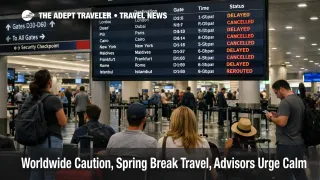
Travel advisors are urging clients not to panic about spring break plans, even as the U.S. Department of State's Worldwide Caution highlights periodic airspace closures after U.S. combat operations in Iran, and as Mexico security operations and roadblocks have recently disrupted ground movement in some corridors. The core shift is not that spring break travel has broadly "stopped," it is that itinerary fragility has increased, especially for trips that depend on a small number of hub airports, tight connections, or same day cruise and resort handoffs. Advisors say most clients are still traveling, but they are planning around flight reroutes, last minute schedule changes, and localized movement constraints instead of assuming the original schedule will hold.
Spring Break Travel Disruptions: What Changed This Week
The Worldwide Caution posted on February 28, 2026, puts "periodic airspace closures" and fast moving security updates back into the traveler decision loop, which is why advisors are watching connecting itineraries more closely than simple point to point trips. In parallel, U.S. Mission Mexico security alerts have described situations where airports remained open, but roadblocks affected access and airline operations, a failure mode that breaks transfers and day plans without "closing" the destination.
On the aviation side, the scale can look intimidating in headlines, including reporting that FlightAware data showed more than 2,400 flight cancellations across Middle East airports on Sunday [March 1, 2026]. Advisors quoted by TravelPulse said they are not seeing major spring break trip pullbacks overall, but they are doing active triage, rerouting, and reassurance focused on facts and official channels.
For readers tracking the underlying disruption, this is the practical "what changed since yesterday" update, the center of gravity has moved from a single shock day into a rolling operations environment where hubs may partially reopen, then tighten again, and airlines may update schedules faster than travelers can refresh their assumptions. For that baseline and the hub mechanics, see Worldwide Caution, Middle East Flights Still Halted.
Which Spring Break Itineraries Are Most Exposed
The highest exposure is not defined by "spring break" as a category, it is defined by how many dependencies your itinerary has. Trips that rely on a Gulf hub connection, especially Dubai International Airport (DXB), Hamad International Airport (DOH), or Abu Dhabi Zayed International Airport (AUH), have the most volatility because airspace constraints can force cancellations, long reroutes, crew legality issues, and missed connection cascades even when your first segment operates.
The next tier of exposure is any trip where you cannot tolerate a same day slip, including cruise embarkations, wedding weekends, timed event travel, and non refundable resort check in nights. In these cases, "it's only a few hours late" can quickly become an unplanned overnight when rebooking capacity is constrained.
Mexico exposure is more situational, and it is mostly about ground access reliability, not the runway. In the Puerto Vallarta region, for example, Licenciado Gustavo Díaz Ordaz International Airport (PVR) may remain operational, but roadblocks can still complicate airport transfers and excursion logistics, and cruise lines can treat a port call as discretionary when mobility becomes unpredictable. If you have a Mexico Riviera itinerary built around tight port timing or long overland transfers, the most useful local framing is Puerto Vallarta Fallout, Cruise Calls Shift, Flights Normalize.
A smaller but real niche exposure right now is Indian Ocean itineraries that connect through the Gulf hub system. If you are traveling to the Maldives and your routing depends on those connections, disruptions can turn into practical questions like whether you can extend a stay, change departure timing, or revalidate document requirements after reroutes. The clean reference for that side is Maldives Entry Requirements For Tourists 2026.
What Travelers Should Do Now
Start with a simple posture change, treat your operating airline and airport status as the source of truth, not the itinerary you booked weeks ago. The Worldwide Caution explicitly points travelers to follow the latest security alerts from the nearest U.S. embassy or consulate, and that guidance is only useful if you check it before you are committed to a transfer, not after you arrive at the airport.
Set a decision threshold that matches your risk tolerance. Rebook proactively if you have a tight international connection through a Middle East hub, if you are traveling on separate tickets, or if a missed arrival would break a cruise embarkation or a non refundable event. Waiting can still be rational if you have genuine date flexibility and you can absorb an overnight, but only if you set a personal deadline to pivot before seats disappear on alternate routings.
Build buffer where the system is most likely to break. Add time for international departures, and add transfer margin on arrival if your destination has shown mobility friction, including places where the airport may be open but access roads can change quickly. If you are already abroad, enroll in the Smart Traveler Enrollment Program so the nearest embassy can reach you quickly if security posture changes.
Then monitor three things over the next 24 to 72 hours, because they are the clearest signals of whether this stays "logistics, not fear." First, whether airspace restrictions narrow to specific corridors or widen again. Second, whether airlines publish waivers that let you reroute without fare spikes. Third, whether the hubs restart full connection banks or only limited waves, because "airport reopened" does not automatically mean "connections are safe."
Why Advisors See Shifting Travel, Not Mass Cancellations
The mechanism is straightforward, and it explains why advisors can be calm without being complacent. When airspace closes or becomes intermittently unavailable, airlines must route around constrained corridors, which increases flight times, changes fuel planning, and pushes crews toward duty time limits. That turns a regional issue into a network issue, aircraft and crews end up out of position, and the recovery schedule inherits those gaps even after partial reopenings.
Mexico's recent disruption pattern illustrates a different but equally important mechanism, mobility volatility. Airports may remain open, but roadblocks and access disruptions can still force flight cancellations and break transfers, excursions, and port logistics, which is why advisors focus on ground plans and buffers, not just the departures board.
Put together, these mechanisms reward the same behavior advisors are describing, flexible routing, earlier decision points, and tighter reliance on verified official updates. That is why many spring break trips can proceed normally, especially domestic and Europe bound travel that does not transit the affected hubs, while the highest risk itineraries require active monitoring and backup options.
Sources
- Worldwide Caution, February 28, 2026, U.S. Department of State
- New Worldwide Travel Alert Issued, What It Means for Spring Break, TravelPulse
- Update to Impact of Ongoing Security Operations, U.S. Mission Mexico, February 22, 2026
- US Iran conflict disrupts thousands of flights, Reuters, March 1, 2026
- Air France KLM cancels Middle East flights on security concerns, Reuters, March 3, 2026
- Thousands stranded as U.S. Israeli strikes on Iran close airspace in the Middle East, CBS News, March 1, 2026