

Kansas City Airport Threat Briefly Shuts Terminal
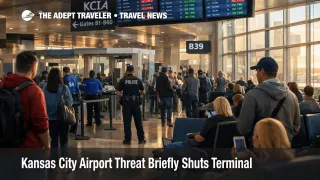
A Kansas City airport threat briefly shut down the terminal at Kansas City International Airport (MCI) on Sunday, March 8, 2026, forcing a precautionary evacuation, holding arriving aircraft on the taxiway, and interrupting normal passenger flow for about two hours. The FBI later determined the threat was not credible, and airport operations resumed shortly after 2:00 p.m. local time. For travelers, that means the main risk has shifted from immediate closure to the aftereffects, screening backups, gate changes, delayed turns, and thinner same day rebooking options for anyone whose trip still touches MCI on Sunday evening.
The practical takeaway is simple. MCI is open again, but travelers should treat the rest of March 8 as a recovery window rather than a fully normal operating day. Even when a threat is cleared quickly, the airport has to restore checkpoint rhythm, reattach inbound aircraft to gates, and absorb passengers whose schedules were disrupted during the shutdown.
Kansas City Airport Threat: What Changed at MCI
The confirmed change is narrower than the headline suggests, but still operationally important. The evacuation began after a threat surfaced around 11:15 a.m. local time, according to airport and wire service reporting. During the shutdown, flights that landed after the evacuation were held on the taxiway, the Federal Aviation Administration temporarily halted flights during the investigation, and at least four Southwest Airlines flights bound for Kansas City were diverted. By Sunday afternoon, the Kansas City Aviation Department said the terminal had reopened, Transportation Secretary Sean Duffy said normal operations were resuming, and FBI Director Kash Patel said the threat was reviewed and found not credible.
That distinction matters. This was not a prolonged airport closure or a confirmed attack. It was a short, high impact security interruption that temporarily broke the terminal workflow. Travelers deciding whether to go to the airport now should think in terms of residual delay risk, not an all day shutdown.
Which MCI Travelers Are Most Exposed Tonight
The most exposed passengers are those still flying out of MCI on Sunday evening, especially anyone checking bags close to cutoff time, relying on a narrow domestic connection, or booked on one of the carriers that had to absorb displaced aircraft and passengers after the pause. A two hour terminal evacuation can create a larger tail than the closure itself because screening lines reform unevenly, gate areas refill in bursts, and late arriving aircraft can disrupt the next scheduled departure bank.
Inbound travelers are exposed in a different way. If your flight was held on the taxiway or diverted, the immediate issue is not just arrival time. It is whether onward ground transport, rental car timing, pickups, or same day onward flights still work once the airport starts moving again. When an airport clears a terminal and then reopens, the first order effect is the pause itself. The second order effect is the compression that follows, multiple flights and passenger flows trying to restart at once.
Kansas City travelers have also seen a similar pattern recently. Adept Traveler covered another short security related disruption in Kansas City Airport Lockdown Lifted, MCI Reopens, and the useful lesson carries over here, once the all clear comes, the real traveler problem is often checkpoint recovery and downstream timing, not the incident itself.
What Travelers Should Do After the Reopening
Travelers departing MCI later on March 8 should leave more buffer than usual, rely on the airline app rather than curbside assumptions, and treat posted departure times as more reliable than earlier terminal rumors. If you have not left for the airport yet, check whether your airline has pushed boarding or departure times before you commit to the trip. If you are already there, focus on whether you can clear security and reach the gate before boarding begins, not whether the airport is technically open.
The rebooking threshold is straightforward. Rebook if your flight is still delayed, your inbound aircraft has not arrived, or your connection was already tight before the incident. Wait if your flight status is stable, your aircraft is on the ground or inbound, and you still have enough time to clear screening and reach the gate without depending on a perfect sequence. For travelers with optional trips, Monday morning may offer cleaner recovery space than fighting for the last seats on Sunday night. That is an inference based on how short airport shutdowns typically compress the remainder of the same day schedule, not a new official advisory.
Watch for three things over the next several hours, gate changes, late aircraft turns, and limited same day reaccommodation. Those are the pressure points most likely to shape traveler outcomes after a short terminal disruption has officially ended.
Why a Brief Security Shutdown Still Spreads Through Travel
A terminal evacuation is a passenger flow problem first, and a schedule problem second. Once officials clear people out, screening stops, boarding stops, arriving passengers can be trapped in holding patterns away from gates, and airport staff have to reset multiple processes at once after the all clear. That is why even a threat later deemed not credible can still disrupt thousands of travelers. Reuters reported that nearly 1 million passengers pass through MCI each month, and AP reported that about 2,000 people were ushered onto the tarmac during the evacuation.
The mechanism is simple. First order, the airport pauses normal movement while law enforcement verifies the threat. Second order, flights bunch together after reopening, crews and aircraft turn late, and passengers who miss one step in the chain, bag drop, screening, boarding, pickup, connection, can lose the rest of their itinerary. For that reason, the main value of this story is not fear. It is timing discipline. MCI is open again, but Sunday travelers should still plan like the system is recovering, not fully reset.