

Disney California Adventure Food Festival: What To Know
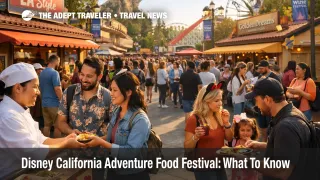
The Disney California Adventure Food Festival is back at Disneyland Resort in Anaheim, California, running from March 6 through April 27, 2026, and it matters less as a novelty than as a real spring trip-planning variable. Disney is positioning the event around limited-time food, beverage seminars, culinary demonstrations, live entertainment, and festival merchandise, which means a normal park day now competes with a lot more timed spending and snacking decisions. If you want to build a trip around the festival, the smart move is to treat it like a seasonal event with capacity and budget implications, not just a bonus once you are inside the gate.
In practical terms, the change is simple. Disney California Adventure has turned food into a spring draw strong enough to shape when people visit, how long they stay, and whether they should plan for a graze-all-day strategy or a regular ride-focused day with a few festival stops. The main traveler decision is not whether the dishes look good, it is whether the festival fits your day well enough to justify the extra cost, extra walking, and extra time away from attractions.
Disney California Adventure Food Festival: What Changed
This year's festival runs for nearly eight weeks and spreads across eight festival marketplaces, plus participating dining locations around Disney California Adventure Park. Disney's official listings also confirm beverage education seminars, culinary demonstrations, live music, "Cookin' with the Jammin' Chefs," and festival-specific merchandise, which makes this a broader event footprint than a simple kiosk crawl.
For travelers, the biggest operational detail is that entry still depends on standard park access rules. You need valid admission to Disney California Adventure Park, plus a park reservation where required, and Disney explicitly says reservations are limited and not guaranteed. That means the festival is only useful if your ticket and reservation strategy is sorted first. Do not build a food-focused Anaheim day around this event and assume availability will work itself out later.
The other meaningful change is how Disney continues to formalize tasting as a purchasable workflow. The Sip and Savor Pass remains the main way to sample multiple eligible items in tasting-size portions rather than buying larger standalone meals one by one. For 2026, Disney lists the four-entitlement pass at $34, including tax, and the eight-entitlement pass at $64, including tax, with Magic Key holders able to buy the eight-entitlement version for $59. Those passes expire on April 27, 2026.
Who This Spring Event Is Best For
This festival fits repeat Disneyland visitors, local or regional travelers, and adults who already see Disney parks as a dining destination, not just a rides destination. It also works for split-focus groups, where some people want seasonal food and others want a standard day, because the marketplaces and participating venues are spread through the park rather than isolated in one small corner.
It is a weaker fit for first-timers trying to cover both Disneyland Park and Disney California Adventure in a compressed trip. The festival adds one more layer of decision friction. You are balancing mobile order and pickup windows, tasting stops, lines at marketplaces, entertainment timing, and beverage add-ons that are not covered by the Sip and Savor Pass. If your real priority is headline attractions and character time, the event can quietly eat hours you thought you would spend elsewhere.
Families can still use it, but the value math changes. Disney says the pass covers eligible food and nonalcoholic beverages only, and the portions are tasting size, not full entrées. That makes it better for sampling and sharing than for replacing every meal in the park. The tradeoff is obvious, you get variety and novelty, but not always the most filling or cheapest way to feed a group.
How To Plan Around Tickets, Timing, and Budget
Buy your park ticket and lock your park access first, then decide whether the festival is the center of the day or a side activity. If it is the center, the Sip and Savor Pass is usually the cleanest way to control spend while trying multiple items, especially if you split one with another person. Because the pass can be used across multiple visits before it expires on April 27, it is especially useful for locals and short-repeat visitors who are not forcing every bite into one long day.
Wait on beverage seminar planning only if you are comfortable missing out. Disney says those guided tastings at Sonoma Terrace require reservations, run on Saturdays and Sundays from March 7 through April 26, and last about 30 to 40 minutes. That is manageable on paper, but it also creates a harder time commitment inside a park day that already has attractions, shows, and meal stops competing for time. Travelers who want the seminar experience should book it early and build the rest of the day around it, not squeeze it in later.
Culinary demonstrations are a softer commitment, but still affect pacing. Disney lists them in Hollywood Land at 330 p.m. and 500 p.m. during the festival window. Those slots matter because they sit in the middle of a high-value part of the day when guests often pivot between rides, snacks, and evening entertainment. If you care more about food content than ride throughput, aim for a slower itinerary and accept that this is not the most efficient possible park strategy.
Why This Launch Matters For A Disneyland Day
The festival changes a Disney California Adventure day because it redistributes attention. Instead of guests flowing mainly from attraction to attraction, more people are stopping at marketplaces, comparing value across tasting items, and carving out time for live demonstrations or drinks. First order, that increases demand for food-focused stops and makes the park day feel more segmented. Second order, it can push some guests to rely more heavily on Downtown Disney for later meals, or to rethink whether a one-park day is enough if food is part of the reason for visiting.
It also matters because Disneyland Resort has continued adding non-ride trip-planning variables that shape how visitors budget time and money. Recent examples include hotel-perk changes and Downtown Disney dining additions, both of which affect how guests structure a full Anaheim stay around park access, meal timing, and nighttime spillover. In that broader context, the Food & Wine Festival is not just a menu event. It is one more sign that Disneyland trips increasingly reward travelers who plan around operations, not just attraction wish lists. Disneyland Early Entry Ends in 2026, Perk Replaced and Gordon Ramsay at The Carnaby coming to Downtown Disney both fit that pattern.
For most travelers, the right threshold is simple. Build around the festival if tasting, seasonal food, and a slower spring park day are the point. Treat it as a side benefit if rides, first-time sightseeing, or maximizing both Anaheim parks matter more. Disney has made the event substantial enough to justify a visit, but not so frictionless that every traveler should plan their day around it.
Sources
- Disney California Adventure Food & Wine Festival, Disneyland Resort
- Sip and Savor Pass, Disneyland Resort
- Culinary Demonstrations at Disney California Adventure Food & Wine Festival, Disneyland Resort
- Disney Eats: Disney California Adventure Food and Wine Festival Foodie Guide 2026, Disney Parks Blog
- Disneyland Early Entry Ends in 2026, Perk Replaced, Adept Traveler
- Gordon Ramsay at The Carnaby coming to Downtown Disney, Adept Traveler