

Glasgow Central Closure Disrupts UK Rail March 9
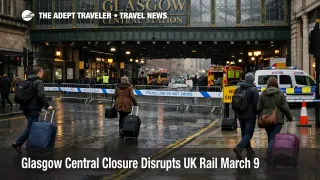
Glasgow Central closure has turned into a same day UK rail problem, not just a local Glasgow, Scotland station incident. National Rail says the station is closed until further notice after a fire in a nearby building, with no trains running to or from the high level platforms and major disruption expected through at least the end of Monday, March 9, 2026. The practical move for travelers is to stop treating Glasgow Central as usable today, shift to Glasgow Queen Street, Argyle Street, Motherwell, or deferred travel, and recheck before making any attempt to move early on Tuesday, March 10, 2026, because officials still have no reopening estimate.
The change from background risk to live operational failure is straightforward. Network wide rail plans are now being rebuilt around one closed hub, and that matters because Glasgow Central is the key station for many ScotRail commuter and regional flows, Anglo Scottish Avanti West Coast services, CrossCountry links, and TransPennine Express trains to Manchester Airport and Liverpool Lime Street. What changed since Sunday is that operators moved from warning language to concrete cancellations, route truncations, and ticket acceptance rules travelers can act on today.
Glasgow Central Closure, What Changed for Travelers
National Rail's current disruption notice says no trains will run to or from Glasgow Central high level platforms, while low level trains can still pass through but will not call at the station. Instead, travelers needing low level services are being told to use Argyle Street, which is about a five minute walk away. National Rail also says there is no estimate for when the station will reopen, and that disruption is expected on routes to, from, and through Glasgow Central through at least the end of Monday.
That closure hits four major operator groups at once. Avanti West Coast says no trains will run to or from Glasgow Central on Monday, with an amended service operating to Motherwell, Carlisle, and Preston instead. CrossCountry tickets are being accepted on alternative ScotRail routes, while TransPennine Express says its Glasgow Central to Manchester Airport and Liverpool Lime Street trains will not operate on Monday at all. ScotRail has suspended several Glasgow Central based routes outright and cut or shortened others, including services that now start or terminate at Paisley Gilmour Street, Kilwinning, Motherwell, Barrhead, or Kilmarnock instead of Glasgow Central.
The result is that travelers are not dealing with one canceled departure board. They are dealing with a broken interchange point that normally ties together western Scotland local services, airport oriented rail flows, and long distance rail into England. That is why the disruption reaches well beyond Glasgow commuters and into hotel, flight, and ferry planning for the rest of Monday.
Which Travelers Face the Most Disruption
The most exposed travelers are the ones whose itinerary depends on Glasgow Central as a transfer node rather than a final destination. If you were planning a same day connection from a regional ScotRail service into Avanti West Coast, or from an intercity arrival into a Manchester Airport train, your route now has extra steps, fewer fallback frequencies, and a higher risk of crowding at substitute stations. That is where a manageable delay turns into a missed onward leg.
Anglo Scottish rail passengers are also in the high exposure group. Avanti is directing affected customers toward Motherwell for onward services, or toward Edinburgh via Glasgow Queen Street for alternatives on LNER and CrossCountry. That can still save the trip, but it adds extra handling, more walking, and tighter decision points around when to abandon a through Glasgow plan entirely.
Local and regional passengers around the south and west side of Glasgow face a different problem. ScotRail has suspended some routes completely and cut others back short of the city center, while warning that replacement transport is very limited. That means travelers should not assume a bus bridge exists at scale. They should assume patchy substitution, heavier demand at Glasgow Queen Street, and more strain on nearby corridors, which is the same failure pattern travelers have already had to plan around in other recent UK disruption stories such as London Underground Strike Risk Rises, Heathrow Transfers Hit.
What Travelers Should Do Before Tuesday Morning
For Monday, March 9, 2026, the cleanest approach is to split trips into three buckets. If your journey can be completed via Glasgow Queen Street, Argyle Street, Edinburgh, or Motherwell with one manageable change, rebuild it now and travel only after checking the live operator update. If your trip depends on Glasgow Central itself, or on a TransPennine Express departure to Manchester Airport or Liverpool, treat that plan as failed for today. If the trip is discretionary, defer it and protect the ticket refund or flexible reuse options instead of forcing a fragile chain.
The strongest same day workaround for many longer distance travelers is to use Glasgow Queen Street for Edinburgh, then continue south from there, or to travel via Argyle Street or Motherwell where ticket acceptance applies. Avanti says Anglo Scottish tickets dated between Sunday, March 8, 2026 and Thursday, March 12, 2026 may be used on any Avanti West Coast service until the end of Thursday, March 12, 2026. TransPennine Express says affected March 9 tickets can be used on March 10 and March 11 at no extra cost, which gives some travelers a better option than trying to salvage today's plan.
Before Tuesday morning, monitor one thing above all else, whether officials publish a confirmed reopening plan, not just a hopeful update. National Rail still says there is no estimate for reopening, and TransPennine Express is already telling customers to check before travel on Tuesday. Until that changes, travelers should assume the first departures on Tuesday could still be unstable even if some service resumes.
Why the Disruption Spreads Beyond One Closed Station
The mechanism here is simple but severe. Glasgow Central is not just a terminus, it is a distribution hub. When the station closes, the first order effect is obvious, trains are canceled, shortened, or diverted. The second order effect is what hurts travelers more, substitute stations absorb extra people, bus replacement capacity runs thin, and long distance travelers start competing for the same smaller set of usable paths south and east.
That is also why airport and ferry impacts show up even though the fire was beside a station, not at an airport or port. Rail travelers heading for Manchester Airport, onward flights, or ferry departures lose timetable certainty first, then lose connection buffer next. Once the hub breaks, the failure spreads into overnight stays, missed check ins, and more expensive same day rebooking.
The closure itself stems from a major fire in a building beside the station, with AP reporting the adjacent historic structure was destroyed and firefighters working overnight, while rail officials said the area remained unsafe for normal operations. For travelers, the key point is that Glasgow Central closure is still being managed as a safety problem with no firm reopening time, not as a routine signaling issue that can be patched quickly.
Sources
- Incident: Glasgow Central | National Rail
- ScotRail update - no services to operate from Glasgow Central station tomorrow | ScotRail
- Travel Updates | TransPennine Express
- Avanti West Coast live train status
- Glasgow building fire closes Scotland's busiest train station and disrupts rail services | AP News