

JetBlue Outage Briefly Grounds Flights, Delays Linger
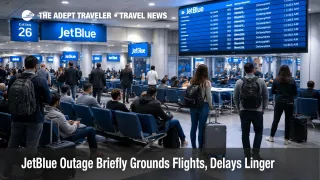
JetBlue flight outage delays became a real overnight travel issue on March 10, 2026, when the Federal Aviation Administration briefly halted all JetBlue departures at the airline's request after an internal system problem. The stop was lifted within about an hour, but that does not make the story operationally meaningless. The main traveler risk has now shifted from the stop itself to same day recovery, especially for passengers starting at JetBlue heavy airports such as John F. Kennedy International Airport (JFK) and Boston Logan International Airport (BOS). Travelers flying JetBlue on Tuesday should check flight status before leaving for the airport and treat tight connections as weaker than they looked the night before. The key change from the initial alert is that flights are moving again, but aircraft and crews still need to be repositioned. That is where small overnight disruptions often turn into morning and midday schedule friction.
JetBlue and the FAA have confirmed the outage and the short duration of the stop, but JetBlue has not publicly detailed what system failed. That matters because travelers can verify that operations resumed, but they cannot yet judge from public information whether the issue was narrow, broad, or likely to recur later in the day.
JetBlue Flight Outage Delays: What Changed
The confirmed facts are straightforward. The FAA said it briefly grounded JetBlue flights early Tuesday after a request from the airline, and both AP and Reuters reported the halt was lifted in roughly 40 minutes to an hour once the problem was resolved. JetBlue said only that a brief system outage had been resolved and operations had resumed. Flights already airborne were allowed to continue, which limited the damage compared with a broader network shutdown. Still, a national departure pause, even a short one, matters for a carrier built around dense early morning banks and frequent turns.
For travelers, the practical implication is that this is not a full day collapse story. It is a network timing story. A short stop in the middle of the overnight and pre dawn operating window can leave aircraft out of position, compress crew assignments, and reduce schedule margin at the first few major banks of the day. That is why the biggest Tuesday exposure is less about whether JetBlue is flying at all, and more about whether a specific flight still lines up cleanly with its aircraft, gate, and onward passenger connections.
Which Travelers Face the Most Disruption
The most exposed passenger is not every JetBlue customer equally. It is the traveler on the first half of Tuesday's schedule at JetBlue dominated airports, especially New York and Boston, or anyone depending on a short same day connection through the carrier's core network. JetBlue's own public tools direct travelers to check status by route or flight number, which is the right move here because disruption from a short outage tends to show up unevenly across the schedule rather than as one systemwide cancellation wave.
A traveler on a later nonstop may feel very little. A traveler trying to connect from the Northeast to Florida, the Caribbean, Latin America, or the West Coast on a narrow buffer may feel a lot more. That is because the first order effect is delayed departures. The second order effect is broken onward timing, missed connection windows, and thinner reaccommodation once the first bank slips.
This is also a useful moment to separate airport wide disruption from carrier specific disruption. The outage does not appear to be a general FAA system failure or a broad U.S. airport shutdown. It is a JetBlue specific operational problem that briefly required FAA action. That makes airport choice less important than airline exposure. A traveler at JFK or Boston on another carrier is not in the same position as a traveler there on JetBlue.
What Travelers Should Do Now
JetBlue passengers flying on March 10 should check the airline's flight status tools before heading to the airport, then check again before leaving home or the hotel if the trip starts later in the day. If your itinerary includes a short connection, a cruise embarkation, a hard tour departure, or the last practical flight of the day, protect time instead of assuming the early recovery will hold. A delay of 20 or 30 minutes on the first segment can still break the day if it lands in the wrong place.
Rebook early if your itinerary cannot absorb slippage and you still see viable earlier or nonstop options. Wait if you are on a later nonstop, have flexible plans, or can tolerate arriving somewhat late. The tradeoff is simple, preserving the original booking may save money or hassle, but changing earlier can preserve the actual purpose of the trip.
For broader same week context on how March air travel is already carrying less slack than normal, Flight Delays and Airport Impacts: March 9 and U.S. Air Traffic Control Privatization: Reality Check are useful background. The first explains why spring demand and daily flow friction are already making recovery harder, and the second helps explain why small disruptions can propagate faster across a dense U.S. aviation network.
Why the Disruption Spreads Through Travel
A short airline system outage does not need to last all day to matter all day. Airlines run on tightly sequenced aircraft turns, crew pairings, gate assignments, and connection banks. When departures are paused, even briefly, the first direct consequence is obvious, some flights leave late or do not leave at all. The less obvious consequence is that the whole sequence behind them becomes less orderly.
That propagation is why these stories matter even when the headline sounds modest. A single delayed aircraft can become a late inbound for the next route, a missed crew connection for the next rotation, or a broken same day itinerary for passengers who built around a narrow transfer window. That is also why the best traveler response is not panic. It is targeted caution. Tuesday's JetBlue issue looks more like a recoverable operational disruption than a prolonged shutdown, but recoverable does not mean friction free. Travelers who monitor status closely, avoid unnecessary connection risk, and make early decisions where needed should be in better shape than those who assume the outage ended when the ground stop did.