

Nepal Lifts Movement Limits, Vote Count Risk Remains
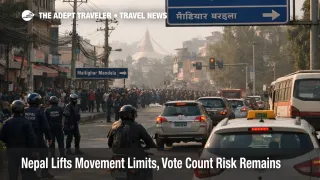
Nepal election travel disruption has shifted, not disappeared. The U.K. Foreign, Commonwealth & Development Office, or FCDO, said restrictions on movement imposed around Nepal's March 5, 2026 election have been lifted, but it also warned that protests, political violence, curfews, and broader travel disruption can still follow as votes are counted, results are announced, and a new government takes shape. For travelers, that means Nepal is easier to move around than it was during the restriction window, but Kathmandu, Nepal is not back to normal operating conditions yet, especially near political flashpoints and major transfer corridors. The FCDO is now pairing that lift with a specific warning on ongoing vote count and government formation risk, while also flagging a practical safety valve for stranded foreign nationals, a no cost visa extension at the airport if flights were disrupted.
Nepal Election Travel Disruption: What Changed
What changed is the legal versus practical picture. The formal movement restrictions linked to the March 5 election have been lifted, but the FCDO says there is still a risk of protests, political violence, clashes, increased police presence, short notice curfews, and travel disruption tied to vote counting, results, and coalition building. It specifically tells travelers to stay away from vote counts, rallies, demonstrations, political party offices, and the Maitighar Mandala area of Kathmandu.
That matters because the post election phase is now the unstable phase. Reuters reported before the vote that Nepal entered this election after months of political upheaval and repeated changes in government, while the Associated Press said counting continued after polling closed, with ballot boxes still coming in from remote areas and crowds gathering outside counting centers in Kathmandu as results were processed. In plain terms, the fixed restriction window ended, but the political pressure window did not.
Travelers also have a small but important administrative cushion. The FCDO says the Nepal Immigration Department has indicated that foreign nationals whose visas expired because of travel disruption can receive a visa extension without cost until flights are rescheduled, and that this should be arranged at the airport. That is unusually useful in a disruption story because visa stress can become a second crisis after a missed flight or delayed departure.
Which Travelers Face the Most Disruption
The most exposed travelers are the ones relying on timed urban movements in Kathmandu. That includes hotel to airport transfers, same day domestic connections, intercity bus departures, and itineraries that depend on moving through central Kathmandu on a tight clock. Tribhuvan International Airport (KTM) remains the country's main international gateway, so even when the airport itself is operating, city side delays can still break the trip. Travelers following this situation should also see your related coverage, Nepal Election Disruption Hits Kathmandu Transfers, and your airport page for Tribhuvan International Airport (KTM).
Leisure travelers heading into Thamel, Durbarmarg, or central sightseeing districts are more exposed than trekkers already outside the capital. So are travelers using Nepal as a short stopover, because their margins are thinner. A one night Kathmandu stay before an international departure, or a same day transfer from an inbound international flight to a domestic sector, now carries more risk than the headline about lifted movement limits suggests.
Foreign nationals already bumped by wider air disruption face a different problem. Their main risk is no longer just missing the flight, it is getting stuck in a document compliance loop if delays extend their stay. The airport visa relief helps, but only for disruption affected cases, and travelers should not assume it replaces normal extension rules for elective changes of plan. Older U.S. State Department guidance says airport immigration normally is not authorized to extend visas, which makes this current election and disruption related relief look like an exception, not a standing rule.
What Travelers Should Do Now
Travelers in Kathmandu should build more buffer than usual for any airport run, domestic connection, or intercity handoff over the next 24 to 72 hours. Avoid routing near Maitighar Mandala and other political gathering points, even if the city feels calm when you set out. In unrest stories, roads fail faster than terminals, so the real vulnerability is often the journey to the airport, not the departure board itself.
Rebook or simplify the itinerary if you are depending on a same day domestic connection, a narrow airport arrival window, or an overnight visa deadline with no slack. Wait and monitor if you are already in a hotel near the airport, have a flexible fare, or have at least half a day of buffer before the next critical segment. This is a situation where paying a little more for margin can protect the whole trip. The tradeoff is straightforward, save money on a tight connection, or save the itinerary by buying time.
If your flight disruption threatens your visa validity, do not leave this to the last minute. Bring airline disruption evidence, arrive early at the airport, and confirm the process directly with immigration staff before check in. Also monitor local media, your airline, and hotel desk updates because curfews, rallies, or police surges can change the operating picture quickly even after a relatively calm morning.
Why Nepal Is Easier To Move Through, But Not Stable Yet
The mechanism here is simple. Election day restrictions are a rule based control. Post election disruption is a behavior based risk. Once ballots are being counted and parties start reacting to early results, the pressure shifts away from the formal voting window and toward symbolic spaces, counting centers, party offices, and major city corridors. That is why an official restriction can end while the practical travel risk remains elevated.
The first order effect is local, road slowdowns, protest avoidance, police controls, and possible curfews in Kathmandu. The second order effect is what travelers actually feel, missed airport transfers, broken domestic flight chains, delayed tours, extra hotel nights, and visa problems for anyone whose outbound schedule slips. The airport visa relief is important precisely because it interrupts one of those second order failures before it turns into a legal problem.
The bottom line is that Nepal is more navigable than it was during the March 5 restriction period, but not reliably normal yet. Until vote counting finishes, results settle, and government formation becomes clearer, travelers should treat Kathmandu as an operationally fluid city where the safest plan is the one with extra time, flexible routing, and a backup for the airport run.
Sources
- Nepal Travel Advice, GOV.UK
- Nepal to vote in first election since Gen Z-led protests toppled government, Reuters
- Nepal officials count votes after historic parliamentary election, AP News
- Nepal Election Disruption Hits Kathmandu Transfers, The Adept Traveler
- Tribhuvan International Airport (KTM), The Adept Traveler