

London Al Quds Ban Shifts Sunday Travel Risk
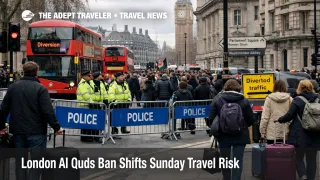
London's Sunday disruption picture changed on March 11, 2026, but it did not disappear. The Metropolitan Police said the Home Secretary approved a one month ban on the planned Al Quds march and any associated counter protest marches, while organizers indicated they still intend a static protest on Sunday, March 15. For travelers, that matters because a banned march can still become a busy central London operations problem when crowds, police cordons, bus diversions, and pedestrian pinch points shift into a smaller footprint rather than spreading along a longer route. The smart move is to treat Westminster and the government corridor as a slower moving zone on Sunday afternoon, not assume the ban removed the need for buffers.
This is a format change, not a clean risk removal. March style events in central London often create the most pain not for people attending them, but for hotel arrivals, sightseeing plans, airport transfers, and short surface hops that cross the same streets at the wrong time. Transport for London already tells travelers to leave extra time when works or events affect journeys, and Sunday visitors should apply that rule here, especially if they are moving with luggage or timed tickets.
London Sunday Travel Risk: What Changed
What changed since earlier expectations is the protest geometry. The Met says the march and associated counter marches are banned from 4:00 p.m. on Wednesday, March 11, for one month, but that does not ban all protest activity. Reporting on organizers' revised plan points to a static protest instead, centered on the Home Office at 2 Marsham Street in Westminster. That shifts the likely traveler problem from rolling route disruption across a wider path to denser crowding and tighter police management in and around the Westminster government zone.
In practical terms, that usually means the highest friction moves closer to where police need to separate groups, manage access, and hold space for safety. For Sunday visitors, that puts the risk focus around Marsham Street, Millbank, Parliament Square, Whitehall, and nearby bridge approaches rather than assuming a longer march corridor through central London. The ban lowers route length, but it can raise local intensity.
Which Central London Trips Look Most Exposed
The most exposed traveler is not necessarily staying near the protest, but crossing it. Hotel check ins around Westminster, coach drop offs, hop on hop off bus plans, and taxi journeys between the West End, Victoria, Waterloo, and the South Bank are the soft targets here because each depends on roads and curbs that can be managed dynamically. Adept's earlier London protest September 6, Westminster and Whitehall alerts and London March for Palestine, Westminster closures linger showed the same operating pattern, police cordons and bridge or corridor friction can slow trips even when Tube service continues.
The weaker Sunday itinerary is the one built on tight timing. That includes matinee and timed attraction bookings, rail departures from nearby terminals after a central London stop, and airport runs that rely on a taxi threading through Westminster in mid afternoon. Travelers heading to London Heathrow Airport (LHR) or London City Airport (LCY) are better off anchoring their trip on rail outside the hot zone than assuming a direct surface transfer will hold. TfL's standing advice is to check live conditions and leave more time when events affect travel, and that is exactly the right frame here.
What Travelers Should Do On Sunday, March 15
The best immediate move is simple, avoid unnecessary surface trips through Westminster from late morning into early evening on Sunday, March 15. If you are sightseeing, stack Westminster Abbey, Parliament, Whitehall, Trafalgar Square, and South Bank plans either earlier in the day or on another date. If you are checking into a central hotel, arrive before protest activity builds or come in by rail to a station outside the densest zone, then walk the final stretch if conditions are calm enough.
The replan threshold is not ideological, it is operational. Rework the journey if you have luggage, a timed tour, an airport run, mobility constraints, or a schedule with less than 45 to 60 minutes of slack. Waiting and hoping is reasonable only for flexible leisure walking in central London, where a detour is annoying rather than trip breaking. For airport transfers, the tradeoff is straightforward, rail first usually beats road first when police may hold traffic or divert buses.
What to monitor next is narrow but important. Watch Metropolitan Police updates for protest conditions and location details, and check TfL's live traffic and service tools before departure and again while en route. This story is now about dynamic management, not just one fixed closure notice. That means the cleanest Sunday plan is a flexible one, shorter road exposure, more walking tolerance, and more buffer than you would normally use for central London. Travelers already navigating other UK friction points, including document checks covered in UK ETA Enforcement Blocks Boarding for Visa Free Visitors, should keep the same mindset here, protect the trip first, then optimize convenience.
Why A Static Protest Can Still Disrupt London
The mechanism is simple. A march spreads disruption over distance, while a static protest concentrates it. Police do not just manage the protest site itself, they manage separation, entrances, exits, nearby junctions, and any counter protest activity that can change crowd direction or require extra cordons. The Met made clear that associated counter protest marches were part of the risk calculation behind the ban, and Reuters reported police still expect a difficult weekend picture even with a static assembly under strict conditions.
That concentrated footprint matters more for travelers than the politics of the event. A static gathering near Westminster can jam buses, slow cabs, narrow pedestrian space, and create intermittent access controls near one of the city's most visitor heavy corridors. TfL's own event guidance is built around exactly this reality, major events and works can change journeys quickly, so travelers should plan around the zone, not through it. The main risk is not citywide shutdown. It is localized friction at the wrong place and time.
Sources
- Statement on Al Quds march, Metropolitan Police
- Major works and events, Transport for London
- Traffic status updates, Transport for London
- Shabana Mahmood approves police request to ban al-Quds march in London, The Guardian
- UK police ban pro-Iranian London march due to 'extreme tensions', Reuters
- Everything we know about the Al Quds march in London, The Standard