

Spirit Pilot Recall Signals A Tighter Summer 2026 Network
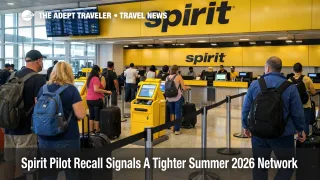
Spirit Airlines has started recalling about 500 furloughed pilots, a concrete sign that its bankruptcy era staffing cuts may have gone too far for the operation it now needs to run into summer 2026. Reuters reported the notices went out on Monday, March 10, while Spirit's February 24 restructuring update said the airline still expects to emerge from Chapter 11 in late spring or early summer. For travelers, this is not a return to the old Spirit. It is a signal that the carrier is trying to stabilize a smaller network after attrition ran higher than expected, which matters because thin staffing at a smaller airline usually means fewer recovery options when flights slip or cancel.
The more important operational point is what changed since late February. At that point, Spirit had lender backing for an exit plan and a target to cut debt and lease obligations from about $7.4 billion to roughly $2.1 billion after emergence. Now there is fresh evidence that staffing has become part of the near term constraint, not just financing. That does not mean a broad rebuild is underway. It means Spirit appears to need more pilots to cover the schedule it intends to keep, especially as it heads toward stronger spring and summer demand.
Spirit Pilot Recall: What Changed for Summer 2026 Travelers
The immediate change is straightforward, Spirit told Reuters that 500 furloughed pilots received recall notices, and CNBC, cited by Reuters, said the driver was higher than expected attrition. That matters because attrition is different from a planned staffing cut. A planned cut can be matched to a smaller schedule. Unexpected pilot losses can leave an airline short in specific crew categories, bases, or fleet assignments, even if the airline is still flying fewer routes overall.
For booked passengers, the traveler takeaway is not that Spirit is suddenly expanding. It is that the airline is shoring up a reduced operation ahead of a busy season. That can be mildly positive for reliability if the recalls translate into better coverage, but it also underscores that Spirit remains a leaner carrier with less slack than before bankruptcy. Travelers who are flying Spirit on a route with only one daily frequency, or who are building in a same day cruise, event, or self connection, should still treat the schedule as less forgiving than a large network carrier's.
This update also sharpens the labor picture. Spirit had already furloughed pilots in waves during the restructuring, and Reuters reported in October 2025 that the airline also planned to furlough about 1,800 flight attendants. One detail worth correcting from the initial framing, it is no longer accurate to say it is entirely unclear whether any flight attendants would return. Spirit and the Association of Flight Attendants said in February that 500 flight attendants were being recalled, but there has been no verified broader recall announcement for the remaining furloughed group.
Which Spirit Travelers Face the Most Exposure
The highest exposure is on routes where Spirit is the cheap nonstop and there is no easy same day backup. Bankruptcy does not automatically ground flights, but it tends to reduce flexibility, because the airline trims aircraft, frequencies, staffing buffers, and marginal routes at the same time. Spirit has already moved to shrink its fleet, cut underperforming flying, and sell some assets as part of the turnaround. That makes the operation simpler, but it also leaves travelers with fewer self rescue options when something goes wrong.
The most vulnerable trips are short leisure breaks, cruise departures, weddings, and separate ticket itineraries where one late or canceled segment breaks the entire plan. The same goes for travelers originating in smaller or secondary markets where Spirit used to pressure fares and offer multiple frequency options. In those markets, even if Spirit keeps service, the schedule may be thinner and reaccommodation choices weaker than they were before the second Chapter 11 filing in August 2025.
There is also a commercial angle here. Spirit says it wants to become profitable by 2027 by focusing on peak travel periods, higher aircraft utilization, and expanded premium seating, including first class style and premium economy style products. For travelers, that means the airline is increasingly optimizing around periods and routes where demand is strongest, not around maintaining broad network coverage for its own sake. Summer 2026 may therefore bring a more stable Spirit in core leisure markets, while weaker shoulder period and marginal market flexibility stays limited.
What Travelers Should Do Now
If you already hold a Spirit ticket for late spring or summer 2026, the right move is not to panic, but to audit how much slack your itinerary has. A nonstop on Spirit that gets you in a day before a cruise or resort check in is a different risk profile from a same day arrival tied to a prepaid tour, a wedding, or a separate onward booking. Where the trip is time critical, paying more for a schedule with multiple same day backup options may still be the cheaper decision once you price in hotel loss, missed deposits, and last minute rebooking risk.
If you have not booked yet, compare Spirit by route, not by brand. On dense core leisure routes, the airline may be perfectly usable if the fare gap is real and you can tolerate modest schedule risk. On thin routes, or on trips where disruption costs would be high, waiting for a lower fare can be a false economy. The tradeoff is simple, Spirit may still win on price, but it is not operating with the same cushion it had before repeated restructuring cuts.
Over the next several weeks, watch three things. First, whether Spirit keeps talking about pilot and flight attendant recalls, because that will tell you whether labor pressure is easing or still biting. Second, whether court and lender milestones stay on track for a late spring or early summer Chapter 11 exit. Third, whether your specific route shows further frequency cuts or timing changes. Earlier Adept coverage on Spirit Airlines Lender Deal Targets Summer 2026 Exit and Spirit's plan: slash fleet, retrench network in Chapter 11 remains useful context, because this pilot recall fits that same pattern, smaller airline, narrower network, tighter recovery margin.
Why Spirit Is Recalling Pilots Instead of Rebuilding Broadly
The mechanism here is narrower than a growth story. Spirit is not recalling pilots because bankruptcy is over. It is recalling pilots because the airline appears to need more staffing to support the operation it expects to run while it finishes restructuring. Reuters reported higher than expected attrition as the immediate trigger. In plain language, enough pilots appear to have left that the original staffing model no longer fit the schedule cleanly.
That matters because staffing friction spreads quickly through a lean airline. First order, too few pilots can raise cancellation risk, limit recovery after weather or maintenance disruptions, and constrain schedule design. Second order, that can increase missed onward plans, hotel costs, and fare pressure on competing airlines in markets where Spirit has already cut capacity. This is why a pilot recall is more than a labor footnote. It is an operating signal from an airline still trying to emerge as a smaller, more profitable version of itself.
Sources
- Spirit Airlines recalls furloughed pilots as it prepares to emerge from bankruptcy, Reuters
- Spirit Airlines Reaches Agreement in Principle on Key Terms of Restructuring Support Agreement with Its Secured Creditors, Spirit Airlines Investor Relations
- Spirit Airlines files for second bankruptcy in a year as financial challenges persist, Reuters
- Spirit Airlines to furlough another 365 pilots amid restructuring, Reuters
- Spirit Recalls 500 Flight Attendants, Association of Flight Attendants-CWA