

Air New Zealand Cuts 1,100 Flights Through Early May
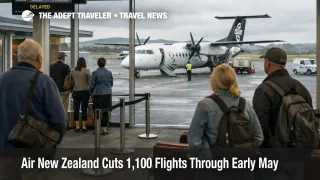
Air New Zealand is no longer treating the Gulf driven fuel shock as only a pricing problem. On Thursday, March 12, the carrier said it will cut about 5 percent of its schedule, around 1,100 services, through early May, and reaccommodate about 44,000 customers. That matters most for domestic and regional New Zealand travelers, because the airline says most of the cuts fall there, while it tries to keep more long haul flying, especially U.S. services that now help funnel Europe bound demand around Middle East airspace disruptions. Travelers with regional feeders into international trips should stop treating this as a routine timetable trim and start treating it as a connection risk problem.
This is the next step after the earlier fare move covered in Middle East Fuel Spike Lifts Qantas, SAS, Air NZ Fares. The difference now is harder on travelers, because capacity is being removed, not just repriced. It also fits the broader pattern outlined in Asia Europe Bypass Fares Spike on Replacement Routes, where Gulf disruption is pushing long haul demand onto alternative corridors and making every feeder miss more expensive to fix.
Air New Zealand flight cuts are thinning frequencies, not killing routes
Air New Zealand chief executive Nikhil Ravishankar said the carrier is consolidating flights rather than abandoning routes outright, and local reporting indicates the reductions run from Sunday, March 16, through Sunday, May 3, 2026. That distinction matters. A route may still exist on paper, but once daily or near daily frequency gets cut back, the practical value of that route drops fast for anyone trying to protect a same day connection, a tour join, or a timed family holiday.
The most exposed places identified so far are regional markets where frequency matters more than raw seat count. Reuters reported that airports serving Marlborough and New Plymouth would see service reductions. New Zealand reporting adds more texture. In Tauranga, local officials said Auckland service would be reduced by 31 rotations, Wellington by 21, and Christchurch by three during the March 16 to May 3 window, while keeping full capacity during the April school holidays. In Marlborough, Mayor Nadine Taylor said Blenheim links to Wellington would be reduced three times per week, with nine rotations cut on the Auckland side. Gisborne to Auckland was also identified for reductions, while Timaru was reported as not affected.
The key travel point is that smaller domestic and regional links now become the weak joint in longer itineraries. Missing a regional feeder into an international gateway is not just an airline inconvenience when bypass routes are already under pressure. It can turn into a hotel loss, a missed cruise embarkation, a broken self connect, or a forced overnight repositioning in Auckland or Wellington. That second order effect is why this story matters well beyond New Zealand domestic travelers alone.
Regional New Zealand routes face the highest Easter pressure
The timing is bad. New Zealand school holidays for Term 1 run from Friday, April 3, to Sunday, April 19, 2026, and Good Friday falls on April 3, with Easter Monday on April 6. Term 2 then starts on Monday, April 20, and Anzac Day is observed on Monday, April 27. In other words, Air New Zealand is cutting flights right through one of the most connection sensitive leisure windows on the domestic calendar.
That makes the most exposed traveler segment fairly clear. It is not only the person flying Tauranga to Auckland or Blenheim to Wellington. It is the traveler stacking a regional sector onto a long haul trip, a family trying to lock in Easter plans without much flexibility, and anyone relying on a same day hop before a cruise, guided tour, sports event, or nonrefundable stay. The airline says it is focusing cuts on lower demand and mostly off peak services, but that still leaves passengers with fewer recovery options when something slips on the day.
A useful way to think about this is frequency versus capacity. Air New Zealand is trying to preserve connectivity, not schedule convenience. For a traveler, that means the route may still be bookable, but the safety margin is thinner. The smaller the market and the fewer the daily departures, the faster the trip becomes fragile.
Why Air New Zealand is protecting U.S. long haul flows
Air New Zealand has been blunt about the network logic. Ravishankar said fewer long haul flights would be cut because U.S. routes have become a more popular stopover path for Europe bound travelers while Middle East airspace remains constrained. That is a rational network choice. When carriers cannot rely on the Gulf as a normal east west bridge, they protect the flying that keeps the biggest amount of high value traffic moving, even if that means trimming thinner regional frequencies at home.
The fuel math also helps explain why this is happening now. Air New Zealand told investors on March 10 that jet fuel, previously around US$85 to US$90 per barrel, had jumped to roughly US$150 to US$200, and that the airline remains exposed to swings in the crack spread even with crude hedging in place. It had already raised fares and warned that schedule changes could follow if the market stayed unstable. Two days later, that warning became a published network cut.
For travelers, the practical meaning is simple. Air New Zealand is trying to preserve long haul utility where it can still sell and reroute effectively, especially on U.S. linked flows, while shaving domestic and regional flying where it sees more room to consolidate. That protects some international demand, but it also makes feeder strategy more important than usual. On a disrupted network, the domestic leg becomes the part most likely to wreck the rest of the trip.
What travelers should do before April peaks
Anyone booked on a regional New Zealand flight between March 16 and May 3 should check whether the trip depends on a same day onward segment. If it does, the threshold for proactive change is lower now. A one ticket itinerary with a comfortable connection is still safer than a self connect, but even protected connections deserve more buffer when regional frequency is being trimmed. For cruise joins, tours, weddings, and long haul departures that cannot slip, an overnight near the international gateway is now easier to justify than it was a week ago.
Travelers flying during the April 3 to April 19 school holiday window, or around the April 3 to April 6 Easter break and the April 27 Anzac observance, should lean toward earlier decisions, not later ones. Waiting may still work for a standalone domestic leisure trip where multiple alternatives remain the same day. It is a weaker bet for regional feeders, limited frequency airports, or trips with expensive onward components. The right question is not whether the airline can reaccommodate you eventually. It is whether the rebooked option still protects the rest of your plan.
Over the next 24 to 72 hours, watch for three signals. First, whether Air New Zealand publishes more route level detail beyond the regional reductions already surfaced locally. Second, whether other South Pacific and Australian carriers deepen schedule action rather than just keeping fares high. Third, whether bypass demand via the United States stays strong enough to keep long haul capacity protected while domestic frequency takes the hit. Until those signals improve, travelers should assume that New Zealand regional flying is now part of the wider Gulf disruption story, not separate from it.