

Asia Europe Bypass Fares Spike on Replacement Routes
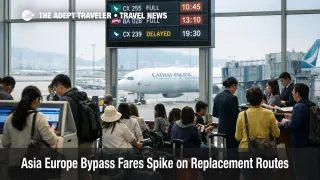
Asia Europe replacement fares hardened again on March 10, 2026, and the practical change for travelers is that the workaround is now expensive enough to become its own problem. Reuters reported that Cathay Pacific showed no economy seats from Hong Kong to London until March 11, with the first available one way fare above HK$21,000 before prices eased later in the month. That matters because the Gulf is still not functioning as a normal bridge between Asia and Europe, so travelers who need to move now are competing for a smaller pool of seats on replacement corridors. Travelers with departures in the next 72 hours should treat this as an inventory and budget problem at the same time, not just a routing problem.
This is an update story. Our earlier article Middle East Airspace Closures Raise Asia Europe Fares established that Gulf hub outages were shrinking capacity and pushing traffic onto East Asia, Southeast Asia, India, and U.S. routings. What changed now is the consumer proof point. The fare spike is no longer just a broad market warning. It is visible on named replacement routes, with Cathay also saying it will add extra passenger flights to London and more capacity to Zurich in March to meet stronger Europe demand.
The near term traveler takeaway is blunt. Last minute Asia to Europe trips are still possible, but the cheapest workable path may no longer be the fastest or cleanest one. Some travelers will end up trading a simple one stop Gulf itinerary for a pricier seat via Hong Kong or Delhi, a longer journey, or a premium cabin they never planned to buy. Others may need to shift their European arrival city to where relief capacity exists, then finish by rail or a separate short haul segment.
Asia Europe Replacement Fares: What Changed
The newest evidence is concentrated on the London side of the market, which makes sense because London Heathrow Airport (LHR) is one of the biggest long haul endpoints for displaced Asia Europe traffic. Reuters reported that Cathay Pacific had no economy seats on Hong Kong International Airport (HKG) to Heathrow until March 11, and that the first available one way fare that day was above HK$21,000. Reuters also reported that those prices dropped later in March, which is an important signal that this is a near term capacity crunch, not a permanently reset market.
The same day, Reuters also reported a second pressure layer, fuel. Jet fuel has surged from roughly $85 to $90 per barrel before the crisis to about $150 to $200, and several airlines including Qantas Airways, SAS, and Air New Zealand have already started raising fares elsewhere in their networks. That matters because even when carriers can keep Asia Europe flying, the operating cost base is getting worse at the same time the usable route map is getting smaller.
There are some relief valves, but they are selective rather than broad. Cathay said it will run extra London flights and add Zurich capacity in March, while Air India said it will operate 78 additional flights between March 10 and March 18 on routes including Delhi to London, Mumbai to London, Delhi to Frankfurt, Delhi to Amsterdam, Delhi to Paris, and Delhi to Zurich. That is useful, but it does not recreate the lost depth of the Gulf connection system. It only gives travelers a few more doors to push on.
Which Travelers Are Paying the Biggest Premium
The most exposed travelers are those trying to book within a few days of departure, especially on major Europe gateways like London where replacement demand is deepest. Business travelers, urgent family travelers, and anyone trying to salvage a partially broken itinerary are the people most likely to face the worst pricing, because they cannot wait for later-month inventory to reappear.
A second group at risk is travelers who were counting on Gulf hubs for value rather than only convenience. When Emirates, Qatar Airways, and Etihad style one stop options stop behaving normally, the remaining seats through Hong Kong, Singapore, India, or other bypass points become more valuable very fast. The result is that an itinerary that was supposed to be an affordable economy trip can turn into a premium economy or business purchase simply because those are the only cabins left on the needed day.
A third group is travelers who have some flexibility, but not enough to wait out the whole disruption. They may still find workable value by changing city pairs rather than insisting on one exact route. Air India's added Europe capacity makes Delhi a more usable rebuild point for London, Frankfurt, Amsterdam, Paris, and Zurich, while Cathay's added London and Zurich lift suggests Hong Kong remains one of the more important East Asia relief nodes. For that reason, the best available trip may be Asia to Zurich or Frankfurt now, then a shorter onward move to the final destination. Adept's Air India Rescue Flights Get Dates Through March 18 coverage is useful here because it lays out the dated windows rather than vague promises of extra seats.
What Travelers Should Do Before Booking
For departures in the next 72 hours, price the whole problem, not just the headline flight. A slightly cheaper fare into a secondary European city may be the better decision if it gets you moving today and avoids another night of hotel costs, missed tour dates, or change fees on onward segments. On the other hand, if your trip can slide by several days, Reuters' later-month pricing signal suggests waiting can still save a meaningful amount.
For travelers who must go now, avoid over-optimizing around one perfect endpoint. Search by corridor first, then destination second. In practice, that means testing London, Zurich, Frankfurt, Amsterdam, and Paris as interchangeable arrival points where your ground or short haul follow on cost stays manageable. It also means giving more weight to routes with published added capacity, because those are the few places where supply is actually expanding instead of just being shuffled around.
For travelers who can wait, the decision threshold is simple. Wait if your trip is discretionary and your fare has jumped into territory that makes the whole itinerary poor value. Rebook now if you have a fixed date, a cruise, a tour start, or a business reason that makes arrival certainty more important than fare discipline. Over the next 24 to 72 hours, watch whether extra London and Zurich seats from Cathay, and the March 10 to March 18 Air India additions, remain bookable at sane prices. If those relief lanes fill, the next pricing wave is likely to spread into more secondary city pairs.
Why Workaround Routes Are Pricing This Hard
The mechanism is not mysterious. Gulf hubs normally do two jobs at once, they connect massive volumes of travelers, and they create fare competition by pooling lots of seats into one transfer system. When that system breaks, demand does not disappear. It concentrates into fewer alternative corridors, and the most desirable seats vanish first. That is why the immediate spike shows up on practical replacement lanes like Hong Kong to London instead of everywhere at once.
The second order effect is broader than airfare alone. Higher replacement fares push some travelers into longer stopovers, different cabins, different arrival cities, and extra hotel or rail costs that do not show up in the base fare headline. They also put more pressure on secondary gateways that were not built to absorb the same volume of displaced long haul traffic the Gulf can normally handle. EASA's current conflict zone advisories still show suspended or active restrictions tied to Iran, Iraq, Lebanon, and wider Middle East and Persian Gulf airspace, which helps explain why this remains a network problem rather than a one day pricing blip.
The recovery signal to watch is not one cheap fare. It is whether airlines can keep adding stable, published capacity on bypass routes, and whether those added seats start pulling prices down across multiple city pairs rather than only on isolated dates. Until that happens, Asia Europe replacement fares will stay exposed to the same two forces that created this spike in the first place, constrained routing and expensive operations.
Sources
- Airline ticket prices soar on Asia-Europe routes after Gulf airport closures
- Airlines hike ticket prices as Iran war propels fuel costs
- Price hikes, outlook cuts, What airlines are doing as fuel costs surge
- The Cathay Group's Operations to the Middle East
- Air India to operate additional flights to Europe and the United States amid ongoing situation in west Asia
- Conflict Zones Advisories