

London Protest Ban Shifts March 15 Access Risk
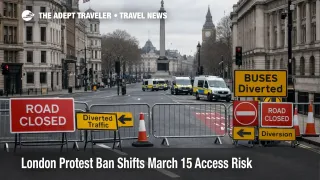
London visitors should treat Sunday, March 15, 2026, as a managed access day in Westminster, not a normal sightseeing Sunday. The Metropolitan Police says the Home Secretary approved a one month ban, effective from 4:00 p.m. on March 11, on the Al Quds march and any associated counter protest marches, but police also said a static assembly cannot be banned and will face strict conditions. The practical change for travelers is that disruption may compress rather than disappear, especially around government buildings and the central ceremonial corridor. If you have a Sunday arrival, a West End matinee, a museum slot, or a rail connection through central London, build more buffer and avoid tight surface transfers in Westminster.
This is a London protest travel disruption story because the operating pattern has shifted from a moving march to a fixed demonstration footprint, while central London is already hosting the Mayor's St Patrick's Festival and parade on the same day. That combination raises the odds of localized crowding, police cordons, bus diversions, and slower hotel or attraction access even if the original protest route is off the table.
London Protest Travel Disruption, What Changed
What changed since prior expectations is not that protest risk vanished, but that the Met and the Home Secretary blocked a march format and left open only a tightly conditioned static assembly. Police said this is the first time they have used this power since 2012, warned of a "challenging, potentially violent weekend," and said anyone attempting to form or join a march could face arrest. For travelers, that matters because static protests usually shrink the geographic footprint, but they can intensify congestion in a smaller area when police create fixed cordons, control points, and separation zones for opposing groups.
The likely traveler problem area remains central Westminster. The Met statement only says "the area," not an exact assembly site, and police had not published the final static protest conditions in the material reviewed here. However, the organizer had previously advertised a Sunday, March 15 gathering at the Home Office on Marsham Street in Westminster before the march ban, so travelers should treat the Westminster government corridor as the most exposed zone until police publish something more specific. That means Whitehall, Parliament Street, Great Scotland Yard, Horse Guards Avenue, and approaches toward Trafalgar Square deserve extra caution.
Which London Plans Face the Most Friction
The biggest exposure is for travelers moving through the overlap between Westminster security activity and the city's St Patrick's program. London City Hall says the St Patrick's Festival runs in Trafalgar Square from 1200 p.m. to 600 p.m. on Sunday, March 15, with the parade starting at noon from Hyde Park, then running via Piccadilly, Piccadilly Circus, Regent Street St James's, and Cockspur Street before passing Trafalgar Square and ending at Whitehall. Road closures start from 500 a.m. on Pall Mall East, with additional central closures from 900 a.m. or 1100 a.m. across Piccadilly, Regent Street St James's, Cockspur Street, Whitehall, Haymarket, Strand, Northumberland Avenue, Parliament Street, Whitehall Place, and Horse Guards Avenue, with parade closures due to reopen at 400 p.m.
That overlap changes the traveler map. A moving march would normally drag disruption across a route over time. A static assembly can be easier to route around in theory, but only if it sits away from other major events. Here, the likely protest zone and the confirmed festival and parade zone sit in or beside the same government and West End corridor, so crowd management can stack instead of spread. Theatergoers, Trafalgar Square visitors, National Gallery visitors, Charing Cross rail users, and anyone relying on taxis or ride hails to central hotels are more exposed than travelers staying farther east in the City or farther west beyond Hyde Park.
What Travelers Should Do On March 15
For Sunday arrivals and timed plans, the cleanest move is to use rail or Tube for the last leg and walk the final stretch if needed, rather than depending on a car through Westminster. City Hall identifies Westminster Underground Station as the nearest step free station for Trafalgar Square, and Charing Cross as the closest Tube and rail station, but both can become pinch points when events and policing overlap. If your hotel sits near Whitehall, Trafalgar Square, Parliament Street, or Marsham Street, assume vehicle access may be slower or temporarily redirected.
Rebook or shift plans if your schedule depends on arriving in Westminster or the West End by car during the middle of the day, especially from late morning through late afternoon. Waiting may be reasonable if you are already in London and your plans are flexible, but it is the wrong bet for airport transfers, prepaid attraction slots, Sunday lunch bookings, or theater tickets tied to a narrow arrival window. In this setup, saving money by keeping a tight surface itinerary can easily cost more in missed reservations and reactive taxi changes. That tradeoff is the main decision point.
Over the next 24 to 72 hours, watch three things, the Met's final conditions for any static assembly, TfL live travel updates, and any event guidance from venues in Trafalgar Square, Whitehall, or the Westminster government district. For broader context on how central London demonstrations can keep Westminster access uneven even after the main movement changes, see London March for Palestine, Westminster closures linger. The right assumption for now is simple, London protest travel disruption on March 15 is likely to be localized, but still very real.
Why The Risk Persists After The March Ban
The mechanism is straightforward. A march ban removes the long moving ribbon of disruption that can snarl multiple districts in sequence, but it does not remove the policing burden when organizers can still hold a lawful static assembly and police expect counter protests. In some cases that is easier for travelers. In this case, it is not necessarily easier because the remaining protest pressure sits inside one of London's most sensitive visitor corridors and lands on the same day as a major city festival and parade.
That is why the likely ripple effects go beyond the protest site itself. First order, expect cordons, officer deployments, crowd control points, and slower road movement in Westminster. Second order, bus diversions, slower hotel drop offs, denser pedestrian flows near Charing Cross and Trafalgar Square, and timing risk for museums, theater, and national rail connections can spread into the West End and government corridor even if trains keep running normally. The main takeaway is that a banned march is not the same thing as a normal Sunday, especially when Whitehall and Trafalgar Square are already committed to another large event.