

Bangladesh Fuel Rationing Slows Ground Travel
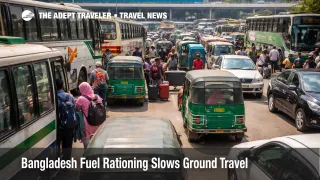
Bangladesh fuel rationing has become a traveler mobility story, not just an energy story. The U.K. Foreign, Commonwealth & Development Office, FCDO, updated its Bangladesh advice on March 10 to warn that fuel sales limits may cause transport disruption and delays in some areas, and local reporting now shows bus operators around Dhaka already cutting trips, waiting longer to depart, and running below normal patterns. For travelers, that means the risk is not a closed airport, it is a slower and less predictable surface trip to Hazrat Shahjalal International Airport (DAC), bus terminals, river links, and domestic flight joins. Travelers moving in the next 24 to 72 hours should add buffer time, avoid tight same day connections, and treat normal road timing assumptions as unreliable until supply conditions stabilize.
The Bangladesh fuel rationing travel problem is now defined by transfer reliability. Authorities say they are securing extra diesel and LNG supplies, but the practical friction on the ground is already visible, especially in and out of Dhaka, where queues at pumps and rationed sales have changed how transport operators dispatch vehicles.
Bangladesh Fuel Rationing Travel: What Changed
What changed this week is that the traveler warning is no longer implied. FCDO now explicitly says Bangladesh is facing energy and fuel shortages linked to global supply disruptions, that authorities have announced limits on fuel sales, and that this may lead to transport disruption and delays in some areas. That matters because official travel advisories rarely add operational language like this unless the issue is material enough to change how visitors should move around a destination.
The local operating picture supports that warning. Reuters reported on March 6 that Bangladesh imposed vehicle specific fuel limits, including caps for private cars, SUVs, microbuses, local buses, and long distance buses, while requiring filling stations to verify prior purchase receipts before refueling. On March 8, The Business Standard reported fewer outbound bus departures from Dhaka, longer waits at terminals, and operators reducing trips because drivers were struggling to secure the fuel volumes they normally use.
This is also new versus Adept's recent Bangladesh coverage, which centered on airspace and flight disruption after Biman Bangladesh Airlines suspended Gulf flying on February 28, 2026. That earlier story was about canceled air links and rebooking pressure. This one is different. The current risk is that even when flights operate, getting to the airport or onward from it can take longer and become less predictable. Bangladesh Biman Suspends Gulf Flights Feb 28, 2026
Which Travelers Face the Most Disruption
The most exposed travelers are those using Dhaka as a same day transfer hub. If you are relying on a road transfer into Hazrat Shahjalal International Airport, then connecting onward to a domestic flight, an international departure, or a rail or river leg, the weakest part of the itinerary is now often the ground segment before you ever reach the terminal. A 30 to 60 minute road delay becomes much more expensive when it breaks check in cutoffs or forces a missed sector on a thin domestic schedule. That is why this story matters even without evidence of an airport fuel shortage at DAC itself.
Budget independent travelers, bus users, and tour passengers on tightly sequenced overland itineraries are more exposed than travelers using private hotel cars with flexible schedules. Local reporting shows bus operators in Dhaka waiting to fill buses before departure and, in some cases, cutting trip counts because they cannot source normal fuel volumes. That creates two kinds of risk at once, departures that leave later than expected, and less frequency if you miss one.
Travelers heading beyond Dhaka should be careful with assumptions about smooth onward movement. Bangladesh's authorities say the country has secured about one month of diesel supply with another month being arranged, and they have also bought higher priced LNG cargoes to steady supply. That reduces the odds of an immediate nationwide stop, but it does not guarantee normal dispatch patterns at the traveler level while rationing and sales limits remain in place. In other words, the macro supply picture may be improving while the micro transport picture remains messy.
What Travelers Should Do Now
For departures over the next several days, the most rational move is to protect the surface leg first. Leave earlier for Dhaka airport than you normally would, build extra time for refueling related delays, and avoid assuming that a taxi, car service, or intercity coach will run on its usual cadence. If a flight is important, an overnight near the airport can be cheaper than losing the itinerary because the last road segment failed.
Rebook or reshape the trip if your plan depends on back to back same day joins. That includes airport to launch pier, airport to rail terminal, airport to long road transfer, or coach to domestic flight pairings. Waiting can make sense if your itinerary has slack and you are monitoring local conditions closely. It makes less sense if the trip includes a fixed tour start, a cruise embarkation, a visa deadline, or a limited frequency domestic flight where one missed departure can cost a full day. The tradeoff is straightforward, spending more time or a little more money now may save the whole itinerary.
Watch three things next. First, whether fuel sales limits are eased further after Bangladesh Petroleum Corporation already moved to soften some cuts in divisional cities. Second, whether local operators in Dhaka resume normal departure patterns. Third, whether official airport or airline channels begin flagging surface access problems around DAC. As of March 13, 2026, I found no verified evidence that Hazrat Shahjalal itself is facing an airport fuel shortage or published access restrictions tied directly to this rationing round, which is important, because the current traveler problem is mainly getting across the ground system on time.
Why the Disruption Spreads Through Travel
The mechanism is simple. Bangladesh depends on imports for about 95 percent of its energy needs, and the current Middle East shock has pushed the government to ration vehicle fuel, restrict diesel sales, buy emergency supply from India and China, and pay sharply more for spot LNG cargoes. Those steps are designed to keep the system running, but they also make local transport less fluid while operators adapt to lower daily availability and more cumbersome refueling.
First order, buses, road transfers, and other ground movements can slow, leave less often, or bunch around available supply windows. Second order, that road friction spills into aviation and tourism timing, because airports, hotels, guides, and domestic transport providers all depend on travelers arriving in sequence. Even when flights operate normally, a weaker road network can still produce missed check in windows, broken tour sequences, longer hotel arrival gaps, and more fragile onward travel across Bangladesh. That is why this is now a destination transport story, not just an energy procurement story.
Sources
- Bangladesh travel advice, GOV.UK
- Bangladesh rations fuel as Middle East conflict spur panic buying, Reuters, March 6, 2026
- Officials assure steady fuel supply, yet long-distance operators reduce trips, The Business Standard, March 8, 2026
- Bangladesh secures diesel supplies amid major energy disruptions, sources say, Reuters, March 10, 2026
- Bangladesh secures spot LNG cargoes as costs soar, seeks Indian oil, Reuters, March 12, 2026