

Bangladesh Biman Suspends Gulf Flights Feb 28, 2026
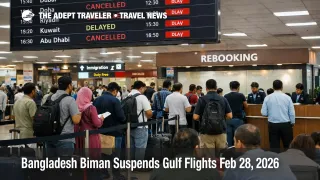
Bangladesh travelers heading to the Gulf lost a major nonstop bridge on February 28, 2026, when Biman Bangladesh Airlines halted Middle East flying amid a fast moving regional airspace and security situation. For passengers, the consequence is immediate: cancellations out of Dhaka, Bangladesh, plus a scramble into fewer remaining seats on alternate carriers, often with longer routings and higher missed connection risk for onward travel to Europe, North America, and Africa. If you are due to fly in the next 24 to 72 hours, the practical goal is not just "get rebooked," it is to protect your itinerary from a cascading failure that starts with one canceled segment and ends with a stranded overnight, or a broken long haul connection.
Biman Gulf Flights Suspended: What Changed For Travelers
Biman confirmed on February 28, 2026, that it temporarily suspended Middle East flights, citing ongoing attacks and disruptions affecting Gulf airspace and operations. This aligns with wider airline suspensions and reroutes across the region the same day as carriers reacted to conflict escalation and multiple airspace constraints.
For travelers originating in Bangladesh, the operational reality is that the Gulf is not only a destination region, it is also the dominant connection platform for labor travel, visiting friends and relatives travel, and long haul onward itineraries. When a flag carrier pulls capacity on the day of travel, the system does not fail gracefully. Inventory disappears first, then rebooking queues stack, then the remaining routings get longer and more fragile.
Which Travelers And Itineraries Take The Biggest Hit
The highest risk group is anyone ticketed Dhaka, Bangladesh to Gulf gateways for same day onward connections, especially if the Gulf segment was the "feeder" into a longer itinerary. When the feeder cancels, you can arrive late to the hub, or not arrive at all, and the onward long haul can depart without you. Even on a single ticket, reaccommodation can take days when multiple airlines are simultaneously reducing flying, or detouring around constrained airspace.
The second fragile group is travelers who were counting on Biman specifically for labor and VFR travel patterns where timing is tight and flexibility is low. In these itineraries, an extra overnight is not a mild inconvenience. It can collide with employer start dates, visa and residency timelines, medical appointments, or family commitments that are not easily shifted.
A third group to call out is anyone already airborne, or positioned at the airport, when airspace access changes mid flight. Bangladesh reporting described cases where a Biman flight to Doha, Qatar was forced to divert when airspace access changed, which is the failure mode that turns a routine travel day into a welfare, baggage, and accommodation problem.
What Travelers Should Do Now
Start with a hard decision check: do you have an onward connection, a fixed deadline, or a separate ticket anywhere in the next 48 hours. If yes, treat waiting as a decision, not a default. Your best odds are usually early action while seats still exist, even if the new routing is longer or less convenient.
If you are already canceled, push for one of three outcomes that actually reduce risk. First is a protected reroute on a single ticket that keeps you inside one carrier, or one alliance, with connection time that can absorb delays. Second is a refund that lets you rebook on another carrier immediately, when the offered reroute is clearly fragile. Third is a reroute that uses a hub with multiple later same day backups, because your real enemy is getting stuck on the last departure bank with no inventory left.
If your trip is optional, or you can tolerate arriving a day late, waiting can be rational, but only if you set a deadline for yourself. For example, if you do not have a confirmed, ticketed reroute by the end of February 28, 2026, it is usually smarter to pivot to a different carrier, or a different hub, rather than letting the queue decide for you.
For context on why these disruptions often turn into multi day shortages, not just one bad afternoon, see how airspace constraints have already been forcing longer routings and tighter connection margins in Iran NOTAM Launch Window Triggers Middle East Reroutes. For how quickly carrier network decisions can remove "easy" routings in the region, KLM Suspends Amsterdam Tel Aviv Flights From March 2026 is a useful parallel, it shows the same downstream pattern: fewer clean options, more connections, and higher misconnect exposure.
Why This Spreads Fast Through The Air Travel System
This kind of disruption is not just about one airline canceling flights. The mechanism is capacity compression inside a hub and corridor system that normally runs with limited slack. When airlines suspend or detour flying across the Gulf and adjacent airspace, flight times can grow, arrival banks can drift, and aircraft and crews end up out of position. That is the first order effect.
The second order ripple is rebooking scarcity. A canceled Dhaka to Gulf sector does not only displace passengers on that flight, it also displaces everyone they would have connected into later that day. Reaccommodation then competes for the same finite seats that were already scheduled, and if multiple carriers are constrained at once, that competition turns into sellouts, forced overnights, and longer itineraries with extra connection points.
The third ripple is airport processing and welfare load. When cancellations happen in clusters, customer service lines grow, hotel availability near airports tightens, and passengers who were never planning to stay overnight suddenly need accommodation, meals, and documentation help. The result is that even travelers whose flights still operate can experience longer check in times, heavier gate area congestion, and slower recovery when things restart unevenly.
If you want a structural lens on why seat availability and recovery flexibility are often worse than travelers expect during disruption periods, AI Data Centers And The Airline Supply Chain, A 2030 Outlook explains how longer term capacity constraints can reduce the system's ability to absorb shocks.
Sources
- Biman suspends Middle East flights amid conflict
- Flights between Dhaka and Gulf destinations suspended amid tensions
- Bangladesh suspends flights to 4 Gulf countries after Iranian strike on US base
- Airlines suspend Middle East flights after US, Israel strikes on Iran
- Attack on Iran disrupts flights across the Middle East and beyond