

Carnival Adventure Standoff Sharpens Sydney Scrutiny
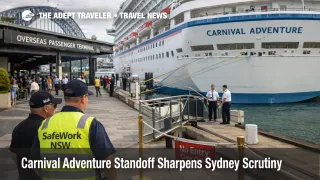
Carnival Adventure standoff scrutiny in Sydney, Australia, is rising after two SafeWork NSW inspectors and Maritime Union of Australia representatives were turned away while trying to pursue crew welfare complaints. For travelers, this is not yet a passenger disruption story, but it is a live operator oversight story that could bring more inspections, more legal friction, and more attention on how Carnival's Australia based ships are supervised. The practical takeaway is to watch for escalation, not panic, because the central dispute is still whether the attempted entry right applied here and under which regulator.
The confrontation matters because it combines serious allegations with an unresolved jurisdiction fight. Reports tied to the case include claims of overcrowded crew accommodation, poor access to safe drinking water, and extremely low pay, but those remain allegations unless regulators confirm them. Carnival's position, reflected in current coverage, is that the Australian Maritime Safety Authority, not the union, is the proper authority to inspect seafarer living and working conditions.
Carnival Adventure Standoff, What Changed
What changed is that a labor and safety dispute moved from background allegation to visible port side confrontation. Cruise Hive reported that officials from SafeWork NSW and the Maritime Union of Australia attempted to board Carnival Adventure in Sydney and were denied entry, while Daily Cargo News separately reported that SafeWork NSW inspectors attended on Monday, March 10, 2026, to help resolve the dispute and that the agency's enquiries remain ongoing. That date split matters because it shows the public record is still forming, even though the broader fact pattern, an attempted boarding followed by refusal and a live dispute over authority, is well established.
The sharpest way to frame this is not that wrongdoing has already been proved. It is that Carnival is now in a filmed oversight fight over who can inspect crew welfare complaints on a homeported ship in Sydney. That is a stronger travel story because it is both more accurate and more durable. If regulators later confirm deficiencies, the story hardens. If they do not, the jurisdiction fight still matters because it affects how similar complaints will be handled on future sailings.
Which Cruise Travelers Should Pay Attention
Passengers booked on Carnival's Australia based ships do not need to assume immediate itinerary changes, but they should understand where the real exposure sits. The first group that should pay attention is near term embarkation passengers sailing from Sydney, because any increase in inspections, boarding controls, or public dispute at the terminal can slow normal port routines even when the sailing still departs. The second is travelers comparing Australian homeport cruise options for later in the season, because repeated labor or welfare disputes can become a reputational drag long before they become a schedule problem.
This also matters for travelers who dismissed the earlier Carnival Encounter case as isolated. ABC reported in February that AMSA boarded Carnival Encounter in Darwin after whistleblower complaints that included low wages, overcrowded crew spaces, water access concerns, and illness related issues. Later coverage said Carnival maintained that AMSA found no deficiencies and required no follow up, but ABC also noted that AMSA had not publicly settled the final outcome at that stage. In other words, the Encounter episode did not fully close the issue down, and the Adventure standoff keeps the wider scrutiny alive. Adept's earlier coverage, Darwin AMSA Inspection Hits Carnival Encounter Cruise, gives readers the background on that earlier inspection cycle.
What Travelers Should Do Now
If you are due to board Carnival Adventure or another Australia based Carnival sailing soon, keep your focus on operational signals, not the viral clip alone. Check for any direct line communication from the cruise line, monitor the terminal operator or port instructions if your embarkation is close, and keep ground transport timing flexible enough to absorb a slower than usual check in or terminal access process. Right now, there is no verified evidence of broad passenger disruption tied to this standoff.
The decision threshold for changing plans is still high. Rebook only if you see confirmed inspection related delays, formal regulator action that affects boarding, or a pattern of repeated port side disputes that starts interfering with embarkation or disembarkation windows. Until then, the more rational move is to preserve flexibility, keep travel insurance documents handy, and avoid assuming that a legal fight over inspection authority automatically means your cruise will be disrupted.
Over the next 24 to 72 hours, the main things to monitor are whether SafeWork NSW or AMSA issue clearer public statements, whether Carnival changes its wording on inspection authority, and whether any new allegations turn into confirmed regulatory findings. That is the next real decision point. Until those facts move, this remains a scrutiny and oversight story, not a proven passenger impact event.
Why This Oversight Fight Matters
The legal distinction here is the whole story. Under the New South Wales Work Health and Safety Act 2011, a person must not intentionally and unreasonably hinder or obstruct a WHS entry permit holder, with maximum penalties of 121 penalty units for an individual and 607 penalty units for a body corporate. But those penalties matter only if the entry holder was entitled to enter in this case and was exercising rights in accordance with the Act. That is why this story should be framed as a contested enforcement dispute, not a settled breach.
For travel readers, the broader mechanism is straightforward. Oversight fights rarely stay confined to legal filings. First order, they increase the odds of more inspections, more media pressure, and more scrutiny at the ship and terminal level. Second order, that can spill into slower port routines, tighter embarkation margins, and a weaker perception of reliability for travelers deciding between competing cruise products in Australia. That does not mean disruption is guaranteed. It means the line between crew welfare enforcement and traveler operations is thinner than it looks.
Sources
- Tense Standoff as Carnival Adventure Denies Access to Inspectors
- MUA and Carnival at odds over inspections
- Maritime safety regulator investigating Carnival cruise ship exploitation claims
- Exploitation claims have been levelled against cruise ship company Carnival. Here's what we know
- Work Health and Safety Act 2011 No 10, NSW Legislation