

Cuba Fuel Shortages Hit Airport Operations, Tourism
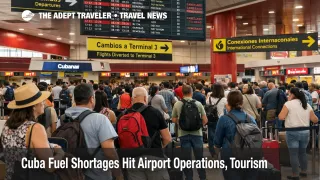
Cuba fuel shortages are now a destination level travel problem, not just a cost story. The U.K. Foreign, Commonwealth & Development Office says worsening fuel shortages and power outages are significantly affecting transport, medical care, communications, and tourism operations in Cuba, while FAA linked notices cited by industry reporting say Jet A1 is unavailable at 10 Cuban airports through at least April 4, 2026. For travelers, that raises the risk of flight cuts, slower airport processing, unreliable road transfers, and more brittle resort logistics, especially for trips built around Havana, Varadero, Cayo Coco, and other fly in beach corridors.
The new issue is operational exposure at the destination. This goes beyond the broader cost pressure Adept covered in Travel Costs Rise as Iran War Pushes Up Oil Prices, because Cuba fuel shortages now affect whether aircraft can refuel, whether hotel and transfer systems run reliably, and whether tight itineraries still work.
Cuba Fuel Shortages: What Changed
The clearest new development is that official travel advice and airport fuel warnings are now pointing in the same direction. FCDO says Cuba is experiencing severe and worsening disruption to essential infrastructure, with persistent power outages and fuel shortages significantly affecting reliable transport and tourism operations. The same advisory says all international airports are without aviation fuel, and that Terminal 2 at José Martí International Airport (HAV) in Havana has closed, with flights diverted to Terminal 3.
Industry reporting based on FAA linked notices says the no fuel warning runs through at least April 4 at 10 airports. Those include José Martí International Airport (HAV), Juan Gualberto Gómez Airport (VRA) in Varadero, Jardines del Rey Airport (CCC) in Cayo Coco, Abel Santamaría Airport (SNU) in Santa Clara, Frank País Airport (HOG) in Holguín, and Antonio Maceo Airport (SCU) in Santiago de Cuba, plus airports in Camagüey, Cayo Largo del Sur, Cienfuegos, and Manzanillo.
Carrier behavior has also shifted from contingency planning to actual service cuts. Reuters reported in February that Air Canada, WestJet, and Air Transat suspended Cuba flying as fuel reliability deteriorated, and Reuters reported on March 4 that Air France would temporarily suspend Paris to Havana service from late March because of the fuel shortage and its effect on economic and tourist activity. FCDO also says all Canadian airlines and LATAM have suspended flights, while other airlines are still reviewing routes.
Which Travelers Face the Most Disruption
The highest exposure sits with travelers on short stays, same day resort transfers, and multi segment itineraries that do not leave much slack. Havana arrivals are exposed because HAV is Cuba's main international gateway and Terminal 2 is closed, while Varadero and Cayo Coco travelers are exposed because those airport corridors depend heavily on reliable onward road movement to resorts that are already operating inside a wider fuel and power shortage environment.
Travelers connecting to beach areas and cruise style land programs should assume the first order problem is not only whether the inbound flight operates, but whether the transfer, hotel intake, and return logistics remain smooth once they land. The second order effect is that a delayed or trimmed inbound schedule can cascade into missed international returns, longer coach waits, hotel consolidations, and extra night costs when the island's transport system has less spare capacity than normal. That risk is highest in Varadero, Cayo Coco, and other leisure corridors where many visitors rely on tightly timed airport to resort movements.
The least exposed travelers are the ones treating Cuba as a flexible trip rather than a precision itinerary. Travelers with nonstop flights, refundable rooms, private transfers, and at least one buffer night before an international departure are in a better position than passengers trying to chain airport arrival, resort stay, and outbound connection with little margin for error.
What Travelers Should Do Now
Travelers with Cuba departures before April 4, 2026, should treat this as a plan tightening event. Confirm whether your airline is still operating the route, verify which Havana terminal applies if you are using HAV, and avoid assuming that airport refueling or normal turnaround patterns are available at the destination. If your itinerary depends on a same day international connection on the way home, add a buffer night if you can.
The main rebook versus wait threshold is straightforward. Rebook now if your trip depends on a charter style leisure corridor, a short stay, or separate tickets that leave you exposed to a missed return. Waiting is more defensible if your airline is still operating, your hotel and transfer provider are confirming service in writing, and your trip can absorb a delay without breaking a cruise embarkation, wedding, guided tour, or onward long haul segment.
Over the next several days, watch four recovery signals. First, whether the aviation fuel warning is shortened or withdrawn. Second, whether FCDO softens its language on transport and tourism disruption. Third, whether suspended carriers start restoring Cuba service instead of extending cuts. Fourth, whether HAV resumes normal terminal use rather than continuing the Terminal 2 diversion into Terminal 3. Until those signals improve, tight flight plans and rigid resort transfers are the wrong fit for most travelers.
How the Fuel Crisis Spreads Through Cuba Travel
The mechanism matters here. When Jet A1 is unavailable at destination airports, airlines either suspend service, tanker in enough fuel for the next leg, or add refueling stops in a third country. Reuters reported in February that some airlines were already planning refueling stops outside Cuba, and AP said Air France had been refueling in the Bahamas on return sectors before deciding to suspend Havana service. That means even flights that remain on sale may operate with less flexibility and more disruption risk than normal.
On the ground, the same fuel and power shortage spreads through the visitor experience. FCDO says authorities have introduced fuel rationing, scaled back public services, and made temporary changes to transport and tourism operations to conserve limited energy supplies. In plain language, that turns a fuel shortage into a whole trip reliability problem. Airport operations weaken first, then road transfers, then hotel systems, then communications and emergency support.
That is why Cuba fuel shortages are one of the strongest destination disruption stories in the Caribbean right now. The immediate issue is airport fuel and flight reliability, but the broader traveler problem is that once the destination itself is short on fuel and power, every tightly timed part of the itinerary gets less dependable. Travelers deciding whether to go should focus less on headline airfare and more on whether the full trip, airport, transfer, hotel, and return segment, can still tolerate disruption.
Sources
- Cuba travel advice, GOV.UK
- Canadian airlines suspend Cuba flights as island set to run out of jet fuel, Reuters, February 9, 2026
- Air France to temporarily suspend services to Cuba due to fuel shortage, Reuters, March 4, 2026
- Air France will suspend flights to Havana for weeks in latest blow to Cuba's tourism, AP News, March 5, 2026
- Cuba warns of jet fuel unavailability through early April, FlightGlobal, March 5, 2026