

Peru GNV Shortage Puts Road Transfers at Risk
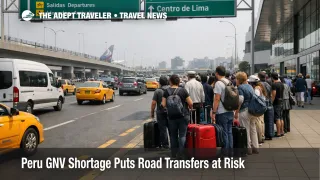
Peru road transfer disruption is now the sharper traveler issue, not a flight shutdown, after the U.K. Foreign, Commonwealth and Development Office said a State of Emergency remains in place and warned that emergency measures following the Camisea gas pipeline rupture are causing shortages of natural gas for vehicles, GNV. The immediate exposure is highest in Lima, Peru, and Callao, Peru, where official measures have included remote work and remote classes to reduce movement while fuel supply remains strained. Travelers should treat taxis, hotel cars, sightseeing coaches, and other road legs as less reliable than usual, build extra transfer time, and confirm ground transport directly with providers before moving.
The core point is that Peru still appears operational by air, but surface transport is the weaker link. Officials have prioritized essential services and mass transit, which helps keep the biggest urban transport systems moving, yet that does not guarantee normal service for visitor dependent road transfers or private touring. President José María Balcázar said on March 10 that GNV sales should restart on March 14, with Lima and Callao distribution expected to normalize on March 15 if repairs stay on schedule. That is a meaningful recovery signal, but for travelers moving before the weekend, the safer assumption is continued friction.
Peru Road Transfer Disruption: What Changed
What changed is the type of transport risk. The FCDO update, current on March 13, says Peru is under a State of Emergency and specifically warns of disruption and shortages of GNV after the Camisea pipeline rupture, while temporary measures in Lima and Callao were expected to last around 14 days. The U.S. Embassy in Lima has also warned that the shortage could affect buses, taxis, and other transport services during the week of March 9, and possibly longer.
That makes this less of an airline operations story and more of an itinerary reliability story. A flight into Jorge Chávez International Airport (LIM) can still operate, but the road segment after landing may take longer, cost more, or require a last minute substitution. The same applies in reverse for departures, where an otherwise normal check in plan can be broken by a weak transfer layer between hotel and airport. So far, I have not found an official airport operator statement showing broad airport service disruption tied directly to the gas shortage. The confirmed risk is on the ground transport side, not a verified airport shutdown.
Which Travelers Face the Most Exposure
The highest exposure sits with travelers whose Peru itinerary depends on tightly timed road legs. That includes airport transfers in Lima and Callao, day tours that use coach or van transport, cruise or rail passengers connecting on fixed schedules, and anyone stacking separate tickets or nonrefundable bookings around a same day road move. Business travelers who assume a routine taxi supply are exposed too, because the shortage has hit the vehicle fuel layer rather than the runway.
The picture is more mixed for public transport. Lima and Callao authorities said on March 3 that the Metropolitano, complementary corridors, and Metro Lines 1 and 2 were operating normally, because priority fuel supply and non GNV power sources helped protect those systems. That matters for local resilience, but it does not fully solve the visitor problem. Tour coaches, hotel cars, independent taxis, and app booked rides can still face tighter supply, longer waits, or higher dependence on whichever stations can refuel.
The regions most clearly named in official emergency measures are Lima and Callao, even though the rupture itself occurred in Megantoni, in Cusco region. That means travelers should not assume the whole Peru tourism map is equally affected in the same way. The strongest confirmed urban transport exposure is in the capital region. For tourist corridors elsewhere, the prudent move is to verify each road segment directly rather than assume either normality or collapse.
What Travelers Should Do Now
For departures and same day connections, add a serious ground buffer. In Lima and Callao, that means treating airport runs, rail station transfers, and hotel to meeting point moves as potential failure points, especially if your transport plan relies on taxis or small private vehicles. A one hour buffer that normally feels conservative may not be enough if vehicle availability thins or refueling delays build into the system.
Decision wise, keep the trip if your exposed road legs are flexible, provider arranged, and easy to rework. Rebuild the itinerary if you have separate tickets, late night arrivals with limited backup transport, or lodge and rail connections that fail hard after one missed handoff. Travelers arriving before March 15 should also assume recovery may be uneven even if pipeline repairs meet the government's stated schedule, because station level replenishment usually lags system restart. That last point is an inference from how fuel distribution systems normalize, not a separately published Peru specific timetable beyond the government's March 14 to 15 target.
Keep monitoring three things over the next 24 to 72 hours. First, whether Peru sticks to the March 14 restart and March 15 normalization timetable. Second, whether embassies or local authorities widen or narrow the warning beyond Lima and Callao. Third, whether your airline, hotel, rail operator, or tour company starts proactively adjusting transfer guidance. Earlier Adept coverage on Peru strike disrupts Lima, roadblocks through October 15 is also useful here, because it shows how quickly surface disruption in Lima can break otherwise workable airport plans.
Why the Shortage Spreads Through Travel
The mechanism is straightforward. A rupture on the Camisea system cut gas supply, and the government responded by prioritizing essential uses and mass transport while urging remote work and remote schooling in Lima and Callao. Reuters described the event as Peru's worst energy crunch in two decades, and officials said only a fraction of normal gas supply was being delivered at the height of the disruption.
First order, vehicles that depend on GNV become harder to keep moving. Second order, travel friction spreads into airport access, sightseeing circuits, hotel logistics, and any itinerary built around precise overland timing. Even where flights, trains, or attractions continue to operate, the transfer layer between them becomes less predictable. That is why this story matters for travelers before there is any need to declare a full transport shutdown.
Sources
- Peru travel advice, GOV.UK
- Natural Gas Shortage Impact on Transport and Services in Peru, U.S. Embassy Lima
- GNV para Metropolitano y Corredores está garantizado: servicios operan con normalidad, El Peruano
- El sábado 14 de marzo se reabrirá el sistema de gas para los grifos, El Peruano
- Peru taps fuel reserves to combat worst energy crunch in two decades, Reuters
- Peruvian gas pipeline to be fixed this weekend, Balcazar says, Reuters