

Metro Manila Protests Raise Airport Timing Risk
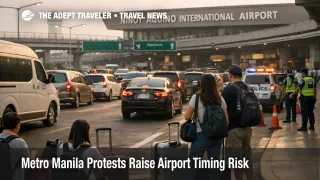
Metro Manila protest risk has become a more practical travel issue, not just a security note. The U.K. Foreign, Commonwealth & Development Office now warns that large scale demonstrations are expected over the coming weeks in Metro Manila and elsewhere in the Philippines, that they may disrupt travel, and that travelers should allow extra time for journeys. The same advisory also says Middle East escalation can still affect flights even when the destination is outside that region, which matters for Manila trips that already depend on tight airport timing. For travelers, the takeaway is simple, build more slack into airport runs, domestic connections, and fixed time city plans.
Metro Manila protest risk now matters because official advice no longer treats demonstrations as a background issue. It explicitly connects them to movement delays, which is the part that breaks itineraries. A trip can fail without ever entering a protest zone if crowd controls, diversions, or heavier police management make road times unreliable on the same day.
Metro Manila Protest Risk: What Changed
What changed is not the existence of political tension, it is the operational wording. The FCDO advice says demonstrations are expected over the coming weeks in Metro Manila and elsewhere, may lead to travel disruption, and require extra time for journeys. In the same update, it says commercial options to depart the Philippines remain available, but Middle East escalation can still affect travel plans even when the destination is not in that region. That combination turns a generic caution into a planning problem for both ground access and flight reliability.
This also fits a broader pattern seen in Manila this year. A March 7 U.S. Embassy Manila security alert warned of the potential for demonstrations and anti U.S. or anti Israeli sentiment, even while saying there was no specific credible threat to the embassy at that time. That does not prove every coming protest will hit the same neighborhoods, but it does support the idea that demonstrations are an active, current operating condition in the capital rather than a theoretical risk.
Adept already covered the first March 6 advisory in Philippines Protest Warning Hits Manila Trip Timing. The sharper angle now is that this story should be treated as a rolling transport reliability issue for the next several weeks, not a one day alert tied to a single march.
Which Travelers Face the Most Disruption
The most exposed travelers are those using Ninoy Aquino International Airport (MNL), those making same day domestic connections, and those crossing Metro Manila on fixed schedules for tours, meetings, visa appointments, cruise check in, or ferry departures. Manila is a hub that leans heavily on road access, so a delayed airport transfer can do more damage than a delayed sightseeing block. The first order effect is a slower trip to the terminal. The second order effect is a missed check in cutoff, a broken domestic connection, or an extra hotel night.
Travelers staying in bayfront and central districts should pay attention even if their hotel looks close to the map's main attractions. Earlier Manila protest coverage on Adept showed how routes between the airport, Roxas Boulevard, Rizal Park, Intramuros, and downtown hotel zones can snarl when protest activity triggers road controls, while Quezon City's February 21 traffic advisory showed another stress point around EDSA, Katipunan Avenue, Ortigas Avenue, White Plains Avenue, and Temple Drive ahead of a February 25 rally. The lesson is not that all of Metro Manila will lock up at once, it is that major choke points can fail quickly and unpredictably.
Travelers outside Manila should read the advisory carefully, but not overread it. The FCDO says demonstrations are expected "elsewhere in the Philippines," yet it does not identify a nationwide closure pattern or name specific additional cities in the current text. That means the clearest near term transport exposure remains Metro Manila, while travelers on domestic itineraries elsewhere should mainly treat this as a warning against narrow buffers and tightly stacked same day transfers.
What Travelers Should Do Now
For airport runs, normal timing should be treated as outdated on protest days, on days with visible security buildups, and on days when local advisories mention route controls. Travelers should leave earlier than usual for Ninoy Aquino International Airport, avoid short same day domestic connections where possible, and ask hotels or drivers which route they plan to use before departure. The practical goal is not to predict every demonstration, it is to avoid building an itinerary that fails when one key road slows.
For city stays, the decision threshold is straightforward. If your day depends on crossing Metro Manila at a fixed hour, add buffer or move the activity. That is especially true for travelers trying to combine a morning tour, a midday hotel transfer, and an evening domestic flight. Anyone with only one night in Manila should think seriously about staying closer to the airport or choosing plans that do not depend on one protest exposed corridor. Related earlier reporting such as Manila Protest March To Block Roads November 30, 2025 shows how quickly airport access math can deteriorate when central routes are restricted.
Over the next 24 to 72 hours, the main things to watch are local government traffic advisories, police or embassy alerts, and airline notices that mention access delays or broader network disruption. Because the FCDO also warns that Middle East escalation can still affect flights even when the destination is elsewhere, travelers should separate two risks before departure, road access into Manila, and flight reliability beyond Manila. If both are in play on the same day, rebooking early can be smarter than hoping each part of the chain holds.
Why Metro Manila Delays Spread Through Travel
The mechanism is simple. Demonstrations do not need to shut an airport to disrupt a trip. In a dense capital region, they only need to slow or reroute the roads that feed terminals, hotels, business districts, and transfer points. Once authorities create security perimeters, meter traffic, or close turning movements around a rally, travel time becomes less predictable long before transport fully stops.
Quezon City's February 21 advisory is useful because it shows what this looks like in practice. Ahead of a February 25 rally, the city warned of slower traffic around EDSA, Katipunan Avenue, Ortigas Avenue, White Plains Avenue, and Temple Drive, set a zipper lane on White Plains Avenue overnight, and said White Plains Avenue would close from 6:00 a.m. on the day of the rally. That is exactly how a political event turns into a traveler problem, not through abstract unrest language, but through a few road changes that ripple into airport runs, hotel pickups, and connection windows.
That is why Metro Manila protest risk is now a true travel story. The capital's transport network carries too many linked traveler movements on the same roads for officials to warn about demonstrations and disruption without that affecting trip design. The sensible response is not panic. It is better timing, wider buffers, fewer same day dependencies, and closer attention to local advisories before leaving for the airport.