

American Airlines App Adds Delay Reasons
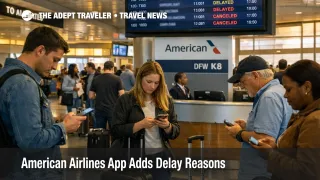
American Airlines delay reasons are now moving from airline back end jargon into plain language that travelers can actually use. Starting Monday, March 16, 2026, American said customers will begin seeing clear explanations for flight delays and cancellations in the carrier's mobile app and on aa.com, with rollout continuing across March. For travelers, that matters because the difference between weather, air traffic control, and maintenance is not just informational, it changes whether you should wait, rebook, chase a waiver, or expect a longer recovery window.
This also builds on American's January disruption platform update, which already pushed rebooking, bag tracking, and eligible hotel, meal, or transportation vouchers into one place inside the app and website. The new step is context. Instead of only seeing that a flight changed, passengers now get a clearer explanation of why it changed, plus more tailored push notifications, emails, and text messages tied to their own itinerary.
The practical takeaway is straightforward. American is trying to turn a disruption from a vague alert into a decision workflow. That will not stop weather or maintenance problems, but it should reduce one of the most frustrating parts of irregular operations, the gap between "your flight changed" and "what exactly should I do now?"
American Airlines Delay Reasons: What Changed
What changed on March 16 is that American began surfacing customer friendly disruption causes directly in its digital channels. The airline said customers will see easy to understand explanations for delays and cancellations on the mobile app and aa.com, and that these reasons will identify causes such as weather, air traffic control, or maintenance issues. American also said tailored notifications by push alert, email, and text would begin rolling out during March.
That may sound cosmetic, but it is more useful than a normal status ping. Airline disruptions often leave travelers guessing whether a delay is likely to clear quickly or whether it signals a deeper network problem. Weather and air traffic control delays often spread across multiple flights and airports, while a maintenance delay may stay more aircraft specific, at least at first. The value here is not that American can predict everything perfectly, but that it is giving passengers a more actionable first read on the problem.
American's own framing makes that clear. The airline said the explanations appear alongside its disruption platform so customers can immediately choose a next step rather than hunt across multiple channels. In other words, this is not just a message update, it is an attempt to make the app the main control center when a trip breaks.
Who Benefits Most From The New Disruption Tools
The travelers who benefit most are people with tight connections, complex same day itineraries, or limited slack in hotel, cruise, tour, or ground transfer plans. If you are flying nonstop for a flexible leisure trip, a plain language delay reason is helpful, but not transformative. If you are connecting through a constrained hub, heading to a cruise embarkation, or trying to salvage the last flight of the day, better explanation can change the decision window.
This is especially useful in the kind of operational environment travelers have already been dealing with this month. Recent network wide delay risk has been shaped by weather, terminal congestion, and FAA traffic management programs, including the broad disruption patterns covered in Flight Delays and Airport Impacts: March 15. In that environment, knowing whether your problem is local, system wide, or aircraft specific matters because each scenario produces a different recovery path.
There is also a second audience here, travelers who want to self solve before lines build. American said its disruption platform lets customers rebook onto another flight, track checked bags, access eligible vouchers, and view updated departure times for other flights. Pairing those tools with cause explanations could reduce the tendency to wait passively for an agent when the smarter move is to switch flights early.
What Travelers Should Do When A Flight Changes
When an American itinerary shifts, the first decision should be based on the type of disruption shown in the app. If the delay reason is weather or air traffic control, travelers should assume the problem may widen beyond one gate or one aircraft and should check nearby flights, alternate airports, and any waiver options quickly. If the problem is maintenance, it may still become a long delay, but it is more likely to remain tied to that aircraft or rotation rather than spreading instantly across an entire region.
Rebook early if the trip includes a short connection, a same day cruise embarkation, a late hotel arrival that cannot slide, or an onward rail or tour commitment with little flexibility. Wait longer only when you have slack in the itinerary and the app is showing a contained issue rather than a broader network squeeze. That tradeoff matters because the cheapest move is not always the safest move. Preserving the trip can be worth more than preserving the exact original flight.
Travelers should also treat the American app as the first stop, not the last resort. American said the disruption platform appears directly on the home screen when disruptions occur, and this month it will also begin appearing within the reservation itself. That should make it faster to compare options, find voucher eligibility, and track baggage without jumping between multiple support channels. Travelers trying to understand how larger FAA system constraints can still affect an airline even when the problem is not the airline's fault may also want the broader context in U.S. Air Traffic Control Privatization: Reality Check.
Why Better Explanations Matter In Real Operations
The mechanism here is simple. Airline operations are complex, but passenger decisions usually are not. Travelers mostly need to know whether the disruption is likely to stay narrow, spread through the network, or trigger support options that make a reroute easier. American said its systems now translate operational complexity into clear, customer friendly messaging, which is another way of saying the airline wants to convert internal dispatch and operations data into something a passenger can act on.
The first order effect is clarity. A customer sees why the flight changed and can react faster. The second order effect is that clearer explanations may reduce airport desk pressure, call center volume, and the time passengers waste waiting for information they could have used earlier. That matters most on bad weather days and in tight hub banks, where every extra minute spent waiting to understand the problem can mean losing the best remaining rebooking options.
There are limits. Better messaging does not guarantee better recovery, and travelers should not confuse transparency with compensation. American's conditions of carriage still set the baseline on refunds and rebooking obligations, including refund rights when the airline cancels a flight or when long delays cross published thresholds. The improvement here is operational, not magical. But in irregular operations, better information at the right moment is often the difference between a manageable reroute and a much more expensive travel day.
Sources
- A new digital experience: American gives customers more timely flight information, American Airlines Newsroom
- Turning disruptions into decisions: American Airlines empowers customers with new app enhancements, American Airlines Newsroom
- Conditions of Carriage, American Airlines
- Flight Delays and Airport Impacts: March 15, Adept Traveler
- U.S. Air Traffic Control Privatization: Reality Check, Adept Traveler