

Flight Delays and Airport Impacts: March 15
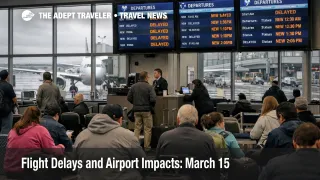
March 15 flight delays are shaping up as a broad weather and traffic management day, not a single airport failure. The FAA's live operations plan points to thunderstorm pressure in Chicago and Florida, snow and low visibility at Minneapolis, wind constraints at Detroit, Philadelphia, Denver, and the New York area, plus possible ground stops or delay programs later in the day at Chicago O'Hare International Airport (ORD), Chicago Midway International Airport (MDW), Dallas Fort Worth International Airport (DFW), Dallas Love Field (DAL), Newark Liberty International Airport (EWR), Miami International Airport (MIA), Fort Lauderdale Hollywood International Airport (FLL), Orlando International Airport (MCO), Tampa International Airport (TPA), and Denver International Airport (DEN). For travelers, that means the biggest risk is not only a late departure at the origin, but a disrupted connection chain into tonight.
The public FAA daily report page was still showing Friday, March 13 guidance when checked on Sunday, March 15, so the more useful signal today is the FAA command center advisory rather than the stale daily summary page. That advisory shows active flow programs, reroutes, and a likely weather driven squeeze on Chicago and Florida banks during one of the heaviest leisure travel periods of the month.
March 15 Flight Delays: What Changed
What changed on Sunday, March 15 is that the FAA's live planning escalated from a general windy weekend pattern into a more operationally specific map of trouble spots. The command center advisory flags thunderstorms around the Chicago terminal area and Florida, snow and low visibility at Minneapolis, and low ceilings at San Francisco, Seattle, and Southern California. It also says ground stop or delay programs are possible after 400 p.m. UTC for ORD and MDW, after 500 p.m. UTC for MIA and FLL, after 500 p.m. UTC for EWR, and after 700 p.m. UTC for MCO and TPA, while Minneapolis faces a probable ground stop or delay program through 11:00 p.m. UTC.
That matters because today's disruption is stacked across connecting banks rather than isolated to one metro area. Chicago sits in the middle of east west and north south flows, Florida is carrying heavy spring leisure traffic, and Minneapolis is dealing with winter weather at the same time. If one of those regions slips, the next aircraft rotation often slips with it. FlightAware snippets already showed Chicago O'Hare running average arrival and departure delays of about one hour, Miami showing departure delays of 15 to 29 minutes and decreasing, and Orlando showing departure delays of 16 to 30 minutes and increasing.
Which Travelers Face The Most Disruption
The most exposed travelers today are people connecting through Chicago, Minneapolis, Newark, South Florida, Orlando, Tampa, or Denver, especially on late afternoon and evening itineraries. The FAA advisory also shows en route constraints tied to Midwest to Florida traffic, Texas and lower Mississippi Valley to the Northeast, ski country volume, and heavy snowbird demand across the network. That is a warning that even passengers whose origin airport looks normal can still be caught by flow controls somewhere else in the system.
Minneapolis is the clearest weather driven risk point in the Upper Midwest. The FAA lists snow and low visibility there, and Delta said before the weekend storm that it was proactively canceling flights across 26 affected airports, including its Minneapolis, St. Paul hub, with rebooking flexibility through March 22. Around Chicago, the weather side is more mixed, with the National Weather Service in Chicago warning early Sunday that a strong spring storm system could bring damaging winds, waves of showers and thunderstorms, and a period of wintry weather as it moves through the region into Monday.
The Northeast and Florida are exposed for a different reason. Newark is on the FAA's possible GDP list later today, while Florida airports are on the board from South Florida through Central Florida because of thunderstorms, volume, and routing pressure. That is bad news for travelers trying to protect cruise embarkations, same day hotel check in, or one shot evening connections into Caribbean and Latin America departures.
What Travelers Should Do Now
Travelers flying today should treat short connections as the main enemy. If you are connecting through Chicago, Minneapolis, Newark, Miami, Fort Lauderdale, Orlando, or Tampa, a later nonstop or a longer layover may protect the trip better than clinging to a technically on time first leg. This is especially true for evening banks, because the FAA's own advisory puts many of the likely controls later in the day, after delays have had time to accumulate.
For same day departures, check three things before leaving for the airport, your inbound aircraft status, your airline app for reroutes or waivers, and whether your connection airport is on the FAA's planned ground stop or GDP list. If your trip depends on a cruise sailing, an international departure, or a final flight of the night, rebooking earlier is usually the safer choice once the inbound aircraft begins slipping. Waiting may save change fees, but it can cost the whole itinerary if the delay wave reaches your hub after midafternoon.
Over the next 24 to 72 hours, watch Chicago, Minneapolis, Florida, and the Washington system. Chicago and Upper Midwest weather could keep recovery uneven into Monday, Florida banks can remain sensitive after evening thunderstorm programs, and the Washington region is still operating after Friday's Potomac TRACON equipment failure, which affected Ronald Reagan Washington National Airport (DCA), Washington Dulles International Airport (IAD), Baltimore/Washington International Thurgood Marshall Airport (BWI), and Richmond International Airport (RIC). A fresh problem at any of those hubs would make recovery harder during an already dense spring travel period. For more context, see Flight Delays and Airport Impacts: March 14, Washington ATC Outage Delays DCA, IAD, BWI, RIC, and U.S. Air Traffic Control Privatization: Reality Check.
How The Disruption Spreads Through Travel
The mechanism today is straightforward, but brutal. Thunderstorms, wind, snow, and low visibility reduce runway acceptance rates and force reroutes. Once that happens, the FAA meters traffic with ground stops, ground delay programs, reroutes, and flow initiatives so the airspace does not overload. That protects safety, but it also slows aircraft turns, stretches crew duty days, and leaves fewer spare seats for reaccommodation.
Second order effects matter more on a day like this than the first airport board you see. A weather program in Chicago can delay an aircraft heading to Florida, which then arrives late for an Orlando departure, which then makes a Newark arrival bank tighter, which then leaves less slack for the evening return. The FAA advisory explicitly shows Midwest to Florida flow controls, Texas and lower Mississippi Valley to Northeast constraints, and snowbird volume across the National Airspace System. In plain English, the system is already being managed as a connected network problem, not a local airport story.
There is also a structural stress layer underneath the weather. Reuters reported today that airline CEOs are pressing Congress to end the Homeland Security funding lapse because unpaid TSA staff and attrition are adding checkpoint strain during spring travel. That does not mean every airport is melting down on security lines right now, but it does mean travelers should budget more time on a day when flight schedules are already vulnerable.
Sources
- Current Operations Plan Advisory, March 15, 2026, FAA
- FAA Daily Air Traffic Report
- FlightAware Airport Status, Chicago O'Hare International Airport
- FlightAware Airport Status, Miami International Airport
- FlightAware Airport Status, Orlando International Airport
- Delta Cancels Some Midwest Flights as Winter Storm Approaches, The Wall Street Journal
- NWS Chicago Forecast Discussion
- US FAA lifts ground stop at the three Washington-area airports, Reuters
- US airline CEOs urge Congress to end standoff, pay airport security officers, Reuters