

Bali Nyepi Closure Suspends 440 Flights March 19
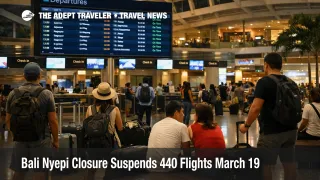
Bali's Nyepi airport closure is now a sharper operational story, not just a calendar reminder. I Gusti Ngurah Rai International Airport (DPS) in Denpasar, Indonesia, will suspend regular commercial flights from 600 a.m. Central Indonesia Time (WITA) on March 19, 2026, to 600 a.m. on March 20, and airport data shows 440 flights affected, 231 domestic and 209 international. The airport has now published the last workable departures and arrivals before the shutdown, which matters because Bali was already absorbing Middle East related cancellations before this week's silence day closure. Travelers with Bali stopovers, airport hotel nights, or onward ferry plans should treat March 18 as the main repositioning day, not March 19.
The practical traveler problem is wider than one airport. Canada, the United Kingdom, and Australia all warn that Nyepi brings island wide restrictions, with transport halted or heavily constrained, people expected to stay indoors, and airports, seaports, and harbours suspended. That means the Bali Nyepi airport closure can break a trip even when DPS is only a transit point or an overnight bridge to Lombok, the Gilis, or another Indonesia leg.
Bali Nyepi Airport Closure: What Changed
What changed since earlier Bali Nyepi coverage is that the airport has published exact edge times around the shutdown. The last domestic departure before closure is scheduled for 1110 p.m. on March 18, and the last international departure for 130 a.m. on March 19. The last domestic arrival is scheduled for 1105 p.m. on March 18, and the last international arrival for 1230 a.m. on March 19. After reopening, the first domestic departure is scheduled for 700 a.m. on March 20, the first international departure for 815 a.m., the first international arrival for 705 a.m., and the first domestic arrival for 820 a.m. Those times matter because they create a narrow shoulder period before and after the full closure, and they tell travelers exactly when a "late March 18" plan becomes a bad gamble.
The annual closure is routine, but the operational relevance is sharper this year because DPS was already dealing with Middle East related disruption. ANTARA reported 35 international Bali flights, 20 departures and 15 arrivals, had already been canceled as of March 12 because of airspace closures in several Middle Eastern countries. In plain terms, Bali is heading into Nyepi with less slack than a normal week.
Which Travelers Face the Most Disruption
The most exposed travelers are not only Bali vacationers. They are also the people using Bali as a timing bridge, late long haul arrivals into DPS, very early March 19 departures, transit passengers, and travelers trying to connect onward by sea. Canada says transit passengers will be required to stay inside the airport during the closure, while Australia says travelers transiting in Bali will have to stay inside the airport and should avoid overland travel. That turns DPS from a flexible transfer point into a hold space for anyone mistiming a connection.
Lombok and Gili itineraries are exposed because the sea side shuts earlier than many visitors expect. Indonesia's Transportation Ministry says the Padang Bai, Lembar crossing closes from 400 a.m. on March 19 until 1130 a.m. on March 20 at Padang Bai, and from 900 p.m. on March 18 until 130 a.m. on March 20 at Lembar. The Ketapang, Gilimanuk crossing also closes, with Ketapang shut from 500 p.m. on March 18 and Gilimanuk from 500 a.m. on March 19, both reopening at 6:00 a.m. on March 20. For travelers, that means a March 18 evening move toward Lombok can already fail before the island wide silence day fully begins. Gili itineraries are also vulnerable when they depend on Bali harbours and pre Nyepi boat timing, even if your final destination is not Bali itself.
What Travelers Should Do Now
The cleanest move is to reposition by March 18, 2026, not to test the margins overnight. Travelers departing Bali should aim to leave on March 18 unless they hold a clearly confirmed pre 6:00 a.m. March 19 departure and have lodging and ground transport close enough to make that timing realistic. Travelers arriving in Bali should also aim for March 18 arrivals with enough buffer to reach their hotel before Nyepi restrictions tighten. Anyone planning Bali to Lombok or Bali to Gili handoffs should move even earlier if their route depends on Padang Bai, Lembar, Ketapang, or Gilimanuk.
The main decision threshold is simple. If Bali is only a connection point, and your itinerary depends on same night movement, do not trust a shoulder hour itinerary around March 19. Rebook earlier if the trip contains a long haul departure, a cruise or tour check in, a wedding, a liveaboard, or any other fixed time commitment. If you will be in Bali during Nyepi, shift from mobility planning to containment planning. Canada says hotels may not offer food service, and official travel advisories say travelers should prepare ahead with adequate food and water and expect shops, restaurants, and tourist sites to close.
Watch March 20 as a recovery day, not a normal day. The airport reopens at 600 a.m., but the first scheduled departures do not begin until 700 a.m. domestically and 8:15 a.m. internationally, which means the first flight banks are already compressed. Add in Ramadan and Eid traffic pressure across Indonesia, which Australia warns will strain airports, seaports, highways, toll roads, and other transport nodes in the same period, and the likely result is a more fragile reopening window for airport transfers and onward island moves.
Why the Disruption Spreads Beyond DPS
Nyepi works differently from a normal airport closure because it is an island wide observance, not an aviation only event. The United Kingdom says people in Bali are expected to stay indoors, turn off lights, and make no noise, with only emergency services and hospitals operating. Canada says transport is halted and everyone must stay home, while Australia says airports, seaports, and harbours suspend operations and travelers should avoid overland travel. Once flights, harbours, roads, and most normal commercial activity tighten together, the usual backup options that save a trip, an overnight airport hotel move, a morning ferry, a late dinner stop, a last minute taxi, or a quick island hop, stop functioning together too.
That is why the first order effect is obvious, no regular arrivals or departures at DPS, but the second order effects are where travelers get trapped. Hotel inventory pressure rises around the airport and major resort zones as people protect March 18 and March 20 timing. Ferry and fast boat demand compresses into the last pre closure sailings and first post reopening windows. Airport and harbour queues can rise even without a "crisis" headline because everyone is trying to use the same few workable banks. That is also why earlier Adept coverage, including Bali Nyepi March 19, 2026 Shuts Airport, Ferries and Fastboats Bali to Lombok Suspended, Same Day Canceled, remains useful context for travelers deciding how much slack to add around Bali and Lombok transfers.
Sources
- Bali Airport Announces 24 Hour Operational Suspension During Nyepi, ANTARA News
- Bali Ferry Services Closed for Nyepi 2026: Full Schedule, ANTARA News
- Travel Advice and Advisories for Indonesia, Government of Canada
- Indonesia Travel Advice and Safety, Smartraveller
- Safety and Security, Indonesia Travel Advice, GOV.UK