

O'Hare Summer Flight Cuts Move Toward Hard Limits
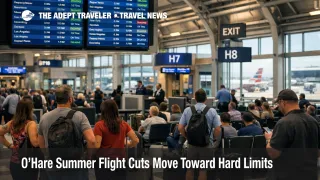
Chicago O'Hare International Airport (ORD) summer planning has moved beyond a weather delay debate and into a formal capacity fight that could change flights already on sale. Reuters reported on March 16, 2026, that the Federal Aviation Administration now wants to cut ORD to 2,608 daily flights this summer, down from the 2,800 level it floated publicly in late February, and far below the roughly 3,080 daily flights airlines had scheduled. The hearing resumes on Thursday, March 19, 2026, which means the next phase is not abstract signaling, it is the lead-in to a final FAA order that could force timetable cuts, retimed banks, and thinner recovery options at one of the country's biggest hubs.
The practical traveler issue is not that every ORD booking suddenly becomes invalid. It is that an itinerary sold before the final order may still be legal to sell today while remaining operationally too optimistic for the summer system the FAA says it can actually run. That makes flexibility, connection margin, and backup options more important than the published schedule alone.
O'Hare Summer Flight Cuts: What Changed
What changed since prior coverage is the floor moving lower. The FAA first proposed a 2,800 daily limit for Summer 2026, but Reuters now reports the agency has reduced its working target to 2,608 daily flights and plans to allocate reductions proportionally based on last summer's schedules so the burden is shared across carriers rather than concentrated on one airline. The agency first convened the meeting on March 4, adjourned it, and now plans to resume on Thursday, March 19.
That matters because 2,608 is not a cosmetic trim. It sits below last summer's average of 2,680 daily flights at ORD, not just below the published Summer 2026 peak schedule. In other words, the FAA is no longer trying to shave back an aggressive growth plan to a familiar operating level. It is signaling that the workable summer ceiling may be lower than what O'Hare actually averaged last summer.
The final order has not been published yet, so travelers should not treat every summer ticket as doomed or every specific flight as already cut. But the process is formal. In its March 3 Federal Register notice, the FAA said it would consider written submissions and then publish a final order on delay reductions at ORD, expected to apply through the Summer 2026 scheduling season from March 29 through October 25, 2026.
Which Travelers And Airlines Are Most Exposed
United Airlines and American Airlines are the clearest exposure points because they drove much of the schedule expansion that triggered the fight. Reuters reported that United planned about 780 daily ORD flights this month, up from 541 per day last year, while American said its summer daily departures would rise to 526 from 484 last summer after announcing 100 added daily departures to more than 75 destinations.
For travelers, the highest risk is not every nonstop. It is itineraries that need O'Hare to function as a clean transfer machine. Domestic to international connections, late day onward banks, separate ticket builds, same day event or cruise joins, and premium itineraries built around narrow timing windows are the most fragile if airlines lose duplicate frequencies or backup departures. That is the real consequence of structural cuts, fewer ways to recover when an inbound runs late, a gate change drags, or weather takes even a small bite out of the day. For prior Adept coverage, see FAA pushes O'Hare summer cuts deeper into peak season and Chicago O'Hare Summer Flight Cap Planned by FAA.
There is also a second order effect outside Chicago. ORD is a national connection hub, so peak hour cuts can change aircraft utilization, misconnect patterns, and same day reaccommodation across Midwest and transatlantic flows. If ORD banks get thinner, displaced demand does not vanish, it spills into rival hubs, alternate departure times, and higher pressure on remaining seats.
What Travelers Should Do Before The Final Order
Travelers with flexible leisure trips should treat current summer ORD schedules as provisional until the FAA issues its final order and carriers reflect any cuts in their timetables. That does not mean panic rebooking every June, July, or August trip. It means favoring tickets with easy change terms, avoiding self-built tight connections, and being skeptical of itineraries that rely on the last practical onward flight of the day.
The main decision threshold is tolerance for failure. If a trip can absorb a modest retime or a later same day reaccommodation, keeping an ORD booking may still be reasonable while you monitor for schedule changes. If a missed connection would break a cruise embarkation, wedding, tour start, or long haul departure, the safer play is to add margin now, either by booking a nonstop, choosing an earlier connection, or arriving the night before.
Travelers should also watch for the order to hit bookings in two stages. First comes the FAA's final order, which sets the operating constraint. Then comes the airline response, which is when specific flights are retimed, combined, or removed from sale. The first visible clue may not be a cancellation email, it may be a quiet schedule change, a vanished duplicate departure, or a weaker same day backup. Broader system context is in U.S. Air Traffic Control Privatization: Reality Check.
Why The FAA Is Pushing Lower, And How The Risk Spreads
The FAA's core argument is straightforward. The published ORD summer schedule is too large for the airport and system to run reliably under current conditions. In late February, the agency said more than 3,080 daily operations were scheduled on peak days, versus about 2,680 last summer, and warned the increase would stress runway, terminal, and air traffic control systems. By March 16, it had moved to an even lower working target of 2,608 daily flights.
This is why the story matters even before summer storms hit. Overscheduling compresses the slack that usually helps a hub recover. When a bank is too dense, the first order effect is local, longer taxi times, slower turns, tougher gate management, and more fragile sequencing. The second order effect is network wide, missed connections, thinner reaccommodation, crew and aircraft displacement, and rising fare pressure on the flights that remain. Chicago has argued the FAA should not cut below 2,800, calling deeper limits unwarranted, but the agency is clearly prioritizing reliability over the airlines' published growth plan.
What is confirmed is that the FAA has a formal process, a resumed March 19 hearing, and a much lower current target than its original public benchmark. What is not yet confirmed is the exact final number that will appear in the order, and which specific flights or banks each carrier will sacrifice. Until that order lands, travelers should read ORD summer bookings as changeable inventory, not settled reality.
Sources
- FAA to resume hearing Thursday on plan to reduce flights at Chicago O'Hare, Reuters
- Operating Limitations at Chicago O'Hare International Airport, Notice of Meeting and Request for Information, Federal Register
- FAA plans to reduce flights at Chicago O'Hare, cites boost in schedules, Reuters
- Chicago says FAA should not cut daily flights below 2,800, Reuters