

Philippines Overstay Relief Runs Through April 1
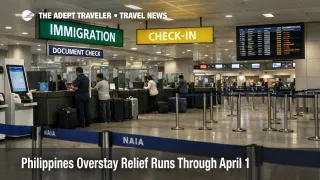
The Philippines has introduced a narrow but useful legal buffer for stranded foreign visitors. Updated U.K. travel advice says the Philippines Bureau of Immigration will allow affected foreign nationals whose valid stay expired on or after February 28, 2026, to remain legally in the country until April 1, 2026, without fees, fines, or penalties, while also warning that Middle East escalation has caused wider flight disruption that can still affect trips even outside that region. For travelers, that changes the immediate decision from panic departure to document preservation, rebooking discipline, and planning for what happens if a new flight slips past the relief window.
The Philippines overstay relief matters because it converts a missed departure from an instant immigration problem into a short planning window. It does not remove the need to leave, and it does not prove that every disrupted traveler will be handled the same way after April 1, but it gives affected visitors breathing room to stabilize flights, lodging, and airport transfer costs without immediate overstay penalties.
Philippines Overstay Relief: What Changed
What changed is specific, and date bound. The U.K. Foreign, Commonwealth & Development Office updated its Philippines advice on March 17, 2026, stating that affected foreign nationals whose valid stay expired on or after February 28, 2026, can remain legally in the Philippines until April 1, 2026, without payment of fees, fines, or penalties. The same update says commercial options to depart remain available, but travel plans may still be affected by broader disruption tied to escalation in the Middle East, including airspace closures and delayed or canceled flights.
That is an important distinction for travelers and advisors. This is not a broad visa amnesty or a long term status change. It is temporary overstay relief linked to disruption, and the practical value is immediate. A traveler who missed a departure or had to accept a later reroute now has a brief legal cushion to reorganize the trip instead of rushing into a same day exit at any price.
Who Qualifies, and Who Still Needs to Act
The clearest confirmed eligibility point is the stay expiry date. The published wording says the relief applies to affected foreign nationals whose valid stay expired on or after February 28, 2026. What remains less clear in the public facing material is how the Bureau of Immigration is defining "affected" in individual cases, so travelers should assume they may need to show that a disrupted or rebooked itinerary actually prevented timely departure.
That means documentation now matters more than arguing later. Travelers should keep the passport page showing their last valid admission or extension, canceled or changed flight notices, new ticket confirmations, payment receipts for extra hotel nights, and any written airline or travel agent communication showing why departure moved. This is the kind of record that can support your timeline if an officer, airline, or insurer later asks why you stayed beyond the original validity date. Travelers moving through Manila should also watch the separate local transport picture, because Metro Manila Protests Raise Airport Timing Risk shows how ground access can still break a legal departure plan even when a flight exists.
The group that still needs to act fastest is anyone whose revised trip is pushing beyond April 1. The Bureau of Immigration's own FAQ says temporary visitors should apply for extensions at least one week before valid stay expires, and that the normal extension process requires a passport and a completed visa extension form filed at a BI office.
What Travelers Should Do Before April 1
First, treat April 1 as a hard decision point, not a vague safety net. If you already hold a confirmed departure before then, keep your documents organized and recheck the booking directly with the airline. If your flight is waitlisted, on a fragile self transfer, or still depends on a reroute through disrupted airspace, start working a backup now rather than assuming another grace period will appear.
Second, line up the paperwork that would support either path. For departure, that means proof of your original stay validity, your disrupted itinerary, and your replacement booking. For a stay that may extend past April 1, it means preparing for the standard extension process instead of improvising at the last minute. BI's FAQ says extensions should be sought at least one week before expiry, and its published visa waiver and extension tables show that normal fees resume outside relief periods.
Third, do not ignore the money side just because the overstay penalty is paused. Legal relief does not automatically solve hotel overruns, new airport transfers, or nonrefundable onward travel. Travelers with expensive uncovered losses should review whether their policy helps with disruption related costs. CFAR Travel Insurance Demand Jumps in March 2026 is not a solution for a trip already underway, but it is a useful reminder that flexible coverage usually has to be purchased early, before a disruption becomes a known problem.
Why Flight Disruption Turned Into an Immigration Issue
The mechanism here is straightforward. The FCDO says Middle East escalation has caused widespread travel disruption, including airspace closures and delayed and canceled flights, and that even travelers whose destination is not in the Middle East can still be affected. Once those delays push a visitor past the end of a lawful stay, a flight problem becomes an immigration problem.
That creates both first order and second order effects. First order, stranded visitors avoid immediate overstay penalties until April 1, which buys time to rebook and avoid a forced high cost exit. Second order, hotels, airport transfers, and onward tickets become more manageable because travelers are not dealing with a simultaneous immigration breach. But the tradeoff is obvious, too. The longer a traveler waits to resolve an uncertain itinerary, the more likely the issue shifts back from protected overstay relief to normal BI processing, fees, and deadline pressure.
The sensible move is to use the Philippines overstay relief window as a controlled reset, not as permission to drift. Keep proof of disruption, confirm whether your departure really clears before April 1, and move to a formal extension path early if it does not.