

Newark Airport AirTrain Delays Hit Weekday Rail Links
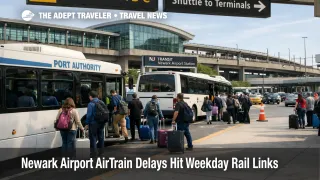
Newark Liberty International Airport (EWR) still has a live daytime rail-to-terminal bottleneck, and that matters more than a one night maintenance notice. NJ TRANSIT says that from 500 a.m. until 300 p.m. on most weekdays through late May, AirTrain service at Newark Airport Station is replaced by Port Authority shuttle buses, even though trains continue making normal stops at the airport rail station. For travelers using NJ TRANSIT or Amtrak to reach EWR, the change is simple but costly, the rail leg still works, but the last transfer to the terminal is slower and less predictable. The practical move is to treat daytime Newark departures and arrivals as shuttle dependent and add buffer before you commit to a tight check in, bag drop, or same day onward connection.
The Newark Airport AirTrain disruption is not a full airport rail shutdown. It is a recurring weekday transfer drag tied to work on the AirTrain Newark Replacement Program, while weekend service generally runs normally and the agencies say some holiday and vacation periods with heavier traffic are excluded from the weekday shuttle substitution. That distinction matters because travelers may see trains operating to Newark Airport Station and assume the rest of the airport rail chain is normal. It is not, at least during the weekday daytime work window now in effect.
Newark Airport AirTrain Disruption: What Changed
What changed is the handoff at Newark Airport Station, not the rail service to the station itself. NJ TRANSIT says trains continue to stop normally, but customers arriving at the rail station are then directed to Port Authority shuttle buses for the terminal leg from 500 a.m. to 300 p.m. on most weekdays through late May. NJ TRANSIT also notes that a normal AirTrain trip between the rail station and the terminals takes about 15 minutes, which gives travelers a baseline for how quickly this transfer usually works when buses are not in the chain. Once buses replace that segment, even a modest queue, luggage loading delay, or curbside backup can stretch the door to door timing.
This is why the story matters during spring travel. EWR still looks rail served on paper, but the traveler experience is now a train plus bus sequence for much of the weekday business and midday flying window. That adds one more failure point to trips that already depend on station arrival timing, fare gate flow, terminal assignment knowledge, and check in deadlines. The result is a softer but still meaningful form of airport access disruption, especially for travelers who chose Newark specifically because the NJ TRANSIT and Amtrak connection usually feels cleaner than driving.
Which Travelers Face the Most Delay Risk
The most exposed travelers are daytime rail users arriving from Manhattan, Newark Penn Station, Trenton, the Jersey Shore corridor, or Amtrak points on the Northeast Corridor who planned around a fast station to terminal transfer. NJ TRANSIT says at least six trains per hour stop at Newark Liberty International Airport Station between 600 a.m. and 900 p.m. on weekdays, which means the rail side remains frequent enough to attract a lot of airport demand. That is exactly why a bus bridge at the station can create friction even without a rail cancellation, because the transfer demand keeps arriving while curbside boarding moves more slowly than an automated people mover.
Travelers checking bags, traveling with children, carrying more luggage, or arriving during the late morning and early afternoon bank are likely to feel the change most. So are people landing at EWR and expecting a smooth same seat rail exit into New York or New Jersey. First order, the terminal to station leg becomes less predictable. Second order, that can break the math on a same day Amtrak departure, a prebooked car pickup, or a meeting, show, or hotel arrival built on normal AirTrain timing. Newark has already been featured in Adept Traveler coverage as an airport where access resilience matters when the region's broader transport network is under stress, including NYC Transit Shutdown Blocks JFK, LGA, EWR Access and the earlier outage focused article, AirTrain Newark closure, August 26 to 27: what to know.
What Travelers Should Do Now
For weekday departures from EWR between now and late May, the safe planning move is to add at least 20 to 30 minutes beyond your normal rail-to-terminal allowance, and more if you are checking bags, moving with a family group, or traveling during midday bank periods. NJ TRANSIT's own guidance says the normal AirTrain station to terminal trip is about 15 minutes. A bus substitution can erase that advantage quickly once you add walking, wayfinding, waiting, boarding, traffic within the airport road system, and unloading with luggage. That means a rail itinerary that looked comfortable on paper can become tight in practice.
For arrivals, do not assume your rail departure time is safe until you are actually clear of the terminal and on the shuttle. If you have an Amtrak booking, a timed intercity bus, or a nonrefundable pickup, build slack on the back end of the flight as well. Travelers with truly tight margins may be better off comparing the cost of a direct taxi or rideshare from the terminal against the risk of missing the longer rail chain, especially because NJ TRANSIT notes rideshare is not directly available at Newark Airport Station itself, which weakens the station as a last minute bailout point.
Over the next several weeks, watch for any update that changes the weekday hours, the holiday exceptions, or the projected late May end point. Until then, the decision threshold is straightforward, use rail to EWR when you still have margin, but avoid treating Newark Airport Station as a quick terminal handoff during the weekday daytime work window. If your itinerary cannot absorb a transfer miss, pay for certainty earlier rather than trying to save money on the access leg.
Why the Rail Link Is Slower, Even With Trains Still Running
The mechanism here is easy to miss because the disruption sits in the middle of the chain. The Northeast Corridor and North Jersey Coast Line still bring passengers to Newark Airport Station, but the final connector is being downgraded from a dedicated automated people mover to a shuttle bus operation during most weekday daytime hours. That swap reduces throughput and increases variability. Trains arrive on schedule, but passengers then have to queue, load baggage, wait for bus capacity, and ride through airport roads that are also handling private cars, taxis, hotel shuttles, and terminal traffic.
That is also why the second order effects matter. A rail link that becomes bus dependent pushes more uncertainty onto the curb, raises the value of direct car service, and makes missed check in windows more plausible for people who would normally trust transit all the way to the terminal. More broadly, this fits a pattern Adept Traveler has been tracking at Newark, where resilience, not just raw service availability, often determines whether an itinerary holds together. The structural backdrop is the multiyear AirTrain replacement effort, and the operational lesson is that access does not have to be fully shut down to become a real traveler risk. For a wider look at how fragile airport systems can become when one link weakens, see U.S. Air Traffic Control Privatization: Reality Check.
Sources
- Newark Airport Station: AirTrain Service replaced by Shuttle Bus - Beginning Thursday, January 15, 2026, NJ TRANSIT
- Newark Liberty International Airport rail service page, NJ TRANSIT
- Newark Liberty International Airport homepage alert, Port Authority
- Construction Advisory, Newark Liberty International Airport