

U.S. Global Entry Restart Eases Arrivals, Not TSA Lines
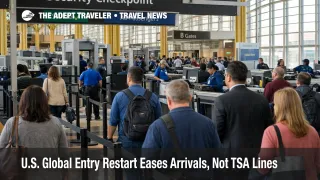
The Global Entry restart is a real traveler operations shift, but it is only a partial fix. The Trump administration reinstated the fee funded program on March 11, 2026, after suspending it on February 22, restoring faster customs and immigration clearance for pre approved, low risk travelers arriving in the United States. That matters because Reuters reported the suspension had pushed some inbound waits past three hours. But it does not solve the bigger departure side problem, where TSA absences remained at 9.9 percent on March 18 and Transportation Secretary Sean Duffy warned on March 19 that smaller airports could soon face shutdown risk if the staffing strain worsens.
Global Entry restart changes the math for eligible inbound passengers, especially those landing on tight onward connections, same day rail links, or hotel check in plans after long haul flights. The immediate traveler takeaway is simple. If you already have Global Entry, arrivals got easier again on March 11. If you do not, you are still exposed to the same immigration queue volatility that built up during the suspension, and everyone remains exposed to unstable security screening on departure.
Global Entry Restart: What Changed for Travelers
The operational change is specific. Global Entry is back, and that restores expedited U.S. customs and immigration processing for enrolled travelers. Reuters reported that DHS reactivated the program at 5:00 a.m. ET on March 11 after suspending it during the partial shutdown. U.S. Customs and Border Protection describes Global Entry as an expedited clearance program for pre approved, low risk travelers, so the restart directly affects the arrivals process at the border, not the security checkpoint before departure.
That distinction matters because some travelers may read "restart" as a broader normalization signal. It is not. The restart eases one border bottleneck for members, but it does not repair TSA staffing, reopen every checkpoint that has been consolidated, or eliminate the need for large departure buffers at stressed airports. In other words, the Global Entry restart helps the back half of an international arrival, while TSA strain is still disrupting the front half of many U.S. departures.
Which Travelers Benefit First, and Who Is Still Exposed
The clearest winners are eligible international arrivals who already hold Global Entry membership. They regain a faster path through passport and customs processing, which can lower missed connection risk on onward domestic flights and reduce late night arrival slippage into rail transfers, car pickups, and hotel check ins. Reuters also cited Senator Mark Warner saying more than 18 million travelers used Global Entry in 2025, saving more than 300,000 officer hours at 79 ports of entry, which helps explain why suspending it quickly became a real operations problem rather than a niche membership story.
The travelers still most exposed are non members, first time international visitors, and anyone departing from airports where TSA staffing remains thin. Reuters reported that about 30 percent of TSA officers failed to show up on Tuesday at New York John F. Kennedy International Airport (JFK), Pittsburgh International Airport (PIT), and George Bush Intercontinental Airport (IAH), while Houston Hobby Airport (HOU) hit 40 percent. Since normal absentee levels are typically under 2 percent, the current gap is not a rounding error. It is a structural operations problem that can still break departure timing even after Global Entry's return.
What Travelers Should Do Now
Travelers arriving from abroad should use the Global Entry restart as a tactical advantage, not as a reason to cut connections too tightly. Members can again expect a faster arrivals process, but baggage delivery, terminal transfers, and any recheck or onward domestic security step can still erase that gain. A shorter immigration line does not guarantee a clean end to end connection.
For departures, the safer play is still to pad airport arrival times, especially at larger U.S. airports already showing elevated callout rates or checkpoint reductions. Reuters reported long lines at several major airports, closed checkpoints at some facilities, and warnings that conditions could worsen as TSA officers approach another missed paycheck on March 27. Travelers with morning departures, complex family check in needs, or checked bags should be more conservative, not less, on timing.
The next decision point is whether this remains a large hub delay story or spills into actual airport shutdowns. Duffy said on March 19 that if the standoff continues into next week, smaller airports could begin shutting down and extensive lines could spread further. That means travelers should watch two things over the next several days, staffing headlines tied to the March 27 paycheck, and whether airports start announcing additional checkpoint consolidations or screening hour cuts.
Why the System Is Improving in One Place and Failing in Another
The mechanism is straightforward. Global Entry reduces workload at the border by moving pre screened travelers through a faster inspection channel, so restarting it immediately helps inbound processing at ports of entry. Reuters reported that the suspension had produced waits of three hours or more for some arriving passengers, which shows how quickly removing a trusted traveler backstop can overload the regular arrivals channel.
TSA is a different system with a different pressure point. About 50,000 TSA officers have been working without pay during the shutdown, daily absences have run around five times the normal rate since Sunday, and 366 officers have left during the funding lapse, according to Reuters. First order, that creates longer security lines and occasional checkpoint closures. Second order, it increases missed flights, strains rebooking desks, and makes same day cruise, rail, and hotel plans less reliable even when the flight itself still operates. That is why the Global Entry restart is real news, but not a clean fix for U.S. airport operations.