

Oahu North Shore Flooding Hits Access and Lodging
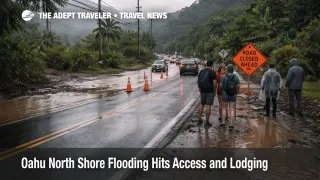
Oahu North Shore flooding turned into an active travel disruption on March 20 to 22, 2026, after severe rain triggered evacuations in and around Waialua and Haleiwa, forced more than 230 rescues, and pushed officials to warn that Wahiawa Dam was at risk of failure. For travelers, the main problem is no longer just rain. It is whether road access, local lodging, and day trip plans remain viable between Honolulu and the North Shore as warnings ease unevenly and cleanup begins. Anyone heading to Haleiwa or Waialua should treat this as a same day verification story, not a normal island excursion.
Oahu North Shore Flooding: What Changed
The disruption began when intense rainfall hit already saturated ground on Oahu, driving flash flooding across the North Shore and downstream of Wahiawa Dam. The immediate evacuation footprint reached about 5,500 people, and Governor Josh Green said damage statewide could exceed $1 billion. By March 21, officials said water levels at the dam had receded from their peak, but the risk had not disappeared completely because more rain remained in the forecast.
For travelers, the most important change since the first emergency push is that evacuation notices were later canceled for Waialua and Haleiwa on March 21, and HIEMA said all remaining evacuation orders on Oahu were lifted later that afternoon. That does not mean a clean return to normal conditions. The National Weather Service still had a Flood Watch in place for Oahu early on March 22, and Hawaii transportation officials were still reporting road hazards, washouts, slides, and flood related repairs across parts of the island.
Which Oahu Trips Face the Most Disruption
The highest risk group is travelers staying in, driving to, or planning day trips through Haleiwa, Waialua, Wahiawa, Waimea, and the North Shore corridor along Kamehameha Highway. Hawaii DOT reported flood related issues on Farrington Highway in Waialua near Naluahi Street and the Kaukonahua dam area, a sidewalk washout near the Karsten Thot Bridge in Wahiawa, and a northbound lane closure on Kamehameha Highway north of Kipapa Bridge in Waipio because of rockfall risk. Separate planned closures and stabilization work around Waimea Bay also matter because they reduce recovery flexibility on a corridor that already has limited alternate routing.
Trips from Waikiki or central Honolulu to the North Shore can still fail even if your hotel in Honolulu is operating normally. The weak point is the corridor itself. If one flood damaged segment, slope hazard, or police closure reappears, the problem spreads quickly into longer drive times, canceled surf lessons and tours, missed dining reservations, and tighter windows for airport transfers or same day returns. That is why Haleiwa and Waialua visitors should think in terms of route reliability, not just destination status.
Lodging is the second pressure point. Officials have been directing residents and evacuees to shelters and recovery resources, and HIEMA has also pointed people to hotel options for evacuees. That does not prove a broad North Shore hotel sellout, but it does support a more cautious planning assumption, especially for small properties and short notice bookings near affected communities.
What Travelers Should Do Now
Travelers with Haleiwa or Waialua stays over the next 24 to 72 hours should call the property directly before departing Honolulu and ask two blunt questions, whether the road approach they recommend is open right now, and whether the property has any flood related service limits or local access restrictions. Do not rely on a booking confirmation, a map app, or yesterday's social posts as proof that the route is usable today.
For day trips, the cleaner decision is to postpone if the outing depends on fixed timing, prepaid activities, or a same day return before a flight. Waiting makes more sense only when the trip is flexible, the operator confirms service the same morning, and Hawaii DOT and emergency alerts show stable access. Travelers with flights out of Daniel K. Inouye International Airport (HNL) should keep the airport and the North Shore as two separate questions. HDOT says HNL remains operational, with temporary pothole repairs underway, while Kawaihāpai, also known as Dillingham Airfield, is closed to all except military and emergency operations through Tuesday, March 24.
The official checkpoints to watch before moving between Honolulu and the North Shore are straightforward. Check Oahu emergency alerts and HIEMA for evacuation or shelter changes, Hawaii DOT's weather traffic page for real time state route impacts, and National Weather Service Honolulu for the latest Flood Watch or Flash Flood Warning language. If any one of those turns negative again, treat the trip as unstable even if the weather looks better from your hotel window.
Why Recovery May Outlast the Rain
The reason this event matters beyond one storm cycle is structural. North Shore travel depends on a limited number of road corridors, so when floodwater, slope damage, bridge concerns, or dam related warnings hit one part of the chain, the disruption does not stay local for long. It spills into lodging turnover, tour operations, airport timing, and the credibility of same day planning. That is the real travel consequence of Oahu North Shore flooding, not just the dramatic rescue count.
What happens next depends on whether additional rain reactivates the same weak points. The good news is that evacuation notices have been lifted, and major airports remain open. The less comfortable reality is that cleanup, inspections, pothole repairs, washout response, and slope stabilization can keep North Shore access fragile after the worst rainfall passes. Travelers should expect a recovery phase measured in route checks and local service confirmations, not a clean on off switch back to normal. For broader destination context, see Hawaii - Travel News and Guides from The Adept Traveler, and for airport side friction in the islands, see Hawaiian Hawaii Airport Renovations Through 2029.
Sources
- Hawai'i Emergency Management Agency
- Weather Related Traffic Alerts | Hawaii Department of Transportation
- Oahu Lane Closures | Hawaii Department of Transportation
- Flood Watch | National Weather Service Honolulu
- Over 5,500 People Told to Evacuate Floods on Oahu's North Shore | AP News
- Hawaii Suffers Its Worst Flooding in 20 Years With More Rain Coming | AP News