

Air France Paris Gulf Routes Stay Cut Through March 31
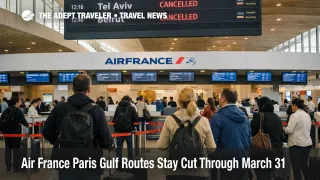
Air France Paris Gulf routes weakened again on Sunday, March 23, when the carrier extended its Dubai and Riyadh suspensions through Monday, March 31, and its Tel Aviv and Beirut suspensions through Friday, April 4. For Europe to Gulf travelers, the practical issue is not only another week of canceled nonstops from Paris. It is that Paris Charles de Gaulle Airport (CDG) becomes a less reliable recovery bridge at the same time regional airspace remains constrained and rival hubs are still operating below normal. Travelers with mixed carrier tickets, short overnight connections, or Easter week repositioning should stop treating Paris as a dependable last minute fallback and rebuild with a protected backup now.
Air France Paris Gulf Routes, What Changed
Air France said on March 23 that flights to and from Dubai and Riyadh are now suspended through March 31, while Tel Aviv and Beirut remain suspended through April 4. The airline cited the security situation at those destinations and the closure of certain airspace. That pushes the disruption window deeper into the final week of March and into the early April holiday buildup, extending a problem that had already been narrowing Europe to Middle East options.
This matters differently from earlier suspension stories because Air France is a major European network carrier with Paris at the center of its long haul connectivity. When Paris loses these nonstop corridors for another week, travelers are not just losing a flight number. They are losing one of the cleaner one stop rebuild options for itineraries that were already damaged by Gulf hub interruptions, fuel shock, and selective route cuts across Europe. In an earlier Adept Traveler article, KLM Dubai, Riyadh, Dammam Suspensions Extend to May 17 showed that even within the Air France KLM group, Gulf access was already tightening. In another, Europe Fare Hikes, Fuel Shortage Warnings Spread explained why replacement capacity is becoming more expensive and less forgiving.
Which Travelers Face the Most Exposure
The most exposed travelers are the ones who were using Paris as a repair point rather than a final destination. That includes Europe based passengers trying to reconnect into the Gulf after earlier cancellations, U.S. travelers building open jaw or mixed carrier itineraries through Paris, and corporate travelers who need Riyadh or Dubai on fixed dates and cannot absorb a missed overnight. Travelers headed to Beirut or Tel Aviv are dealing with a longer suspension window still, which makes Paris less useful for eastern Mediterranean onward planning as well.
The obvious substitute transfer points are the Gulf hubs that are still running reduced operations, namely Dubai, Abu Dhabi, and Doha. But those are not normal substitutes. Reuters reported on March 23 that Emirates was operating at about 75 percent of normal capacity, Etihad at about 50 percent, and Qatar Airways at about 20 percent. That means displaced passengers from Air France, KLM, Lufthansa group carriers, and others are competing for seats in systems that are already capacity constrained. The first order effect is fewer acceptable same day options. The second order effect is more forced overnight stays, more baggage separation across carriers, and more rebooking pressure when one broken segment knocks out the rest of the ticket.
Paris based itineraries are especially fragile when they depend on a self transfer, a separate ticket onward from a Gulf hub, or a same night hotel check in tied to a late arrival. Those plans can still work, but the margin for error is now too thin to trust without a fallback that you would actually be willing to use. In an earlier Adept Traveler article, Qatar Doha Flights Stay Limited Through March 28 showed that even the most important remaining Gulf transfer platform is still operating in a limited, corridor constrained mode.
What Travelers Should Do Now
Travelers booked on affected Air France sectors should not wait for Paris to become a clean late March workaround unless the itinerary is on one protected ticket and the airline has already reissued it. The safer move is to price and compare a backup now, preferably one that keeps the long haul and the onward segment on the same record, or at minimum leaves a real overnight cushion at the transfer point. A protected connection may cost more, but it is often cheaper than paying for a last minute hotel, new baggage fees, and a replacement onward fare after a misconnect.
For travelers who still need Gulf access before April, the next decision point is not whether any seat exists. It is whether the remaining seat leaves enough slack to survive another schedule change. Rebook now if your trip has a fixed arrival date, if you are ticketed on separate carriers, or if a missed arrival would trigger a lost meeting, cruise embarkation, tour, or event. Wait only if your ticket remains changeable, you can accept an overnight disruption, and you are monitoring airline messages closely enough to act before the next capacity squeeze.
Over the next 24 to 72 hours, watch three things. First, whether Air France extends beyond March 31 or April 4. Second, whether remaining Gulf operators trim schedules again. Third, whether fares jump further as more stranded demand is funneled into fewer workable routings. Travelers who still want to use Air France Paris Gulf routes later this week should also check whether their booking has been reprotected onto a partner itinerary or merely left in canceled status awaiting action.
Why Paris Is a Weaker Middle East Fallback Now
Paris is weaker now because the system problem is stacking, not clearing. Air France cited security conditions and closed airspace for this latest extension, while Reuters separately reported that the broader conflict has left major Gulf carriers recovering slowly and well below normal capacity. At the same time, European airlines are warning about higher fares and possible fuel shortages as reroutings lengthen sectors and refined jet fuel costs stay elevated. That combination strips away the normal advantages of a big hub. A large network only helps if there is enough usable onward capacity to absorb disruption.
What happens next depends less on Paris itself than on whether regional airspace and Gulf hub throughput improve. If Gulf operations remain partial, more European travelers will keep crowding into the same reduced set of alternatives, and Paris will stay a weak bridge for Middle East recovery even after one airline restores a route. If operating windows widen, Paris can recover some of its usefulness quickly because Air France still offers a powerful network base. For now, though, the prudent assumption is that Air France Paris Gulf routes are not a dependable spring repair path unless your backup is already built into the ticket.
Sources
- Air France Extends Suspension of Its Flights to and From Dubai, Riyadh, Tel Aviv, Beirut
- Gulf Airlines Recover Slowly as Iran Conflict Drags
- European Airlines Warn of Higher Fares, Fuel Shortages Due to Iran War
- Qatar Doha Flights Stay Limited Through March 28
- KLM Dubai, Riyadh, Dammam Suspensions Extend to May 17
- Europe Fare Hikes, Fuel Shortage Warnings Spread