

Europe Fare Hikes, Fuel Shortage Warnings Spread
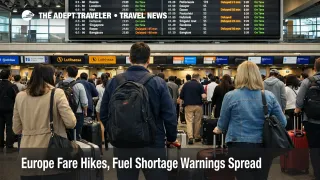
TSA shutdown delays at U.S. airports have moved beyond a bad spring break weekend into a broader network risk as the partial Department of Homeland Security shutdown continues on March 20, 2026. The latest change is not just longer lines at a few big airports. Overall TSA absences rose back to 10.2 percent on Wednesday, with much higher rates at some hubs, while federal officials are now warning that some small airports could face checkpoint shutdowns if another missed paycheck on March 27 pushes more officers to stay home. Travelers should build more buffer, avoid tight same day connections, and treat smaller departure airports as less resilient than usual.
TSA Shutdown Delays: What Changed
What changed since the March 10 line surge is that the disruption has become more structural. U.S. Travel and Airlines for America were initially warning about multi hour waits in places such as Houston, Atlanta, Charlotte, and New Orleans. Now the national absenteeism rate is still running at about five times normal, according to Reuters, and Transportation Secretary Sean Duffy has publicly warned that next week could look materially worse as another paycheck is missed.
That matters because checkpoint problems do not stay contained at the checkpoint. A two or three hour screening delay can break the whole day even when the flight is still operating, especially for travelers connecting onward to a cruise embarkation, an international departure, or a smaller domestic airport with only a few later rebooking options. The TSA passenger volume page shows more than 2.57 million travelers cleared on March 18 alone, which means the system is already carrying heavy spring demand while staffing remains unstable.
The operational seriousness is now higher than a simple inconvenience story. Reuters reported that 366 TSA officers have left during the shutdown, some airports have already closed checkpoints, and senior officials say lightly staffed airports could be forced to stop screening altogether if the standoff drags on.
Which Travelers Face the Most Disruption
The most exposed travelers are the ones who have the least slack in the itinerary. That includes families flying on peak spring break mornings, travelers booked on the first leg out of a smaller airport, passengers with checked bags and short hub connections, and anyone trying to link an airport trip to a fixed time event such as a cruise sailing, wedding, tour pickup, or long haul international departure.
Large hubs are still the most visible pressure points, but not always the most fragile ones. Reuters said absentee rates on Wednesday reached 38 percent at Hartsfield Jackson Atlanta International Airport (ATL) and at George Bush Intercontinental Airport (IAH), while John F. Kennedy International Airport (JFK) and San Juan also posted far above normal absence levels. Big hubs can sometimes consolidate lanes and absorb pain through longer waits. Small airports often cannot. When there is only one checkpoint, the problem can shift from slower screening to no viable screening operation at all.
This is also why the story is no longer only about passenger frustration. U.S. Travel said it has launched a live tracker showing how many days Transportation Security Officers have gone without a paycheck, and Geoff Freeman said the industry is pushing for immediate action and lasting protections after a second shutdown driven pay crisis in less than six months. In practical terms, the staffing problem is becoming a retention problem, and retention problems are harder to reverse quickly than a single bad line day.
What Travelers Should Do Now
Travelers flying in the next several days should leave more buffer than they normally would, especially at airports already reporting strain or on routes that depend on a hub connection. For most domestic trips, the safer move is to treat the airport like a disruption day even if the weather is clear and the airline app shows the flight on time. A clean flight status does not protect you from a screening bottleneck.
The rebooking threshold is also shifting. If the trip has a hard deadline and starts at a small airport, changing to an earlier departure, a larger airport, or an overnight before a long haul segment can be the smarter choice than waiting to see whether local screening holds together. If the trip is flexible and your airport has multiple same day frequencies, waiting can still be reasonable, but only if you monitor both the airport and airline closely. In an earlier Adept Traveler article, U.S. TSA Shutdown Delays Ease, Risk Still Rising tracked the slight improvement on March 18 that proved too small to solve the broader traveler problem. In another earlier Adept Traveler article, U.S. Shutdown Airport Closure Risk Hits Small Fields explained why smaller airports are the next threshold to watch.
What to monitor next is straightforward. Watch for airport specific guidance about reduced checkpoint hours, closed lanes, or earlier arrival recommendations. Watch for another rise in national absenteeism. And watch March 27, when a second missed paycheck could turn an already stretched system into something much less predictable.
Why the Disruption Is Spreading, and What Happens Next
The mechanism is simple. TSA officers are still legally required to work, but unpaid federal workforces do not operate like normal ones for long. More callouts mean fewer open lanes, fewer open lanes mean slower throughput, and slower throughput pushes missed flights, broken connections, and longer airline service lines even when aircraft and crews are otherwise ready. The second order effect is that a checkpoint problem becomes an itinerary recovery problem across airlines, hotels, cruise terminals, car rentals, and airport ground transport.
That is why the travel industry response has broadened. A4A has called the current waits unacceptable, U.S. Travel says current screening rates and spreading delays could cost the economy nearly $1 billion, and the wider industry coalition is now framing the issue as both a traveler security problem and a workforce protection problem.
What happens next depends less on airline schedules than on whether Congress ends the DHS funding lapse before the next pay shock lands. Until that happens, travelers should assume TSA shutdown delays can worsen quickly, unevenly, and airport by airport. The immediate risk is more long lines at big hubs. The more serious risk is that some smaller airports lose screening resilience altogether just as spring travel volume keeps building.
SourcesaEuropean airlines are no longer talking only about expensive fuel. They are now openly warning about higher fares, possible jet fuel shortages, and broader schedule pressure as the Iran war drives up refined fuel costs and forces longer routings around disrupted airspace. For travelers booking Europe trips now, the main risk is not an immediate continent wide collapse in flying. It is a more uneven operating environment over the next several weeks, with pricier tickets, thinner frequencies on weaker routes, and less slack when flights are canceled or missed. The practical move is to lock in important trips earlier, avoid fragile connections, and watch airlines with weaker hedging or already announced cuts.
Europe Airline Fuel Shortages: What Changed
Reuters reported on March 19 that airline leaders in Brussels warned fuel prices have surged as Middle East conflict and airspace disruption hit both cost and operations. The new element is the industry's use of explicit shortage language, especially around jet fuel availability, not just generic inflation talk. Reuters also reported that European jet fuel prices had climbed above $220 per barrel, while refiners and traders in Europe and Asia were scrambling for alternative supply as Middle East output and shipping were hit.
That distinction matters for travelers. A fare increase can be absorbed, delayed, or targeted to certain markets. A physical supply squeeze is different, because it can force airlines to trim flying, prioritize core routes, and run aircraft harder across fewer frequencies. That is already starting to show up in Europe. SAS moved to cancel about 1,000 April flights because of higher fuel costs, and Reuters reported that some carriers are already telling travelers to book earlier before hedges roll off and prices move further.
The industry is also trying to use this moment to challenge EU policy timing. Airlines for Europe said this week that the broader 6 percent SAF target for 2030 could stay if prices fall, but argued the synthetic eSAF sub mandate is now untenable. That lobbying push is real, but it is not itself a confirmed traveler impact yet. The confirmed traveler impacts are higher fuel costs, rerouting pressure, and growing signs of capacity discipline. The policy fight matters mainly because airlines are signaling they may pass more cost through to tickets if Brussels does not ease pressure.
Which European Trips Look Most Exposed
The most exposed travelers are those booking late, relying on marginal leisure frequencies, or connecting through already stressed long haul flows between Europe and Asia. When fuel rises sharply and routings get longer, airlines tend to protect core business heavy routes first and cut thinner flying where multiple daily options do not exist. That leaves island routes, secondary leisure cities, and shoulder hour departures more vulnerable than major trunk markets. Reuters also noted that airlines with hedges are shielded only temporarily, which means the risk can widen as those contracts expire.
Northern Europe deserves closer attention because the first visible cuts have already come from SAS, while Finnair was among the carriers cited by Reuters warning about potential fuel shortages. That does not mean a system wide Scandinavian drawdown is guaranteed, but it does mean travelers in the Nordics should treat spring and early summer itineraries as more fragile than normal, especially where one canceled frequency can remove the cleanest same day alternative. In an earlier Adept Traveler article, SAS April Flight Cuts Hit Nordic Easter Plans we tracked how this was already turning into a booking and reaccommodation problem.
Asia Europe flows remain another pressure point. Rerouting around Gulf disruption lengthens journey times, tightens aircraft utilization, and pushes more travelers onto replacement paths through hubs that were not meant to absorb the full shock. That raises the odds of both higher fares and fewer fallback options if something breaks mid trip. In an earlier Adept Traveler article, Asia Europe Bypass Fares Spike on Replacement Routes we showed how displaced demand was already hardening last minute prices on workaround itineraries.
What Travelers Should Do Now
If you need to travel within Europe, or on Europe bound long haul itineraries, the best move now is to protect the itinerary before the market gets less flexible. Book important trips sooner rather than later, prefer nonstop service or longer connection windows, and avoid assuming that a canceled short haul segment will be easy to replace the same day. On fuel stressed networks, the real damage often comes from the second order effects, missed onward rail, lost hotel nights, and fewer reaccommodation paths once frequencies thin out.
There is also a real tradeoff between waiting for fares to settle and booking before carriers push through more fuel cost. Waiting may still work on competitive trunk routes where airlines are reluctant to damage demand too quickly. But if you are traveling around Easter, on island or secondary city links, or on Asia Europe itineraries already relying on workarounds, waiting increases the risk that you save little and lose routing quality. Travelers using separate tickets should be especially cautious, because tighter schedules leave less protection when the first leg slips.
Over the next 24 to 72 hours, watch for three signals. First, more carriers announcing selective cuts or fare surcharges. Second, more route specific advisories where airlines quietly reduce weaker frequencies rather than headline trunk flights. Third, any escalation from warnings about possible fuel tightness into confirmed supply actions by airports, refiners, or carriers. Until that third step happens, travelers should treat shortage language as a serious warning, but not yet proof of a broad European fueling failure.
Why This Is Happening, And What Comes Next
The mechanism is simple even if the network effects are messy. The Iran war has disrupted energy infrastructure and shipping, pushing up the price of refined products such as jet fuel. At the same time, Gulf airspace disruption forces some airlines onto longer routings, which burns more fuel and reduces how many rotations an aircraft can fly in a day. That combination raises unit costs, compresses schedule flexibility, and makes every cancellation more painful because there are fewer spare seats and less slack in the system.
What happens next depends on duration. If fuel prices ease and airspace stabilizes, Europe may see mostly higher fares and a limited number of tactical cuts. If the conflict drags on, the pressure will shift from price alone to structure, meaning more carriers trimming low yield flying, more pressure on substitute rail and hotel inventory, and deeper disagreement with Brussels over how fast the sector can absorb ReFuelEU costs. The European Commission's published ReFuelEU Aviation timeline still requires 2 percent SAF from 2025 and a synthetic fuel share from 2030, and EU officials have so far resisted calls to postpone those rules.
For travelers, that means this story has moved into the meaningful disruption category, not because Europe is out of fuel today, but because the conditions for wider fare inflation and selective capacity cuts are already in place. The next decision point is whether these warnings stay concentrated in executive rhetoric, or spread into more published schedule reductions, surcharge moves, and airport level supply alerts. That is the threshold that would turn a high cost problem into a broader itinerary problem.
Sources
European airlines warn of higher fares, fuel shortages due to Iran war
Prices for oil, fuel cargoes smash record highs as Iran war chokes Middle East supply
Airline SAS to cancel 1,000 flights in April due to high fuel prices, DI reports
European airlines call for suspension of synthetic fuel mandate
Airline CEO declaration for a competitive and connected European aviation strategy
A4A Statement on Extraordinarily Long TSA Lines at Some U.S. Airports
US official warns small airports could soon shut over TSA absences