

Mediterranean Cruise Demand Softens in March
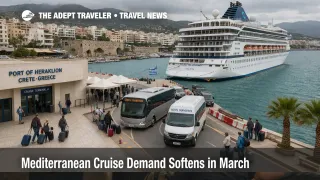
Mediterranean cruise demand softened after the Iran war began on February 28, 2026, but the damage so far looks narrow, not industry wide. Travel Weekly reported on March 22 that Travelsavers and World Travel Holdings both saw weaker Mediterranean interest, especially for close in bookings, while broader cruise demand stayed comparatively steady. The main consequence for travelers is not a collapse in cruise availability. It is a more selective booking market, where Europe shoppers may hesitate, prices can firm, and the best near term value may shift toward the Caribbean, Alaska, Canada and New England, or longer lead Europe sailings.
Mediterranean Cruise Demand: What Changed
What changed is not that cruise demand suddenly broke. It is that the Mediterranean became the first region where geopolitical risk started to show up in shopper behavior during March Wave season. Travel Weekly reported that both Travelsavers and World Travel Holdings saw demand for Mediterranean cruises decline after the war began, but they also described the effect as localized rather than broad based across cruise sales.
That distinction matters. Lori Kostecki of Travelsavers said the weakness has been in close in Mediterranean bookings, while 2027 Europe cruise bookings are still strong. Josh Tolkin of World Travel Holdings said the broader cruise business is still performing in line with expectations. In operational terms, that points to a confidence shock in the near booking window, not a structural retreat from Europe cruising overall.
Pricing pressure appears to be moving in the same direction. Tolkin told Travel Weekly that cruise prices have slightly increased, and Reuters reported on March 16 that oil prices had risen more than 35 percent since the conflict began, with Brent crude moving above $100 per barrel. That does not guarantee an immediate fare spike on every sailing, but it does raise the odds that cruise lines protect yield by offering weaker bundles, fewer extras, or less generous promotions before headline fares move sharply higher.
Which Cruise Buyers Are Feeling It First
The travelers feeling this first are shoppers looking at Mediterranean departures in the next few months, especially those who still need to add airfare, hotels, and transfers around the cruise. Reuters noted that major U.S. cruise operators had no direct ship exposure to the Middle East when the conflict began, which limits immediate itinerary disruption, but analysts still warned that the shock could make Americans more hesitant about booking higher priced Europe travel.
That helps explain why the rest of the market is holding up better. Travel Weekly reported that Caribbean, Alaska, and Canada and New England demand remains high, while Travelsavers and NEST said expedition sales were up 44 percent year over year, river cruises were up 23 percent, luxury cruise sales were up 15 percent, premium up 7 percent, and contemporary up 4 percent. Europe is softer in the near term, but not every cruise category is moving the same way.
The bigger divide may be between short lead shoppers and long lead planners. Travelers booking far out still have more room to compare sailings, airfare, cabin type, and insurance, and they may be less sensitive to today's headlines. That matches recent Adept coverage showing both early Europe inventory tightening and fuel cost pressure during Wave season, as seen in Atlas Mediterranean Epicurean Cruises Tighten For 2026 and Cruise Fuel Costs Rise as Oil Hits Wave Season.
What Travelers Should Do Before Booking
Travelers considering a Mediterranean sailing for spring or early summer 2026 should price the whole trip, not only the cabin. The immediate risk is that a cruise fare still looks acceptable while airfare, hotel nights in embarkation ports, and transfer costs move against you. Reuters said cruise operators are facing higher fuel costs even without direct Middle East sailings, and that kind of pressure often reaches the traveler through weaker package value before it shows up as a simple fare jump.
The decision threshold is straightforward. If you already know your sailing, dates, and air gateway, it is usually smarter to compare all in trip cost now rather than assume conditions will improve deeper into spring. If your Mediterranean plan is still flexible, and you are uneasy about close in Europe exposure, it may be more rational to push the trip farther out or pivot to stronger short haul demand zones where booking momentum is holding. Adept's Wave Season guide is useful here because it focuses on whether a deal is actually improving, or only looks attractive in isolation.
Travelers should also watch the next 24 to 72 hours for two signals. The first is whether oil stays elevated or retreats as diplomacy shifts. The second is whether cruise sellers continue describing Mediterranean softness as localized. If that wording changes to broader Europe weakness, the booking environment would look meaningfully less stable. For now, the reporting does not support that bigger conclusion.
Why Wave Season Still Looks Stronger Than the Headlines
The important context is that Wave season was strong before March turned choppier. Travel Weekly said World Travel Holdings had a healthy January and an even stronger February year over year, while Deutsche Bank analyst Chris Woronka described the likely effect now as more volatility and less consistency, not a complete break in booking momentum.
That fits the larger market picture. Cruise line shares were lower on March 23, with Carnival down about 3.2 percent, Royal Caribbean down about 3.2 percent, and Norwegian down about 3.5 percent at the time of the quote, showing investor concern about fuel and demand sensitivity. At the same time, Reuters reported that higher fuel costs hit operators unevenly, with Carnival the most exposed among the big U.S. lines because it does not hedge fuel the way some rivals do.
The practical read for travelers is blunt. Mediterranean cruise demand has weakened, but not enough to call this a broad cruise downturn. The current evidence points to a narrower March problem, close in Europe shoppers are hesitating, prices are firming, and booking patterns are getting less predictable. Travelers who want the Mediterranean this year should shop with full trip math and clearer thresholds. Travelers who only want a strong Wave season value still have healthier alternatives outside the Mediterranean cruise demand pocket.
Sources
- Cruising's March Wave: Iran Shakes Some Med Demand, Travel Weekly
- US Cruises Sail Into Higher Costs as Oil Prices Rally; Carnival Could Be Hardest Hit, Reuters
- World Markets Rally as Trump Postpones Military Strikes on Iranian Power Plants, Reuters
- Markets Shoot Higher and Oil Futures Sink After Trump Announces Progress With Iran, AP News