

U.S. Visa Bonds Add 12 Countries for April 2
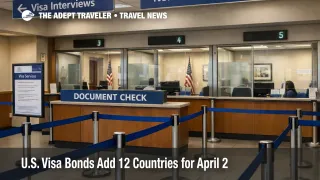
The U.S. visa bond expansion will add 12 more countries on April 2, 2026, which means some business and leisure travelers now face a much larger upfront cash decision before they can lock a U.S. trip. The immediate pressure point is not airfare or hotel pricing. It is whether a traveler can tie up as much as $15,000.00 (USD), or another bond amount set by a consular officer, while still paying for the rest of the trip. For affected travelers, the main planning move now is to confirm whether their passport country is on the updated list, then treat the visa interview outcome as a budget and timing gate before making nonrefundable U.S. bookings.
U.S. Visa Bond Expansion: What Changed
The State Department's updated country list adds Cambodia, Ethiopia, Georgia, Grenada, Lesotho, Mauritius, Mongolia, Mozambique, Nicaragua, Papua New Guinea, Seychelles, and Tunisia effective April 2, 2026, bringing the total number of covered countries to 50. Reuters reported the expansion as a $15,000.00 (USD) requirement, but the underlying pilot rule is more nuanced. Consular officers can require a bond of $5,000.00 (USD), $10,000.00 (USD), or $15,000.00 (USD), and the rule says officers are generally expected to start at $10,000.00 (USD) unless the applicant's circumstances point lower or higher.
That distinction matters for trip economics. Travelers should plan around the highest number because the visa interview can turn a normal short stay application into a cash lockup decision with little room for improvisation. The rule also says the bond must be posted within 30 days after the interview to overcome the initial refusal under INA 221(g), and a single payer can post it on the traveler's behalf.
Which Travelers Face the Biggest Booking Shock
The most exposed trips are short lead leisure bookings, family visits tied to fixed dates, small business travel with limited expense flexibility, and any itinerary that depends on buying flights before the visa process is fully settled. For those travelers, the bond does not replace the rest of the trip budget. It sits on top of visa fees, airfare, lodging, insurance, and daily spend, which can make a U.S. trip workable on paper but unrealistic in cash flow terms.
The policy hits late booking behavior especially hard. A traveler who could normally decide on a conference, wedding, cruise embarkation, or school visit within a few weeks may now need more planning runway because the visa interview, bond decision, payment step, and visa issuance all become part of the financial timeline. That can suppress last minute U.S. demand from affected markets, narrow spontaneous business travel, and push some travelers toward destinations that do not require a comparable cash deposit. In an earlier Adept Traveler article, US Visa Bond Expansion Starts Jan 21, New Countries Listed the earlier pressure point was country expansion plus entry restrictions. This round matters more for spring booking behavior because the affected pool is wider and the April 2, 2026 start date is close.
What Travelers Should Do Before Booking
Travelers from the 12 newly added countries should avoid treating a visa appointment as the last administrative step. It is now a financial checkpoint. The practical sequence is to confirm the country list, budget for a possible $15,000.00 (USD) bond even though the assigned amount could be lower, and delay nonrefundable U.S. purchases until the interview outcome and payment requirement are clear.
For business trips, the next decision point is whether an employer is willing to float the bond or reimburse it fast enough to keep the trip viable. For leisure trips, the threshold is simpler. If tying up several thousand dollars would force a traveler to cut the rest of the trip budget too tightly, the safer move is to postpone booking or look at alternate destinations. This is especially true for itineraries with fixed events, cruise departures, or onward domestic connections inside the United States, where one visa delay can unravel the whole chain.
Travelers who do post a bond should also keep their departure documentation organized. The rule says the bond is fully refunded when the traveler complies with the bond terms, including timely departure, no travel after visa expiry without use, or a refusal of entry captured in the system. If departure is not properly recorded, the traveler may need to request manual cancellation outside the United States within 30 days and present evidence such as boarding passes, passport stamps, or dated records showing presence in another country. There is no interest paid on the refunded bond.
Why the Rule Is Expanding, and What Happens Next
The State Department's pilot rule says covered countries are selected based on factors that can include high B1 and B2 overstay rates, deficient screening and vetting information, or citizenship by investment cases where citizenship was obtained without a residency requirement. The bond program is designed both as an overstay deterrent and as a test of whether visa bonds can be administered at scale over a 12 month pilot period that began on August 20, 2025.
For travelers, the bigger consequence is that this is no longer a narrow edge case. At 50 countries, the U.S. visa bond expansion becomes a structural booking constraint for a larger share of inbound visitor traffic. What happens next depends on whether more countries are added, whether consular practice settles around $10,000.00 (USD) or moves higher more often, and whether the State Department keeps using 15 day notice windows to amend the list. Until that picture stabilizes, affected travelers should treat U.S. trip planning as a two step process, visa economics first, itinerary building second.