

London Tube Strike Dates Shift to Late Spring
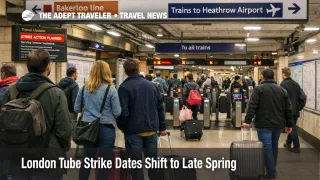
London Tube strike dates have moved out of the late March window that many travelers were watching, but the risk has not gone away. Transport for London now says the March 24 to March 27 strike dates are suspended and services will operate as normal on those days, while separate strike windows remain posted for April 21 to April 24, May 19 to May 22, and June 16 to June 19. For travelers, that changes the decision from urgent late March rerouting to late spring contingency planning, especially for airport transfers and tight same day city schedules.
London Tube Strike Dates: What Changed
The practical change is timing. TfL's strike page now lists the March 24 to March 27 action as suspended, with normal service expected on those days, but it still shows planned Tube driver strikes across three later blocks in April, May, and June. Reuters reported the March suspension followed progress in talks over proposed working hour changes, while the union also said the dispute remains live. That means late March travelers can step back from emergency workarounds, but late spring bookings should still be built with a backup plan.
This is an update, not a clean resolution. In an earlier Adept Traveler article, London Tube Strike Threat Eases for Late March, the immediate March pressure had already started to ease. The new operational shift is that TfL's strike calendar is now clearer for the rest of spring, so travelers have more time to decide whether to keep Underground dependent plans or shift toward rail, coach, or airport hotel fallbacks before those windows arrive.
Which London Trips Face the Most Late Spring Risk
The most exposed travelers are the ones stacking multiple timed moves onto the Underground on the same day. That includes Heathrow Airport transfers using the Piccadilly line, rail to hotel handoffs through central London, business trips built around morning meetings and evening departures, and leisure itineraries that assume fast cross city movement between stations, museums, theaters, and airports. Heathrow has non Tube alternatives, including the Elizabeth line and Heathrow Express, but those become more valuable, and often more crowded, when travelers start abandoning the cheapest direct Tube route.
The second pressure point is substitution. When Underground capacity is threatened, demand does not disappear, it spills outward. TfL's own strike advice tells passengers to plan ahead, check before travel, and use alternative routes. That is why the practical risk is broader than the Tube itself. Heathrow Express, the Elizabeth line, buses, coaches, taxis, and hotel night counts can all take the hit when travelers rebuild around a weaker Underground. In an earlier Adept Traveler article, London Heathrow Transfers Still Snag on Weekend Closures, that same substitution logic was already visible when separate Piccadilly line disruption narrowed Heathrow transfer options.
Travelers heading to Gatwick Airport (LGW) and London Stansted Airport (STN) are less directly exposed to the Tube itself because their strongest airport links are mainline rail and coach services, not Underground access at the airport. Even so, central London positioning can still become slower if a hotel, meeting, or station transfer depends on the Tube before reaching Gatwick Express, Thameslink, or Stansted Express services.
What Travelers Should Do Now
For travel through March 27, the right move is usually to keep the original London plan unless another separate disruption appears. TfL says services should operate as normal on the suspended March dates, so most travelers do not need to pay more for taxis, coach tickets, or airport hotel changes solely because of the strike threat that was hanging over late March.
For the April 21 to 24, May 19 to 22, and June 16 to 19 windows, the decision threshold changes. Travelers should start prechecking whether their airport journey has a non Tube backup that is acceptable on cost, time, and luggage handling. If the itinerary depends on Heathrow via the Piccadilly line, a same day Eurostar connection, or multiple cross city hops before a long haul departure, it makes sense to price Elizabeth line, Heathrow Express, coach, or airport hotel alternatives before the strike window begins. If the trip is flexible and mostly local, waiting for closer to date TfL updates may be the better tradeoff.
Travelers should also avoid treating London as one single risk bucket. A hotel near Paddington, St Pancras, Liverpool Street, or Victoria can reduce dependence on the Underground compared with a stay that requires one or two Tube changes just to begin the airport journey. For first time visitors still refining plans, London Travel Guide: The Ultimate 7-10 Day Itinerary for First-Time Visitors is a useful reminder that where you stay in London often matters as much as what you book.
Why the Spring Windows Still Matter
The main reason this remains a real travel story is that the labor dispute is paused, not settled. Reuters reported the suspension came after progress in talks over working hour changes, but the union said further talks will continue and the dispute remains live. That leaves room for another operational shift if negotiations improve, stall, or break down.
There is also a timing problem inside the broader London transport network. Separate engineering work can narrow alternatives even when the strike action itself is confined to the Tube. TfL's Piccadilly line upgrade calendar already shows multiple closures and part closures in April, May, and June, including airport facing sections at different points. When strike risk and planned works sit near each other on the calendar, travelers should assume less slack, not more, in the network.
What happens next is straightforward to watch. The first signal is whether TfL removes or revises the late spring strike dates. The second is whether Heathrow and central London journeys keep strong non Tube options on the affected days. The third is whether your itinerary can survive one missed transfer without forcing a hotel change or a new ticket. That is the real seriousness test here. Late March is calmer, but late spring still carries meaningful airport and city transfer risk for travelers who build London itineraries too tightly.
Sources
- Strikes, Transport for London
- Piccadilly Line Upgrade, Transport for London
- London Tube Drivers' Strike Suspended, Union Says, Reuters
- Elizabeth Line, Heathrow Airport
- Heathrow Express, Heathrow Airport
- Travelling on the London Underground to Heathrow Airport, Heathrow Airport
- Travelling To or From London, London Gatwick Airport
- London Stansted Express, London Stansted Airport