

Mauritania Alert Raises Nouakchott Security Risk
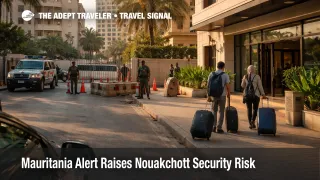
The Mauritania alert issued by the U.S. Embassy on March 23, 2026 changes the planning baseline for travelers in Nouakchott, Mauritania, especially U.S. citizens and other Western travelers who may be more visible to hostile actors. The embassy said there is an elevated risk of terror attacks directed at the embassy and against U.S. citizens based on a recent threat, and it told Americans to monitor local media, stay aware of their surroundings, keep a low profile, and avoid all non essential travel to the embassy. That does not automatically mean broad citywide shutdowns or airport closures are underway. It does mean discretionary movement, embassy district visits, and loosely timed urban transfers should be treated more cautiously right now.
Mauritania Alert Nouakchott Security Risk: What Changed
What changed is not Mauritania's baseline risk category alone, but the immediacy of the threat picture. The embassy's March 23 alert adds a specific near term warning on top of the State Department's existing Level 3 advisory, which already tells Americans to reconsider travel to Mauritania because of terrorism and crime. The standing advisory says terrorist violence remains a risk, that attacks can come with little or no warning, and that places frequented by Westerners are potential targets. The new embassy alert matters because it narrows that broader warning into a concrete operational planning issue centered on Nouakchott.
In practical terms, the immediate traveler consequence is not that every movement becomes impossible. It is that normal assumptions about casual city mobility become less reliable. A traveler who planned to move between hotels, embassies, business meetings, restaurants, or government offices with little buffer should now assume a thinner margin for error. First order, travelers may choose to cancel unnecessary appointments, change routes, or stay closer to secure lodging. Second order, those choices can ripple into earlier airport departures, compressed sightseeing, altered driver pickups, and more conservative decisions about where to spend time after dark.
Which Travelers and Areas Look Most Exposed
The most exposed group is U.S. citizens in Nouakchott, followed by other Western travelers whose routines or locations may overlap with the same target environment the embassy warning describes. Business travelers, aid workers, embassy linked visitors, contractors, and anyone staying in higher end districts or moving through diplomatic and administrative zones face the clearest planning impact because their itineraries are more likely to include predictable movement patterns or locations associated with foreign interests. Travelers on overland itineraries beyond the capital also face a harder decision chain because the State Department says U.S. government employees have limited movement outside Nouakchott, may travel outside the city only during daylight, and need special permission for wider travel.
The advisory does not name a broad exclusion zone inside Nouakchott itself, so travelers should be careful not to invent one. Still, the practical pressure points are fairly clear. The embassy district and any nearby routes become more sensitive. Places closely associated with Westerners also deserve more caution because the standing advisory explicitly warns that terrorists may target places frequented by Westerners. Outside the capital, the risk picture remains worse in restricted northern and border areas, particularly near Mali and Algeria, but this new story is mainly about how travelers already in Nouakchott should adjust behavior now, not about opening a new nationwide ban.
What Travelers Should Do Now
Travelers in Nouakchott should cut discretionary movement first. That means postponing non essential embassy visits, avoiding predictable routines, limiting nighttime road movement, and keeping transport plans tighter than usual. Hotel changes, casual neighborhood exploration, and loosely timed restaurant or social plans are the easiest things to trim because they add movement without adding much trip value under a security alert. If you need to move, use direct routing, confirm pickup points carefully, and make sure someone knows where you are going.
The main decision threshold is simple. If your itinerary depends on embassy business, repeated urban transfers, or overland touring that is not essential, waiting is safer than pressing ahead casually. If you are near the end of a trip and have flexibility, it is reasonable to move airport bound earlier than normal rather than risk a last minute scramble. Nouakchott-Oumtounsy International Airport (NKC) sits outside central Nouakchott, so any traveler deciding to reduce time in the city may also end up rebuilding the final airport transfer window. That does not mean panic departing immediately. It means removing avoidable friction from the last 24 to 72 hours of the trip.
The other move is information discipline. Enroll in STEP if you have not already, monitor embassy and local reporting closely, keep your phone charged, and make sure your hotel, driver, or host can reach you quickly if conditions change. Travelers should also keep original travel documents secure, carry copies, and be prepared to adjust plans quickly if the embassy issues more specific instructions. In an earlier Adept Traveler article, Jewish Traveler Security Risk Is Spreading, the broader point was that security alerts change how neighborhoods and daily movement work on the ground. Nouakchott now fits that same operational logic, even though the local trigger is different.
Why This Alert Matters Beyond One Embassy Notice
The mechanism here is straightforward. A destination with an existing terrorism advisory becomes a sharper travel planning problem when an embassy adds a new threat based warning aimed at its own facility and U.S. citizens. That raises the cost of routine movement even if no attack occurs. Travelers start consolidating errands, hotels may see earlier departures or shortened stays, transport providers may face more last minute schedule changes, and airport runs become more conservative because people are less willing to stay exposed in the city longer than necessary. The disruption spreads through behavior before it spreads through closures.
What happens next depends on whether the embassy follows with narrower instructions, whether Mauritanian authorities visibly harden security around diplomatic or Western linked sites, and whether the warning remains precautionary rather than event driven. For now, the best reading is narrow and serious. Nouakchott is not confirmed to be in a citywide lockdown, but the alert is specific enough that travelers should stop treating security posture as background noise. The practical shift is immediate, especially for Americans, other Western travelers, and anyone whose plans rely on embassy area movement or flexible same day urban timing.