

Jewish Traveler Security Risk Is Spreading
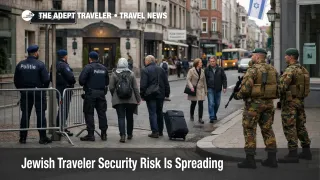
Jewish traveler security risk is becoming a wider planning issue across parts of Europe, not because every destination has moved into the same threat category, but because recent attacks, protective deployments, and official warnings are starting to cluster into a recognizable pattern. The signal is strongest where Jewish neighborhoods, synagogues, schools, volunteer services, and public movement patterns overlap with visible security pressure. Right now, this still looks uneven rather than system wide. But it is serious enough that Jewish travelers should stop treating security planning around community linked travel as a niche concern, especially in cities where recent incidents have already forced a more visible police or military posture.
Jewish Traveler Security Risk: What the Current Evidence Shows
The current signal rests on multiple developments that point in the same direction. In London, an arson attack on Hatzola ambulances near a synagogue in Golders Green pushed the issue beyond a single building and into community infrastructure that residents and visitors rely on. In Belgium, authorities moved soldiers to reinforce security at Jewish sites after recent attacks in Belgium and the Netherlands. In another linked development, the U.S. Department of State issued a worldwide security alert that warned Americans to exercise increased caution because groups supportive of Iran could target U.S. interests and locations associated with Americans abroad. That alert was not limited to Jewish travelers, but it raises the background threat picture at the same time that Jewish sites in Europe are already operating under more visible pressure.
That combination matters more than any one headline on its own. A Travel Signals article has to identify whether separate events are starting to behave like a connected pattern, and here the connection is operational rather than rhetorical. The issue is not only antisemitic sentiment in the abstract. It is the way recent hate incidents, possible external threat links, and stepped up protective measures are beginning to change how Jewish neighborhoods and institutions function on the ground. That is what turns a community safety story into a travel planning story.
The evidence is still limited enough that this should not be framed as a blanket warning for Europe or for Jewish travel generally. That would overstate the case. But the pattern is strong enough to support a narrower and more useful conclusion. Jewish travelers heading into cities with recent attacks or visible security reinforcement should assume that normal access, movement, and visibility conditions may be less stable than they were even a few months ago.
Where the Signal Is Showing Up Now
The signal is showing up first in dense urban settings where Jewish community life is visible, geographically concentrated, and connected to daily movement. Golders Green in London is a clear example because the risk there is not only about formal worship attendance. Travelers visiting family, staying near kosher food options, attending a community event, or moving through the neighborhood for Shabbat related reasons can all be affected when an attack triggers heavier policing and a sharper local security posture.
Belgium shows a second version of the same pattern. Once soldiers are deployed to reinforce security at Jewish sites, the environment changes even without a mass disruption to the broader city. Travelers may face more screening, more police presence, altered access norms, and a more sensitive local atmosphere around synagogues, schools, and nearby streets. That does not mean travel becomes impossible. It means community linked travel becomes more conditional and more dependent on local security conditions.
The risk is also not limited to explicitly religious travel. Jewish traveler exposure can include family visits, neighborhood hotel choices, kosher dining plans, organized tours with community stops, cultural visits, and holiday travel windows when movement patterns become more predictable. A traveler does not need to be headed to a synagogue service to be affected by a tighter security perimeter or a more visibly tense local environment. In practical terms, this signal is about neighborhoods, routines, and access, not only about institutions.
This is also why the signal should be treated as uneven. It is strongest where three things overlap, recent incidents, visible security reinforcement, and established Jewish community geography. A city with one recent alarming headline but no broader pattern may not justify the same level of planning response. A city with repeated incidents, official concern, and visible protective deployment does.
What Travelers Should Watch Now
Most Jewish travelers do not need to cancel broad categories of travel because of this signal. That would be too blunt, and in many cases unnecessary. The better response is more deliberate pre trip planning. Travelers heading into Jewish neighborhoods or planning community linked stops should verify local conditions closer to departure, especially if the trip depends on a specific synagogue, school, event space, kosher district, or family gathering. The most important practical question is whether the place is operating normally or under a more guarded access pattern.
Hotel selection deserves more thought than usual when the trip purpose is tied to Jewish community life. Staying close to a synagogue or kosher district may still be the right choice, but the tradeoff is clearer now. Convenience can come with more visible security, more police activity, and more attention around arrival and departure routines. Some travelers will still prefer proximity. Others may decide that a short taxi ride from a less sensitive area is the better balance.
Ground transport is another pressure point. Pickups, drop offs, and walking routes near protected institutions can become less predictable when police presence increases or when an incident has recently occurred. Travelers should be quicker to confirm exact meeting points, avoid casual late changes, and build more buffer around time sensitive religious or family commitments. The main risk is not always a large scale closure. Often it is a smaller breakdown in access or timing that disrupts the day.
The signal would justify a stronger traveler response if more cities begin adding permanent visible security layers around Jewish institutions, if attacks move from symbolic targets to broader community services, or if official alerts start naming specific places or travel behavior changes. A weaker signal, by contrast, would look like isolated cases without geographic spread, without repeat incidents, and without sustained protective measures after the immediate event. For now, most travelers should monitor, not panic. But travelers with highly visible itineraries tied to Jewish community life should plan as though local conditions can change faster than the average city visitor expects.
Why This Pattern Could Spread, or Stall
The mechanism behind this signal is straightforward. Once attacks or plots target Jewish sites or adjacent community infrastructure, authorities respond by increasing visible protection. That added protection can improve safety, but it also changes how neighborhoods operate. Access gets tighter, routines become more visible, and community linked travel becomes more dependent on current local conditions. As a result, the practical travel effect can widen even without a large rise in total incidents.
A second mechanism is copycat or networked threat behavior. When several countries experience attacks, attempted attacks, or high concern around Jewish sites within a short period, every new incident raises sensitivity elsewhere. That can lead to quicker security reinforcement, faster event restrictions, and a lower threshold for visible protective measures. For travelers, that means the signal can spread through precaution as well as through violence itself.
There are also reasons the pattern may stall. Strong policing, disrupted plots, visible deterrence, and the absence of follow on incidents could keep the signal concentrated in a limited set of cities rather than allowing it to broaden. That is why it is too early to describe this as a continent wide operating change. The evidence supports a widening urban security issue for Jewish travelers in selected places, not a universal travel condition.
For now, the most accurate conclusion is narrow and serious. Jewish traveler security risk is rising as a planning variable in parts of Europe where antisemitic attacks, official warnings, and visible security reinforcement are starting to converge. The traveler question is no longer only whether a destination is broadly safe. It is whether neighborhood choice, community access, and daily movement assumptions still hold under a more fragile local security picture. That is the shift worth watching now.