

Port Townsend Ferry Cancellations Cut Midday March 24
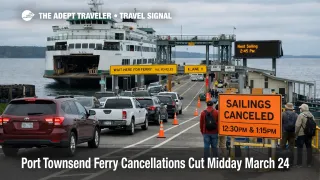
Port Townsend ferry cancellations are creating a real same day planning problem in Washington on March 24, 2026, after Washington State Ferries canceled the 1230 p.m. departure from Port Townsend and the 115 p.m. departure from Coupeville because of tidal conditions. The disruption is narrow, but it lands in the middle of the day on a route that many self drive travelers use to stitch together Whidbey Island, Port Townsend, Olympic National Park, and Seattle area airport or hotel plans. For most travelers, the practical move is simple, shift to an earlier or later sailing, or abandon this crossing for the day and rebuild the route around one of WSDOT's mainland alternatives.
Port Townsend Ferry Cancellations: What Changed
WSDOT's alert for Tuesday, March 24 confirms that one midday sailing in each direction on the Port Townsend to Coupeville route is canceled because of tidal conditions. Specifically, the canceled departures are the 1230 p.m. sailing from Port Townsend and the 115 p.m. sailing from Coupeville. WSDOT directs travelers to Edmonds to Kingston and Mukilteo to Clinton as the alternate ferry options.
That matters because the Port Townsend to Coupeville run is not just another local ferry. It is the short cross Sound link that lets travelers avoid a long loop through the north end of Puget Sound. When that crossing drops out, the problem is not only the lost 30 minute ferry segment. The real issue is that midday itineraries built around a clean handoff, hotel checkout, scenic stop, ferry crossing, then onward drive, suddenly stop working.
The official schedule also shows why this route is vulnerable to this kind of disruption. WSDOT flags that reservations are recommended for all vehicles on the route and that extreme tidal conditions may interrupt service. In other words, this is not a random outage. It is a known structural weak point on a short route where tide windows can remove specific departures even when the rest of the day still operates.
Which Travelers Should Reroute, and Which Can Wait
The most exposed travelers are the ones using the crossing as a timing bridge, not just a scenic add on. That includes Olympic Peninsula visitors heading toward Whidbey Island or Seattle, Whidbey based travelers heading west for Port Townsend or onward to Olympic National Park, and anyone trying to keep a same day airport, cruise, or rental car schedule in the Seattle Tacoma corridor.
If your plan depended on the canceled midday departures, the best option depends on your trip type. Travelers already close to Port Townsend or Coupeville, and without a fixed arrival deadline, can usually salvage the day by waiting for a later sailing. The next workable move is to check WSDOT's live status, reservation tools, and terminal conditions before committing, because once one sailing is removed, the remaining departures can absorb extra vehicle demand quickly.
Travelers with tighter timelines should not assume waiting is the cheaper or safer play. WSDOT's two official alternates are Mukilteo to Clinton, which has an advertised crossing time of about 20 minutes, and Edmonds to Kingston, which has an advertised crossing time of about 30 minutes. Those routes can work well for Seattle area access, but they also shift you south and add highway driving. The substitution is operationally cleaner for airport corridors and central Puget Sound hotels than for travelers trying to keep a simple Port Townsend to central Whidbey hop.
The group that should be most skeptical about "just taking the next boat" is anyone with a flight, paid timed entry, or hard check in window. Once the midday ferry plan breaks, the second order effects spread fast, later ferry demand rises, the replacement crossings absorb displaced cars, and Seattle area traffic can turn a modest ferry issue into a missed connection problem.
How To Plan Around the Disruption Today
For travelers still on the Olympic Peninsula side, the first decision point is whether a later Port Townsend departure still protects the rest of the day. If you have enough slack, waiting may be the least disruptive option, especially if your destination is on Whidbey Island itself and you do not want to overshoot south and drive back north. But that only works if your day is flexible and you are comfortable with the risk that demand compresses into the later sailings.
If you need more certainty, take WSDOT's alternate route guidance literally and switch early, not after you have already lost an hour at the terminal. Mukilteo to Clinton is usually the cleaner substitute for travelers trying to reconnect to Everett, north Seattle suburbs, or Seattle Tacoma International Airport (SEA) corridors. Edmonds to Kingston is often the more natural fallback for travelers already on the Olympic Peninsula side who want to stay closer to the normal peninsula to central Sound flow.
For travelers thinking about skipping ferries entirely, the drive around via Deception Pass is the blunt force option, not the elegant one. Routing services estimate the road distance between Port Townsend and Coupeville at about 212 miles, with a drive of roughly 4 hours and 19 minutes if you abandon the crossing entirely and loop around by road. That can still be the right move for a no fail airport run or a late day hotel arrival, but it is not a casual substitute for a short ferry hop. It effectively turns a midday crossing problem into a major road trip reroute.
Why a Small Ferry Cancellation Can Break a Bigger Itinerary
The mechanism here is straightforward. A short ferry route with a limited daily schedule loses one midday sailing in each direction, and the capacity loss hits exactly where many leisure itineraries are trying to cross. First order, those passengers cannot travel when planned. Second order, they either bunch into later sailings or spill onto other ferry routes that were not built around their original timing. Third order, the substitution pressure shifts from the water to the road network, where Seattle area congestion, terminal wait times, and reservation limits can do the rest.
That is why a small WSDOT alert deserves more respect than its scale might suggest. This is not a systemwide Washington ferry breakdown. It is a targeted chokepoint problem on a route that sits inside a wider self drive tourism market. In an earlier Adept Traveler article, High Winds, Low Tides Disrupt Washington Ferries Dec 18 the same pattern showed up under different conditions, a single route issue pushed travelers onto Edmonds to Kingston or Mukilteo to Clinton, and the real risk became lost time, not simply the lost boat.
For March 24, the cleanest traveler takeaway is this, do not build the middle of your day around the Port Townsend to Coupeville ferry unless you are using a sailing that is actually operating and you have checked status close to departure. If your itinerary includes a firm deadline later today, treat the canceled midday departures as a trigger to reroute early rather than a minor delay you can absorb.
Sources
- WSDOT Ferries Alerts, PT/Coup Tidal Cancellations for Tuesday, March 24
- WSDOT Spring 2026 Sailing Schedule for Port Townsend / Coupeville
- WSDOT Schedule, Edmonds / Kingston, crossing time about 30 minutes
- WSDOT Schedule, Mukilteo / Clinton, crossing time about 20 minutes
- Rome2Rio estimate, Coupeville to Port Townsend drive around route