

High Winds, Low Tides Disrupt Washington Ferries Dec 18
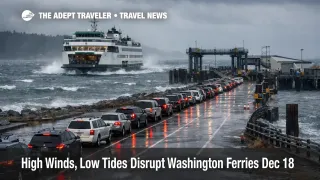
Washington State Ferries is warning that high winds and rough water can drive delays and cancellations across the system through December 18, 2025, with the Anacortes to San Juan Islands and Port Townsend to Coupeville routes most likely to take the hit. Travelers with vehicles, island lodging check ins, and time sensitive day trips are the most exposed because missed sailings can quickly turn into multi hour waits. The practical move is to treat your planned departure as conditional, build a backup routing plan before you arrive at the terminal, and set a firm cutoff for switching to an alternate route or an overnight.
Washington State Ferries Wind Cancellations means wind driven service disruptions can break planned crossings in Washington through December 18, 2025, and force travelers to reroute or add buffer.
On the Port Townsend to Coupeville route, the disruption is not just theoretical. Washington State Ferries posted that the Port Townsend 630 a.m. sailing and the Coupeville 715 a.m. sailing were canceled on December 17, 2025, due to high winds and inclement weather, and it directed travelers to Edmonds to Kingston or Mukilteo to Clinton as alternates. Separately, Washington State Ferries posted a low tide notice stating that on Thursday, December 18, 2025, the 645 p.m. sailing from Port Townsend and the 730 p.m. sailing from Coupeville are canceled due to tidal conditions, with the same alternate routes recommended.
The why behind the warning is visible in regional marine conditions. National Weather Service marine products for the Strait of Juan de Fuca include gale warnings during this window, which aligns with Washington State Ferries expectations that northern routes can become the most disrupted when winds rise and seas build.
Who Is Affected
The highest risk group is travelers booked on Anacortes to the San Juan Islands, including Friday Harbor, Orcas Island, and Lopez Island traffic, because cancellations there strand travelers far from substitutes. If your lodging is on an island and your arrival day is fixed, you face the classic ferry failure mode, the sailing you need is canceled, standby space is scarce, and the next viable arrival time may be after dark, or not until the next day.
Port Townsend to Coupeville travelers are impacted in a different way, there are viable road and alternate ferry fallbacks, but the tradeoff is time and predictability. When the route loses sailings to wind or tide, vehicle demand compresses into fewer departures, queues grow, and check in windows matter more because you can lose your reservation priority and become standby. Even a single missed sailing can break a same day plan on either side, including timed tours, family pickup plans, and evening hotel check ins.
A third group is travelers connecting to flights out of Seattle-Tacoma International Airport (SEA) or planning to pick up rental cars, cruise departures, or intercity rail after a crossing. Ferry disruption tends to fail in chunks rather than minutes, which means a planned two hour airport buffer can disappear quickly if you slip to the next sailing, then hit heavier terminal traffic, then lose additional time in road congestion approaching Seattle area corridors. If you are on separate tickets, the financial downside rises fast because airline and hotel change rules are usually stricter than ferry flexibility.
What Travelers Should Do
Act immediately if you are traveling December 17 or December 18, 2025, and you are already within driving distance of the terminal. Check the Washington State Ferries alerts page before you depart, then check again before you commit to the queue, because the operational picture can change within the same day. Use terminal cameras and posted wait time estimates to spot when the line is building beyond what your plan can tolerate, and do not assume a "delayed" sailing will depart close to schedule once cancellations begin stacking.
Use a clear decision threshold for rebooking versus waiting. If you must be on the island or on the Olympic Peninsula by a fixed time, set a hard cutoff such as "if I am not loaded on a specific sailing by X time, I switch to an alternate route or book an overnight." For Port Townsend to Coupeville, that usually means pivoting to Edmonds to Kingston or Mukilteo to Clinton early enough that you are not arriving at those terminals at the same time as everyone else making the same switch.
Monitor the next 24 to 72 hours with two signals, not one. First, watch for Washington State Ferries to post multiple consecutive sailings operating normally, not just a single restart. Second, watch marine warnings and wind timing, because a late day strengthening can turn an "okay" morning into an evening cancellation scenario, which matters for returns from day trips and for travelers aiming for the final sailings that would get them to a hotel without an extra night.
For deeper ferry disruption pattern context, see Tarifa Tangier Ferries Canceled in Gibraltar Winds. If you are switching modes to protect a flight connection, cross check the wider aviation network in Flight Delays and Airport Impacts: December 18, 2025.
How It Works
Ferry disruption propagates through a queueing and capacity system that is much less forgiving than it looks on a timetable. The first order effect is straightforward, wind and sea state force slower operations or cancellations, and tide constraints can cancel specific sailings even when the weather improves. On Port Townsend to Coupeville, the low tide problem is structural, if the tide window is wrong, the sailing cannot run, and the day's capacity shrinks no matter how many vehicles show up.
The second order ripple is where travelers feel the real cost. When sailings cancel, vehicles and walk ons are pushed into fewer departures, which increases terminal dwell time, pushes more travelers into standby conditions, and stresses downstream road corridors when a large group of vehicles disembarks in a tighter time window. That surge effect creates missed hotel check in windows, missed dining reservations, and missed tour start times, especially in island markets where operators run on small windows and limited staff.
The third order ripple is substitution, travelers reroute to other ferry crossings, shift to longer drive around options, or abandon the ferry day for an overnight. Substitution works, but it also moves congestion, if Port Townsend to Coupeville fails, pressure shifts to Edmonds to Kingston and Mukilteo to Clinton, and those routes can develop their own queues that are invisible if you only watch your original terminal. This is why Washington State Ferries emphasizes checking alerts, using terminal tools, and arriving with a fallback plan rather than treating the posted schedule as a guarantee.