

Montenegro Protests Still Threaten Podgorica Airport Access
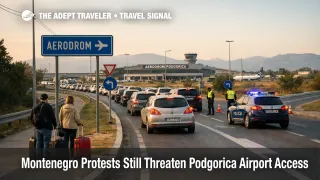
Podgorica airport access in Montenegro still carries a real surface transport risk on March 25, 2026, even if flights at Podgorica Airport (TGD) operate normally. The U.K. Foreign, Commonwealth & Development Office, or FCDO, continues to warn that protests in the municipality of Zeta can disrupt access to the airport. For travelers, that keeps the weak point on the road, not necessarily in the terminal. The practical move is to build extra transfer time, avoid thin same day margins, and treat any departure from Podgorica as a road access problem first, then a flight problem.
Podgorica Airport Access: What Changed
What changed is not a new advisory level. It is that the airport access warning remains current, with FCDO still stating that protests in Zeta can disrupt access to Podgorica Airport. That keeps Montenegro in a live airport corridor risk category on March 25, 2026, even without evidence of a full airport shutdown.
The operational point is simple. Travelers often read a normal flight schedule as proof that an airport is usable. That assumption does not hold when the break point is the approach road. Airports of Montenegro lists Podgorica Airport's address in Zeta and directs passengers in by road from Podgorica and from coast and interior routes, which means the airport depends heavily on a limited surface access pattern rather than a broad set of redundant approaches.
Local reporting shows this is not theoretical. On December 30 and 31, 2025, outlets including Vijesti, CdM, and MINA reported that residents of Zeta blocked the roundabout toward Podgorica Airport, causing traffic jams from multiple directions, with police redirecting some passengers to side roads and protesters signaling additional blockades. That matters more than the formal protest issue itself, because a blocked roundabout can strand airport traffic long before an airline posts a delay or cancellation.
Which Travelers Face the Most Risk
The most exposed travelers are those with no slack in the ground segment. That includes early departures, separate ticket connections, checked bag passengers, rental car returns, private transfers arriving from the coast, and anyone trying to combine an airport run with a same day border or resort transfer. Airports of Montenegro says the drive can be as short as 39 minutes from Cetinje and 55 minutes from Bar under normal conditions, but those baseline times lose planning value if a protest compresses traffic into one choke point near the terminal.
The risk also rises for travelers coming from Budva, Tivat, Herceg-Novi, or other Adriatic points. The airport operator's own route guidance shows many of those trips funnel inland toward Podgorica before the final airport approach. That means what looks like a routine airport transfer can become a cascading timing problem, first on the motorway or city approach, then at rental return, check in, and security, and finally on any onward flight connection if the passenger arrives too late to recover.
In an earlier Adept Traveler article, Montenegro Protests Threaten Podgorica Airport Access laid out the same corridor logic when the warning was current on March 15. The key update now is that the warning still stands on March 25, so travelers should treat this as a persistent planning issue, not a one day anomaly.
What Travelers Should Do Before Departure
Travelers departing from Podgorica should add meaningful road buffer, not symbolic buffer. For an important international departure, the safer move is to stage in Podgorica or near the airport the night before instead of relying on a same day long drive from the coast or border. For shorter domestic or regional trips, it still makes sense to leave earlier than usual, because the main failure mode here is not a slow security queue, it is not reaching the terminal area on time.
The rebook versus wait threshold is mostly about ground risk, not fare risk. If local media or official announcements point to roadblocks in Zeta, or if your driver cannot confirm a clean airport approach, the better decision is to move earlier, overnight closer in, or shift your transfer plan rather than assume the jam will clear. This is especially true for checked bag passengers and separate ticket itineraries, because once the road leg breaks, the rest of the itinerary has very little room to recover.
What to monitor over the next 24 to 72 hours is narrow and practical, local traffic conditions in Zeta, any renewed blockade at the airport roundabout, police diversions onto side roads, and official airline guidance if late arriving passengers begin missing check in cutoffs. Flight status alone is not enough. FCDO explicitly tells travelers to monitor local media and official announcements, plan in advance, allow extra time, and follow local authority guidance.
Why Zeta Protests Keep Reaching the Airport
The reason this keeps mattering is geography and network design. Podgorica Airport sits in Zeta, and local reporting has already tied airport disruption to the roundabout leading toward the terminal. When a protest hits a roundabout or a connecting road in the right place, it does not need to occupy the airport to create aviation disruption. It only needs to slow, block, or reroute enough vehicles to break the timing assumptions behind departures.
There is also a recurrence signal here. The December 2025 reporting did not describe a one off stoppage that disappeared immediately. It described blockades, reopening, announced resumptions, blocked alternative roads, congestion from multiple directions, and police diversion measures. That pattern suggests travelers should think in terms of repeated or rolling access disruption rather than a single isolated demonstration.
What happens next depends less on airport operations than on whether local protest activity in Zeta flares again near the airport corridor. Until the FCDO removes the warning, the smart assumption is that Podgorica departures need extra ground buffer by default. Flights may still run, but the road to the flight remains the fragile part of the trip.
Sources
- Montenegro Travel Advice, GOV.UK
- Parking and Transportation, Podgorica Airport, Airports of Montenegro
- Podgorica Airport, Airports of Montenegro
- Zeta residents block roundabout near Podgorica Airport, announce additional blockades, MINA
- Citizens of Zeta unblocked the roundabout towards the airport, the railway towards Bar was also unblocked, Vijesti
- IN PICTURES: Zeta residents blocked roundabout toward Podgorica airport, CdM
- Montenegro Protests Threaten Podgorica Airport Access, Adept Traveler