

Montenegro Protests Threaten Podgorica Airport Access
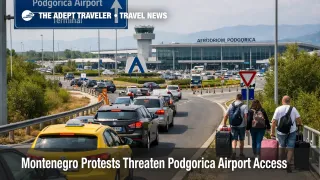
Montenegro has a live airport corridor risk that is easy to underestimate. The U.K. Foreign, Commonwealth & Development Office, or FCDO, says protests in the municipality of Zeta can disrupt access to Podgorica Airport, and that warning was still current on March 15, 2026. For travelers, the problem is not whether the terminal is open, it is whether the road approach still works when you need it. The practical move is to add real transfer buffer, avoid same day long road runs into the airport, and consider staging closer to Podgorica before an early or high value departure.
The Podgorica airport access risk matters because it sits on a narrow operational weak point. FCDO is not warning about nationwide shutdowns, it is naming one municipality whose protests can interfere with the country's main air gateway. Local reporting gives that warning teeth. MINA reported on December 31, 2025, that residents of Zeta blocked the roundabout leading to Podgorica Airport and announced additional blockades, which shows the access threat is not theoretical.
Podgorica Airport Access: What Changed
What changed is not a new national advisory level. It is the continued official warning that airport access itself can be disrupted by protests in Zeta, with the FCDO update dated February 4, 2026, and still marked current on March 15, 2026. That keeps Montenegro in the airport access risk category even if flights are still scheduled and the terminal remains open.
This distinction matters for trip planning. Travelers often assume an operating airport equals a usable departure. That is wrong when the weak point is the road corridor into the airport. MINA's December 31 report about the blocked roundabout near Podgorica Airport shows how a municipal protest can break the ground leg first, before any flight status page reflects the problem.
For related corridor logic, Adept readers can compare Nepal Election Disruption Hits Kathmandu Transfers and Tirana Protest Roadblocks Disrupt City Transfers, where city or protest nodes created airport timing problems even without a full airport shutdown.
Which Travelers Face the Most Risk
The most exposed travelers are anyone trying to reach Podgorica Airport (TGD) on a tight clock. That includes early morning departures, separate ticket itineraries, checked bag passengers, families who need more curbside time, and anyone returning a rental car before flying. These trips have less tolerance for a blocked roundabout, a police diversion, or a driver who cannot reach the terminal approach.
The next high risk group is travelers coming in from outside the Podgorica area on departure day. The farther your starting point, the less room you have to absorb an access disruption near the airport. A short protest action in the wrong place can wipe out the margin you thought you had built into the drive, and once that happens the failure spreads fast, from missed bag drop, to missed security window, to missed boarding. Podgorica Airport says check in counters open 120 minutes before departure and close 30 minutes before departure, while also telling passengers to be at the airport no later than 2 hours before their flight.
Group tours and coach movements are also vulnerable. A coach or transfer van does not reroute as easily as an individual traveler in a taxi, and one delayed vehicle can break airport timing for an entire party. The same is true for travelers with private drivers or hotel arranged transfers, because the transport may still be willing to operate while the final approach to the airport is the piece that fails.
What Travelers Should Do Before Departure
The immediate fix is simple. Build more road buffer than you normally would, and treat that buffer as separate from the airport's own check in guidance. Podgorica Airport already wants passengers there about 2 hours before departure, so your road plan needs extra margin on top of that, not inside it. For a routine day that might feel excessive. For a live protest corridor warning, it is the rational baseline.
For early departures, last flights of the day, or any itinerary with a high rebooking cost, the smarter play is to overnight in Podgorica or as close to the airport corridor as your budget and booking terms allow. The tradeoff is obvious, an extra hotel night costs money, but a missed departure can cost much more once you add a replacement fare, transfer waste, and a disrupted onward itinerary. That is especially true on separate tickets, where one missed leg may not protect the next. This is not panic advice. It is a clean hedge against a corridor problem that can hit with little notice.
The decision threshold is also straightforward. If your departure matters more than the cost of one extra night, or if your drive to Podgorica Airport depends on fixed timing and checked luggage, stage closer the night before. If your ticket is flexible, you are traveling hand baggage only, and you can absorb a delay, you may be able to wait and monitor local conditions longer. Over the next 24 to 72 hours, the right signals are local media, official announcements, and any fresh advisory language, because those will tell you more about your real departure risk than a generic on time flight listing.
Why a Zeta Protest Becomes an Airport Problem
The mechanism is simple. A protest does not need to shut Podgorica Airport itself to disrupt travel. It only needs to block, narrow, or slow one of the main approach points into the terminal area. In the Zeta case, local reporting identified the roundabout leading to the airport as a protest site, which is exactly the kind of choke point that can turn a local political action into an aviation access problem.
The first order effect is delayed or blocked road movement. The second order effect is where traveler pain expands. Rental car returns get compressed into shorter windows, drivers miss pickup slots, tour coaches arrive late, and passengers who should be checking in 2 hours early instead arrive inside bag drop cutoff times. Once a few travelers miss flights, the problem spreads further, later departures fill up, hotel demand near the airport rises, and a local access issue becomes a wider itinerary resilience problem. Podgorica Airport's own procedures show how little slack exists once you are inside the final 2 hour window.
That is why Montenegro's current protest warning is more useful as an airport corridor story than as a generic unrest story. The main risk is concentrated, understandable, and manageable if travelers respect it early. Podgorica airport access is the decision point to watch. If you protect that ground leg, the rest of the trip is still much more likely to hold together.