

Thailand Cambodia Border Warning Redraws Overland Routes
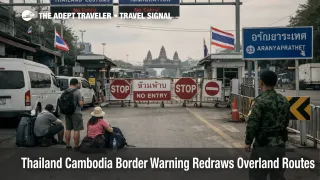
Thailand Cambodia border warning now carries a hard operational consequence for overland travelers, not just a generic caution. The U.S. State Department says travelers should not go within 50 kilometers of the Thai Cambodian border because of ongoing fighting, including reported rocket and artillery fire, civilian casualties, and Thai ordered evacuations in some areas. For travelers moving between Bangkok, Thailand, and Cambodia by land, or adding frontier temples and eastern border districts to a broader Thailand trip, this is a rework now problem, not a monitor later problem. The practical move is to cut any border corridor segment from the plan and shift country to country moves back to air.
Thailand Cambodia Border Warning: What Changed
The most important fact is not new fighting on its own, but the size and specificity of the official no travel band. The U.S. advisory says not to travel within 50 kilometers of the Thai Cambodian border, and says the U.S. government has limited ability to provide emergency services there because official travel is restricted by the armed conflict risk. The parallel Cambodia advisory uses the same 50 kilometer threshold on the other side of the frontier. Britain is somewhat narrower, advising against all but essential travel within 20 kilometers of the land border, but it also says fighting included rocket and artillery fire, that crossings remain suspended, and that temple sites in the border belt are closed.
That distance rule matters because it catches more than the actual checkpoint line. It reaches into road approaches, provincial transfer legs, and day trip territory in eastern and northeastern Thailand. In an earlier Adept Traveler article, Thailand Cambodia Border Clashes: 50 km Avoid Zone laid out how the risk band already extended far beyond the frontier itself. What is different now is that the State Department language remains fully live on March 25, 2026, which means travelers should treat the border problem as an active planning constraint, not an old headline that has faded.
Which Thailand and Cambodia Routes Are Most Exposed
The most exposed travelers are the ones still trying to link Thailand and Cambodia by road. That includes the classic Bangkok to Siem Reap overland chain through Aranyaprathet and Poipet, broader Bangkok to Phnom Penh plans that depend on a land crossing, visa run style trips, and temple side trips near the disputed frontier. The British advisory says land borders and crossings between Thailand and Cambodia continue to be suspended, while Canadian advisories for both countries say the crossings are currently closed and the security environment remains unpredictable even after the December 27, 2025 ceasefire.
The tourist corridors that break first are the cheap and tightly timed ones. If a trip depends on crossing the frontier by minivan, bus, hired driver, or self drive routing, the assumptions that usually make overland Southeast Asia attractive, lower cost, flexible timing, and easy border sequencing, stop holding. Insurance assumptions can also break first near a published do not travel zone, especially if a claim grows out of disruption inside the restricted area. On the Cambodia side, landmine and unexploded ordnance warnings add another layer around border provinces and temple zones, even when Phnom Penh, Cambodia, and Siem Reap, Cambodia, remain viable as air gateways farther from the frontier.
In an earlier Adept Traveler article, Cambodia Thailand Border Clash Cuts Angkor Tour Demand the impact was already showing up in softer land demand around Angkor focused itineraries. That remains relevant because the current warning keeps land based add ons and frontier adjacency riskier than headline city stays.
What Travelers Should Do Now
If your plan crosses the frontier at any point, rebook that segment to air now. Bangkok, Thailand, to Phnom Penh, Cambodia, or Bangkok to Siem Reap are the cleaner substitutes because they remove the border corridor entirely. Keep Thailand and Cambodia as separate trip modules with a buffer night on each side if the itinerary matters more than the lowest fare. Waiting only makes sense if the land segment is fully refundable and non essential.
If you are already in eastern Thailand, check whether any hotel, transfer, ferry approach, or day tour pulls you into the restricted belt or districts still operating under tighter security measures. The earlier Thailand guidance around Sa Kaeo, Trat, Chanthaburi, Surin, Si Sa Ket, Ubon Ratchathani, and Buri Ram showed how travelers could be affected even without intending to cross the border. The decision threshold is simple, if the route touches the border zone, depends on an exact checkpoint hour, or relies on night movement in a security restricted district, cut it from the trip.
Travelers who still choose to go near the region despite the warnings should at minimum carry insurance details, have a self evacuation plan that does not depend on consular help, and enroll in STEP for U.S. alerts. That is not a substitute for rerouting, but it is the floor, not the ceiling, for anyone keeping eastern Thailand in the plan.
Why the Border Problem Still Spreads Beyond the Frontier
The first order effect is obvious, land crossings and nearby road moves become unsafe, unavailable, or operationally fragile. The second order effect is where the wider trip damage shows up. Travelers who cannot cross by land push back onto short haul flights, longer internal bus and rail alternatives inside Thailand, and different hotel sequencing in Bangkok, Phnom Penh, and Siem Reap. That raises the chance of higher last minute air fares, weaker same day flexibility, and more broken multi country itineraries built around one continuous overland loop. This is why a border warning can reshape trips far from the actual line.
What happens next is still uncertain. Canadian guidance says a ceasefire remains in effect from December 27, 2025, but also says the security environment is unpredictable and crossings are still closed. Until officials actually reopen crossings, remove the distance based warnings, and stop talking about curfews, evacuations, and unexploded ordnance, travelers should assume the frontier stays out of bounds for normal tourism.
Sources
- Thailand International Travel Information, U.S. Department of State
- Thailand Travel Advisory, U.S. Department of State
- Cambodia Travel Advisory, U.S. Department of State
- Regional risks, Thailand travel advice, GOV.UK
- Travel advice and advisories for Thailand, Government of Canada
- Travel advice and advisories for Cambodia, Government of Canada
- Thailand Cambodia Border Clashes: 50 km Avoid Zone, Adept Traveler
- Cambodia Thailand Border Clash Cuts Angkor Tour Demand, Adept Traveler